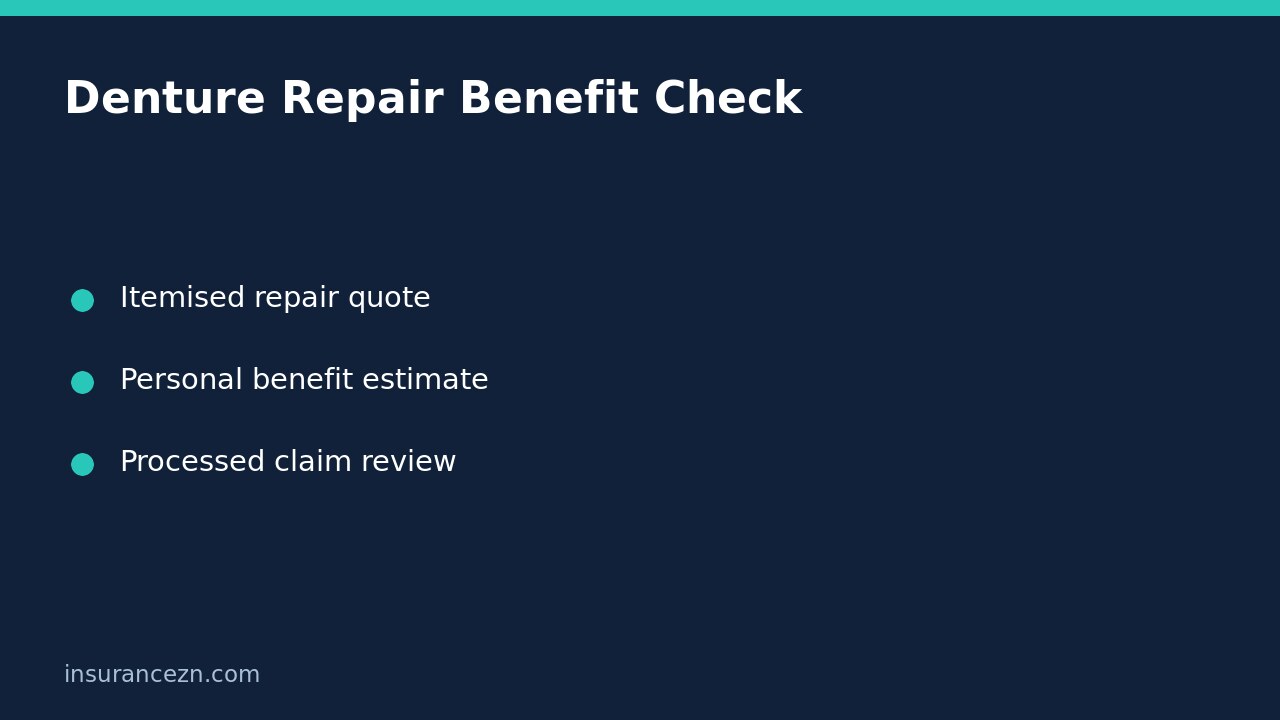

If a denture breaks, do not assume that an extras allowance for dental appliances will pay for repairing it. Ask the treating practice for the exact proposed repair and its billing details, then obtain a personal benefit estimate from your fund before authorising non-urgent work. Repairing an existing appliance, adjusting its fit and making a replacement may be different services under the policy.
This is general information for Australian readers, not personal financial advice. Benefits depend on your policy, fund rules, waiting periods and eligible services. Read the policy documents and any applicable PDS. This checklist is not confirmation that a denture repair is covered.
Get the clinical proposal and billing items together
Contact the treating dental professional about the broken appliance and follow their safety advice. Do not use this insurance checklist as a reason to postpone necessary care or attempt a home repair. Tell the practice if the damage is affecting eating or causing discomfort so it can advise on the appropriate next step.
For the insurance enquiry, request a written quote identifying the patient, practitioner, practice location, service description and any item codes the practice uses. Ask whether the quote is for a repair, a reline, an adjustment or a new appliance. Do not substitute a different description yourself to fit an advertised benefit.
Ask which charges are included and which are additional. Possible questions include whether a consultation, laboratory work, impressions, temporary arrangements or a later adjustment is billed separately. These are questions for the actual proposal, not a statement that every repair involves those charges or that a fund pays them.
Ask the fund about this repair, not dental cover generally
The government’s private health insurance overview explains that extras may include dental treatment, but policies vary and benefits can be constrained by per-service, annual or lifetime limits. That overview does not identify an entitlement to repair your particular denture.
Send the quote to the fund and ask for an estimate under your exact current product. Confirm that the practitioner at that practice is recognised for the proposed service. Recognition alone does not make every charge eligible. Ask the fund to identify any quoted component for which no benefit is available.
- What estimated benefit applies to each quoted item for this patient?
- Are any waiting periods still relevant on the intended service date?
- Does the repair use a dental pool, appliance sublimit or another allowance?
- Do earlier claims or appliance-related conditions affect this estimate?
- Which invoice details and supporting records will be needed?
Record the product, date, reference number and assumptions attached to the response. If the fund cannot estimate a component, label it unconfirmed rather than treating the entire quote as covered.
Compare repair and replacement without mixing allowances
If the clinician offers more than one suitable option, obtain a separate quote for each. A repair estimate cannot establish the benefit for a replacement, and a replacement allowance does not establish the repair benefit. Clinical suitability comes from the treating professional; the fund answers the insurance questions.
For a hypothetical comparison, imagine one quote lists a repair and review, while another lists a new appliance and fitting appointments. Put the charges and the fund’s estimated benefits beside their matching items. Calculate the remaining personal cost for each complete option. Do not subtract an advertised annual dental maximum from either quote unless the fund’s actual estimate supports that amount.
Keep shared balances visible. If both the consultation and appliance work draw on the same pool, it cannot be spent in full twice. Our explanation of why PHIS example benefits are not a personal claim estimate helps distinguish comparison information from an individual answer.
Check the invoice and processed assessment afterwards
Before claiming, compare the final itemised invoice with the services actually supplied. If the treatment changed, request an updated fund estimate where practical; do not assume the original response follows a different procedure automatically. Ask the practice to correct genuine factual errors without relabelling services to obtain a benefit.
After submission, check the processed assessment, benefit paid and remaining allowance. An upload receipt is not a completed assessment. If the result differs from the estimate, send the quote, fund response and invoice under the existing enquiry or claim reference and ask which rule or changed detail explains the difference.
Quick questions before you proceed
Does unused dental cover guarantee payment? No. Eligibility, item benefits and other applicable conditions must be checked first.
Does a written estimate guarantee the final result? No. Retain it, but reconcile it against the actual service and the fund’s processed assessment.
Will switching funds solve the repair cost? Do not assume so. Check the proposed product, waiting periods, previous claims and actual payable premiums before changing cover for an immediate expense.