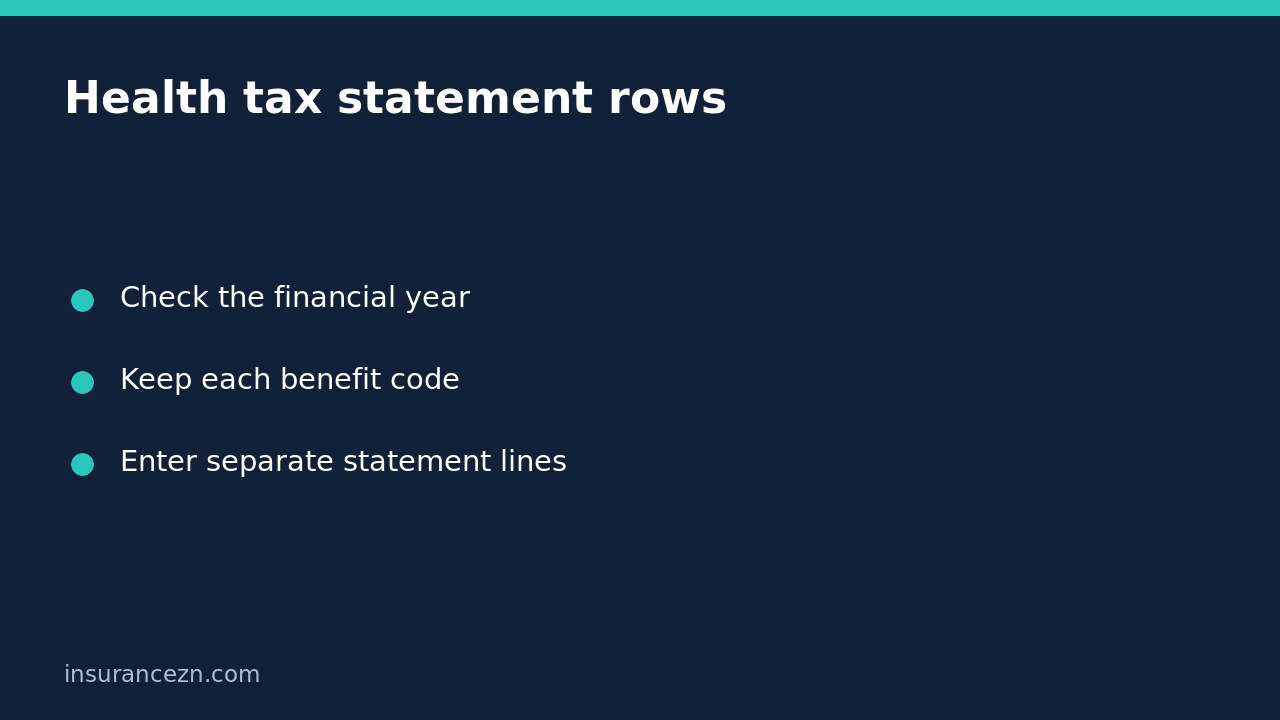

Two or more rows on your private health insurance tax statement do not automatically mean duplicate charges. The Australian Taxation Office explains that different rebate periods and some age changes can create separate lines. Its instruction is specific: enter every line separately in your income tax return, without adding the amounts together into one total.
This is general information for Australian readers, not personal financial advice. Tax treatment depends on your circumstances and the applicable financial year. Insurance benefits remain subject to policy terms and any applicable Product Disclosure Statement (PDS). Ask the ATO or a registered tax agent for help with your own return.
Why one membership can produce several rows
The ATO’s private health insurance statement explanation says the rebate percentage is generally adjusted on 1 April each year. A statement therefore commonly separates premiums paid and rebate received before April from those paid and received from April. Each line has a different benefit code.
There may also be additional lines when the oldest person covered turns 65 or 70 during the year. That does not make a repeated membership number an error. First inspect the benefit codes and the financial year, rather than deleting a row because the insurer ID and membership number look familiar.
This is a statement-entry task, not a recommendation to change products or nominate a different income tier. If you are comparing cover itself, our explanation of PHIS example benefits deals with another document that should not be confused with a tax statement.
Read the labels before copying the figures
The statement identifies the insurer and membership, premiums eligible for the Australian Government rebate, rebate already received through reduced premiums, and a benefit code. These fields serve different purposes. The rebate received is not an extras claim payment, and eligible premiums are not simply a request to copy your bank-account debit total.
- Check that the document is for the financial year you are completing.
- Keep each row’s insurer ID and membership number attached to its figures.
- Copy the eligible-premium amount, rebate-received amount and benefit code from the same row.
- Check the hospital-cover-days field separately; it concerns appropriate private patient hospital cover, not the number of extras appointments.
The ATO also distinguishes the numeric benefit code from the lettered tax claim code. The benefit code relates to rebate age and period settings; the tax claim code depends on your circumstances on 30 June. Do not substitute one for the other merely because your software asks for a code.
A two-line example without invented totals
The ATO’s published 2025–26 example shows Stephen Smith with one membership and two lines. The first has eligible premiums of $1,125, rebate received of $375 and benefit code 30. The second has eligible premiums of $377, rebate received of $123 and benefit code 31. These are the authority’s example figures, not a quote or an entitlement calculation for you.
The action is to preserve those two sets of entries. Do not combine the premium figures into a single row, combine the rebate figures, or choose whichever code appears last. The separate codes carry information that a combined dollar total would discard. Likewise, do not copy these sample numbers into your return: use the statement or prefilled information for your own membership and year.
Check prefilled information without creating duplicates
The ATO says health insurance details should be prefilled when you use myTax or a registered tax agent. A statement may only be provided if you request it from your registered health insurer. If the details are missing, or you lodge on paper, contact the insurer for the statement rather than reconstructing codes from memory.
Compare any existing prefilled entries with the statement before adding information. The fact that you downloaded a document does not mean you should enter another copy of records already present. If you cannot determine whether a line is missing or duplicated, seek guidance before changing it. Keep the original document and identify the exact row in your enquiry.
If a figure appears factually wrong, ask the fund to explain it and confirm any correction. An enquiry acknowledgement is not a corrected statement. A correct statement is also not proof of your final rebate entitlement or a guarantee of a tax refund.
Final checklist before lodging
Can I merge rows to simplify entry? The ATO expressly says to enter each line separately, without adding columns or rows into one amount. Do several rows prove several policies? No; period and age changes can produce multiple rows within one membership. Does the statement approve treatment? No; it is tax information, not hospital admission or extras benefit approval. Retain the statement and obtain advice if its codes or your personal tax circumstances remain unclear.