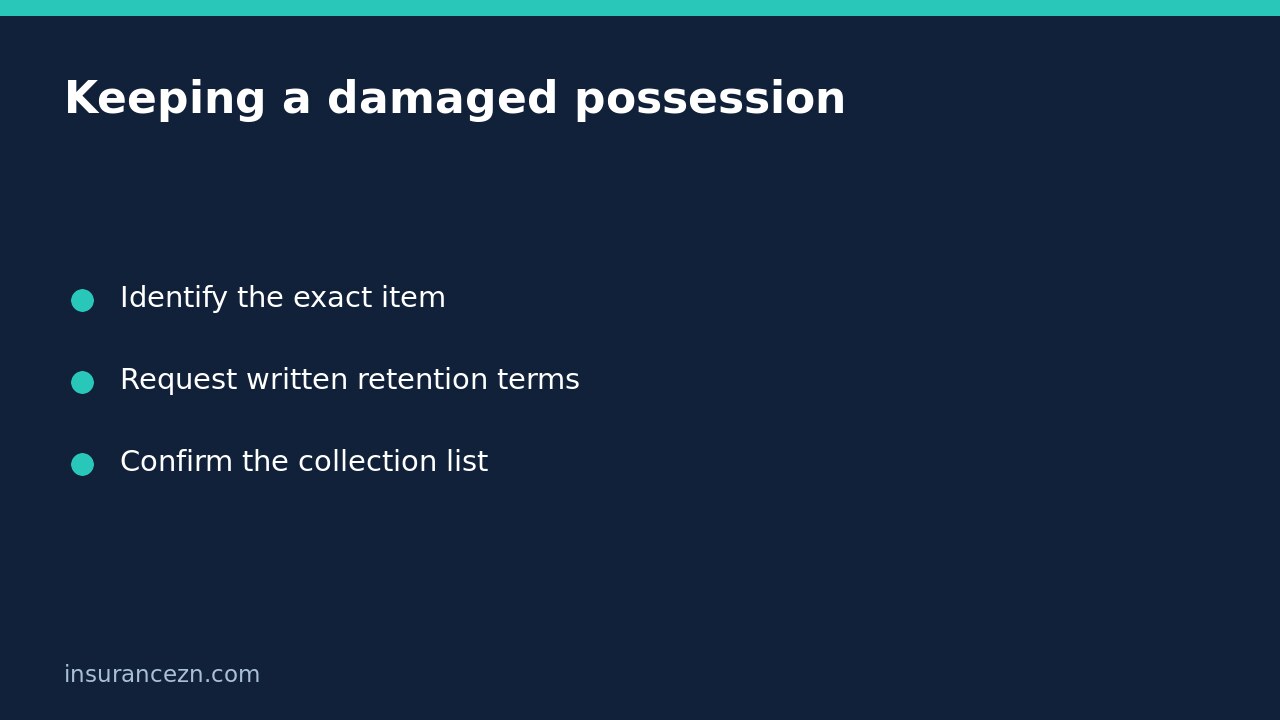

If you want to keep a damaged possession after a home contents claim, tell the insurer before collection is arranged. Identify the exact item and ask whether retention can be agreed under your policy and proposed settlement. Do not assume that ownership before the loss, sentimental value or an offer of replacement automatically gives you the right to keep it on unchanged terms.
This is general information for Australian readers, not personal financial advice. Cover and settlement depend on your policy, Product Disclosure Statement (PDS), schedule, exclusions and claim assessment. The provider example below supports evidence-preservation steps; it does not establish a universal right to retain damaged goods.
Separate keeping evidence from keeping the item permanently
There are two different questions: must the damaged item remain available for inspection, and may you retain it after settlement? An instruction not to dispose of evidence answers the first question, not necessarily the second. Likewise, a collection appointment is not a complete explanation of the settlement terms.
In its home, contents and landlord claims instructions, Suncorp says not to dispose of items before its builder or assessor attends unless they pose a health risk. If disposal is necessary, it asks for multiple clear photos beforehand. These are Suncorp’s instructions, not a statement that every insurer uses identical rules.
Do not keep a hazardous electrical appliance connected, handle contaminated goods or enter an unsafe room merely to preserve an item. Explain the hazard and follow appropriate professional safety directions. Evidence collection should never delay urgent safety action.
Identify exactly what you are asking to retain
Use the existing claim reference and the item number on your contents list. Include its description, model or distinguishing features where known, photographs already supplied and its current location. State whether you are asking to retain the whole item or a particular component. Do not quietly remove parts while an assessment or collection is pending.
A hypothetical example is a damaged cabinet with a sentimental hand-painted panel. The owner wants the panel, not the entire unsafe cabinet. That is a different request from retaining a working appliance for continued use. Explain the actual request so the insurer can consider it; this example does not establish a benefit, valuation or safe dismantling method.
For a proposed replacement, our new-for-old specification comparison addresses the replacement itself. Agreement about the replacement model should not be treated as agreement about what happens to the original.
Ask how retention affects the proposed settlement
Request a written answer before accepting an arrangement on assumptions. Useful questions include:
- Does the applicable policy or settlement require this item to be surrendered, collected or disposed of?
- Can the requested retention be agreed, and by whom?
- Would retaining it change the replacement arrangement or cash offer? If so, what exact change is proposed and why?
- Is any further inspection required before the item is moved or altered?
- Who is responsible for arranging any permitted separation, storage or collection?
These are clarification questions, not promised options. Do not invent a standard salvage deduction, automatic buy-back price or entitlement to both a full replacement and the damaged item. If the insurer proposes different terms, ask it to identify the relevant wording and provide the revised offer before you decide.
Reconcile the collection instructions with the decision
A message saying your request was received is not permission to retain the item. Obtain the actual decision and check that the supplier’s collection list matches it. Where the answer remains unresolved, ask the insurer how to handle the appointment; do not assume that sending an email automatically cancelled collection.
Keep a simple record of the claim number, item identifier, retention request, written outcome and collection instructions. If approval covers only a panel, do not interpret it as permission to retain the entire cabinet. If only some items are to be collected, check each description with the supplier before handover and retain any receipt or collection record.
Use a verified insurer contact channel to resolve discrepancies rather than relying on an unexpected caller’s explanation. Ask the insurer to communicate the agreed scope to its supplier. Supplier attendance by itself does not establish authority to change your settlement.
Close the task without assuming future cover or safety
After collection, compare what actually happened with the agreed list. Report an incorrect collection promptly under the existing claim reference and preserve the original records. Do not create a duplicate claim simply to raise an administrative discrepancy.
Does permission to keep an item mean it is safe? No; insurer administration is not an electrical, structural or contamination clearance. Will it remain insured afterward? Ask separately about the item’s condition and future cover; do not infer this from retention approval. What proves the arrangement is settled? A clear written decision, any accepted settlement changes and collection instructions that match the actual items—not just an upload receipt or a friendly verbal assurance.