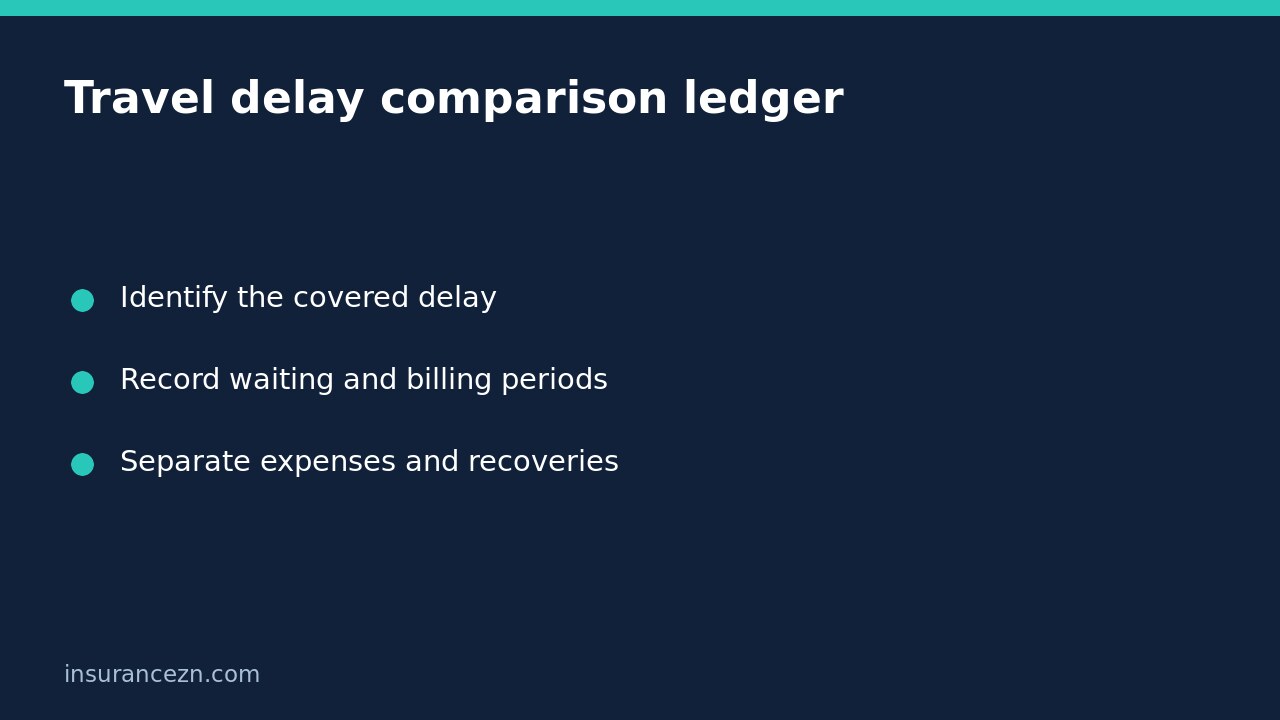

A large travel delay limit does not tell you when benefits begin or which expenses qualify. To compare policies before buying, build a small ledger showing the covered cause, waiting-time rule, expense categories, payment periods and other recoveries. This is more useful than ranking policies by the biggest headline number.
This is general information for Australian readers, not personal financial advice. Read each Product Disclosure Statement (PDS), certificate and applicable policy terms. The examples below are comparison exercises, not insurer quotes, coverage decisions or promised reimbursements.
Start with the covered cause, not the clock
The CHOICE guide hosted by Smartraveller explains that delay expenses are not always covered. It notes that benefits can depend on waiting times and payment-period limits, and that transport-provider rescheduling can be excluded. Some policies may provide particular additional-expense benefits for travellers already en route.
For each shortlisted policy, write down what must cause the delay. Ask whether the wording covers your intended international or domestic itinerary, whether the relevant journey must already have started, and what evidence establishes the cause. Do not assume a flight status reading “delayed” proves an insured event.
Keep travel delay, missed connection, cancellation and additional accommodation provisions separate. A loss may need assessment under a different section, but you cannot assume multiple sections pay the same expense twice.
Build a timing row for each policy
Record the waiting threshold exactly as written, without substituting a typical number from a comparison website. Ask what starts the clock: the original departure time, a later scheduled time or another defined point. Then identify the payment unit and whether a partial period qualifies. A reference to a daily maximum does not automatically mean a calendar-day reset at midnight.
Your worksheet can have these columns:
- Covered cause and required carrier confirmation.
- Starting point for elapsed delay and qualifying threshold.
- Payment period and treatment of incomplete periods.
- Permitted expense categories and any reasonableness conditions.
- Per-person, shared-policy and overall caps, where applicable.
- Relevant excess and reductions for other recoveries.
If the documents do not answer a column, mark it unresolved and ask the insurer. Do not turn a blank cell into an assumption of unlimited cover.
Test one realistic itinerary without inventing an entitlement
Imagine, hypothetically, a scheduled evening flight is delayed until the next morning. You buy dinner and book a hotel. To compare two products, give both insurers the same itinerary, cause, scheduled and actual times, travellers and proposed costs. Ask which section would assess those costs and which conditions would still need to be met.
This exercise exposes differences that a single benefits-table figure hides. One product might have a different qualifying threshold; another might apply a shared limit or exclude the cause. Those are possibilities to check in the actual wording, not descriptions of named products.
Do not buy a policy after a disruption is already known and expect this worksheet to create cover. It is a pre-purchase comparison method. Purchase timing and known-event exclusions must be considered separately.
Keep expense evidence separate from reimbursement
If a delay occurs, keep a dated expense ledger with the supplier, description, amount, currency and receipt. Record the carrier’s explanation, original itinerary and replacement arrangements. Distinguish meals, accommodation, transport and replacement tickets rather than grouping everything as “delay costs”.
Add separate columns for airline assistance, refund requests, credits offered and money actually received. Ask the insurer how each affects assessment; an offered credit is not necessarily the same as a cash refund. Do not claim an expense already paid by another party without disclosing that recovery.
Contact ordinary insurer assistance channels for clarification or any required approval before discretionary spending when practicable. A receipt proves expenditure, not that the expense was authorised or covered. In an urgent safety situation, prioritise safety rather than waiting for an administrative reply.
Final comparison questions
Does passing the waiting time guarantee payment? No. Cause, eligibility, expense rules, exclusions, limits and evidence still matter.
Can I spend up to the advertised maximum? A maximum is a ceiling, not a spending authority. Check the actual payable-expense conditions and assistance requirements.
Where should I read beyond the benefits table? The CHOICE fine-print checklist highlights the cover section, general exclusions, definitions and claims requirements. Use those sections to resolve your ledger before choosing.
Also check how easily you can reach help during a disruption. Our guide to comparing travel insurance assistance access covers contact arrangements; a reachable service is useful, but does not itself approve an expense.