
If your house keys are stolen, make personal safety the priority, then ask your home insurer which lock-replacement benefit and approval process apply. A locksmith’s availability does not establish insurance cover. Separate the immediate security work from optional upgrades before authorising a combined quote, and retain a clear record of the stolen keys and affected locks.
This is general information for Australian readers, not personal financial advice. Cover depends on your policy, certificate, Product Disclosure Statement (PDS), limits, excesses and exclusions. The example below describes one insurer’s published feature; it is not a rule applying to every home or contents policy.
Check the trigger, not just the word locksmith
On its Home Insurance page, Suncorp describes a lock-replacement feature covering replacement or recoding of external door or window locks if keys are stolen anywhere in Australia or New Zealand. That wording makes the event, location and type of lock important. It does not establish that every policy includes the feature, that lost keys satisfy a stolen-key trigger, or that all security upgrades will be paid.
Read the documents applying to your own policy period and ask the insurer to identify the relevant section. Confirm whether the feature sits under building or contents cover for your circumstances, the applicable limit and excess, and whether approval or a nominated repairer is required. A broad sales-page heading is not enough to settle those questions.
Record the facts without filling gaps with guesses
Write down when you last had the keys, when you discovered the theft, what was stolen and which home locks the keys operate. Distinguish a confirmed theft from an unexplained missing set. If you do not know whether a key was taken, say so rather than changing the description to fit a benefit.
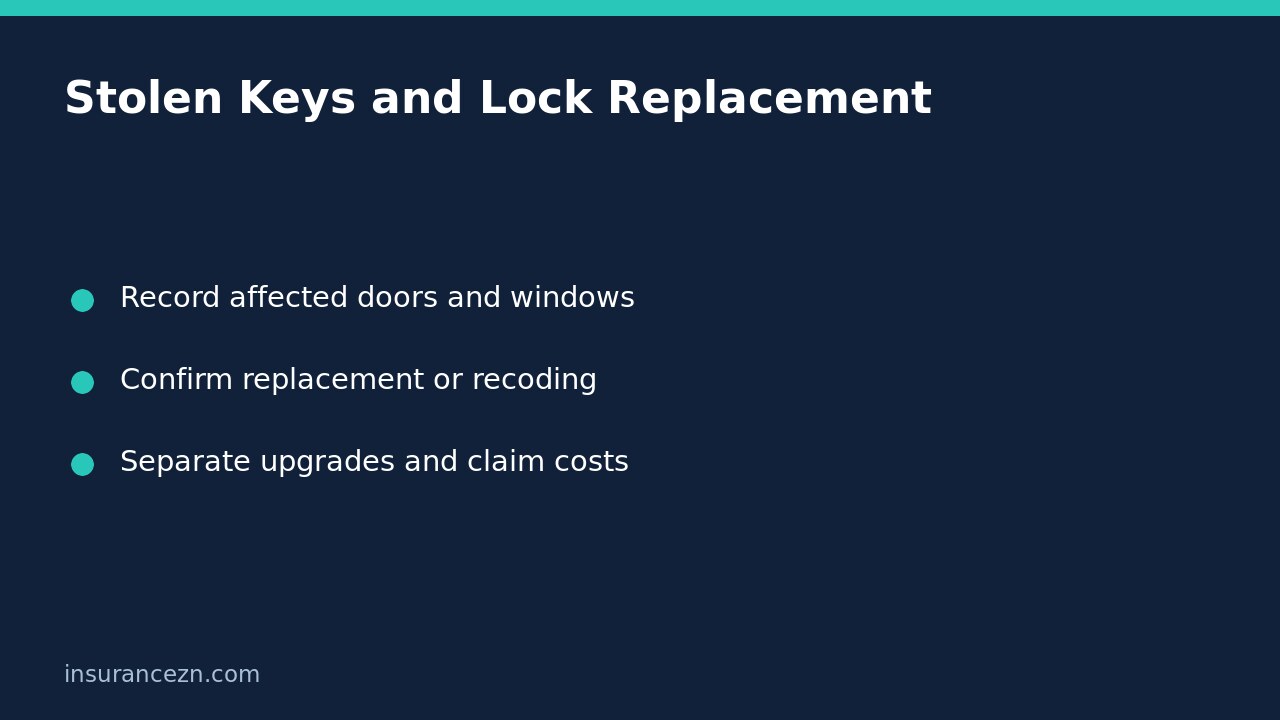
- List affected external doors and windows individually.
- Note whether documents identifying your address were taken with the keys.
- Keep any relevant police report reference and the insurer’s separate claim reference.
- Save the locksmith’s diagnosis, proposed work and itemised estimate.
- Keep photographs of damage where it is safe and relevant.
Do not post key photographs, security weaknesses or your full address publicly. If there is an immediate threat, contact the appropriate emergency services. Do not wait for an insurance decision before taking necessary steps to protect people, but do not assume every urgent expense will be reimbursed.
Split replacement, damage repairs and improvements
Ask the locksmith to separate recoding an existing lock, replacing a lock that cannot reasonably be recoded, repairing damage to a door or frame, and optional improvements. This lets the insurer assess the work against the actual benefit instead of receiving one unexplained total.
For a hypothetical example, a stolen key may operate both the front and back doors. The quote might include recoding those locks plus fitting a new electronic access system. Ask the insurer whether the two existing locks are within the accepted scope, whether replacement is necessary, and how the proposed electronic upgrade would be treated. Do not represent the whole package as an equivalent replacement without explaining the change.
Also identify work affecting rented or strata property. Check who can authorise alterations with the owner, agent or relevant strata contact. Ownership, permission to alter a lock and insurer funding are separate questions; one approval does not supply the others.
Do not confuse a callout service with a claim benefit
Suncorp’s same page separately describes optional Home Assist, including access to locksmith assistance for qualifying sudden and unforeseen home emergencies. It lists its own conditions, limitations and exclusions. That service is not the same question as whether a stolen-key lock-replacement claim is payable under your home policy.
Before booking through any assistance programme, establish whether you are using an included callout, arranging privately paid work or making an insurance claim. Ask which attendance, labour and material costs are included and which need further approval. A call reference or dispatch message does not approve every item on a later invoice.
Reconcile the invoice with the accepted scope
Keep the original quote, the insurer’s written response, your authorisation and the final invoice. If the locksmith finds additional damage, request an updated itemised scope and check approval for the extra work. A previous approval for recoding does not automatically authorise door replacement or a higher-cost system.
When the claim is assessed, match the accepted items, excess, customer contribution and any payment against the invoice. A receipt proves a cost was paid; it does not prove reimbursement approval. Query a difference using the existing claim reference rather than lodging the same expense again.
Quick check: Have you distinguished theft from loss, identified each affected lock, confirmed the policy section, separated upgrades and saved the processed assessment? Our broader guide to home theft evidence and security questions provides context for keeping the incident records together.