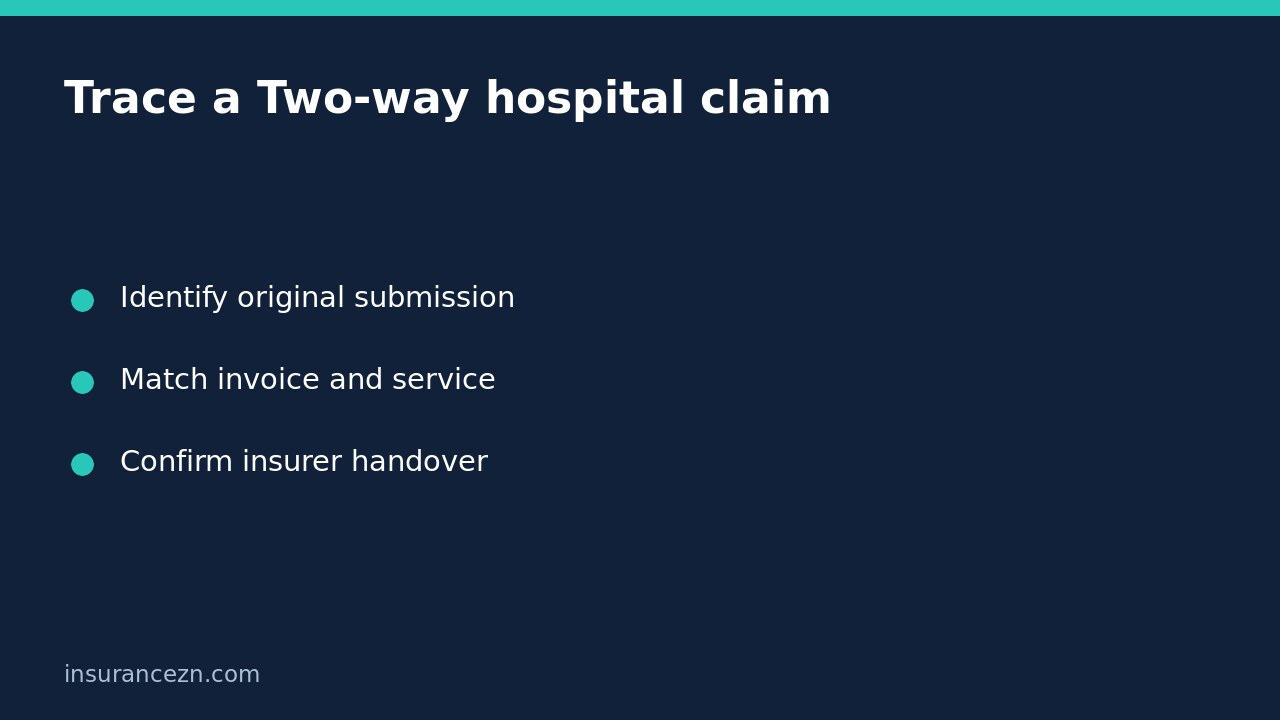

After a private hospital admission, a doctor’s invoice can move between the provider, Medicare and your health insurer. Sending another copy everywhere may make the trail harder to follow. First identify whether Medicare Two-way was used and whether the insurer already received the relevant claim.
The practical task is to trace one invoice through its submission route. This is different from estimating the gap before admission or deciding whether a treatment category is included on your policy. Neither a forwarding confirmation nor a statement entry establishes that every remaining charge will be paid.
Identify which bill you are looking at
Put the invoice next to the hospital paperwork. Record the patient, provider, service date, invoice number and item details. Distinguish a doctor’s professional fee from the hospital’s own account. If a billing agent is involved, keep its name with the provider’s name so support can find the transaction.
Do not assume all invoices from the same stay used the same claiming route. One provider may have arranged billing while another sent an account to you. Make a separate line for each invoice rather than labelling the whole admission ‘claimed’.
Our guide to PHIS examples and personal benefit estimates explains a related limitation of summary information. Here the question is about an actual submitted account, not an illustrative benefit.
Find the original Two-way submission
Services Australia’s Medicare Two-way guidance explains that the program can route eligible in-hospital and ancillary claims between Medicare and participating insurers. Check that your fund participates. The instructions differ according to whether you submit through Medicare or through the private health insurer.
Look for the completed forms, attachment copies and submission confirmation. If someone helped you lodge the paperwork, ask which channel they used. A saved blank form is not evidence that a completed claim was submitted. A provider’s assurance that it would send an account also needs to be distinguished from an actual submission reference.
When asking support to locate the record, explain the route you believe was used and what evidence supports that belief. If you are uncertain, say so. That is more useful than presenting a guess as a confirmed handover.
Separate Medicare processing from insurer assessment
Under the Medicare-submission route described by Services Australia, Medicare processes its part and, if payable, forwards the claim to the participating private health insurer. That handover does not turn a policy exclusion into cover or remove the need for the insurer to assess its own part.
The ahm claiming page gives a practical insurer-specific example: when the hospital claim is submitted through Medicare using the relevant claim and Two-way forms, Medicare forwards the details to ahm and the member need not submit anything further. The same page describes submission of a Medicare Statement of Benefits when one has been received. Other funds’ instructions should be checked directly.
Ask a narrow question: ‘Has this invoice been received through Medicare Two-way, and is any further document required from me?’ Include the reference rather than starting another claim just to obtain a new confirmation.
Read statement payment labels in context
The official Medicare statement explanation says a payment method labelled Private Health means Medicare paid its benefit directly to the insurer or billing agent for private patient hospital services. It does not mean that benefit should also arrive in your bank account.
Match the statement entry to the invoice using the patient, date and item details. Do not rely only on a familiar provider name; the statement explanation notes that hospital care can involve several providers and multiple items. If the match remains unclear, ask Medicare or the billing provider to explain the entry.
A general claims history is useful for reconciliation, but do not assume that any screenshot is the particular document your insurer requested. Ask for the exact document name and acceptable submission format.
Use a small handover ledger
A hypothetical member has separate surgeon and anaesthetist invoices. The surgeon’s account has a confirmed Two-way reference; the anaesthetist’s invoice arrived directly by email. The member records each separately. They ask the insurer to trace the surgeon’s existing submission and ask the anaesthetist’s billing office which process applies to its account.
Useful ledger headings are invoice identifier, service date, original submission channel, Medicare reference, insurer reference, documents requested and next action. Leave unknown fields marked unknown. A clear missing field is preferable to incorrectly attaching one provider’s reference to another provider’s bill.
If a due date is approaching, contact the billing provider about the unresolved processing position. Do not assume that a claim enquiry automatically suspends an invoice’s payment terms or guarantees a later reimbursement.
Close the loop without creating duplicates
Retain the eventual insurer response with the original submission evidence. If you are instructed to submit again, label the new message as a follow-up to the existing account and quote the prior references. Keep the old documents rather than replacing the history with the latest version.
Before marking the matter finished, confirm which charges were assessed, where any payment was sent and whether the provider still records an outstanding balance. Administrative completion is not the same as a promise of no out-of-pocket cost.
This is general information for Australian readers, not personal financial advice. Check your current PDS, policy and member guide, and contact your insurer about your individual cover and the exact evidence needed for the claim.