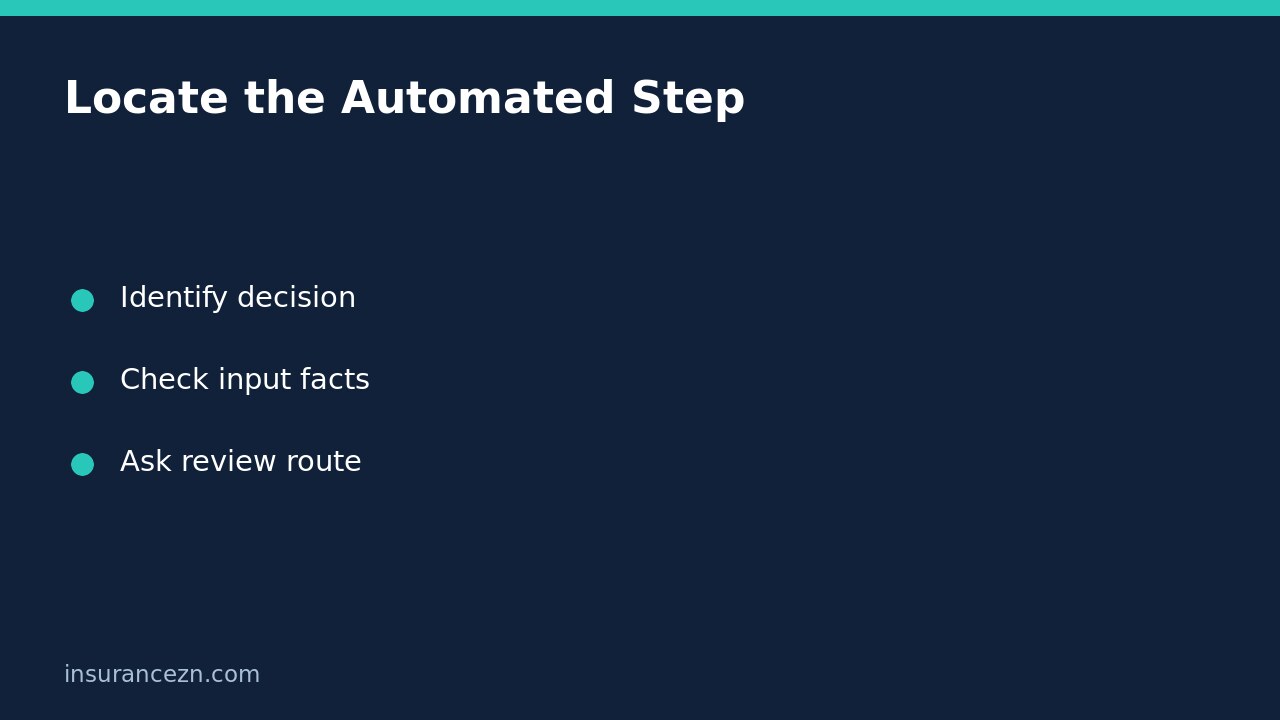

A computer-generated insurance message does not tell you which part of the process was automated. A quote stopping before completion, a claim being checked before assessment and a final claim decision are different events. If you want a useful explanation, identify the event first and ask how technology contributed to that particular step.
This guide provides an enquiry method, not a finding that an insurer used artificial intelligence incorrectly. This is general information for Australian readers, not personal financial advice. Check your current PDS and policy terms, and contact your insurer about your individual cover. The questions below do not promise access to proprietary software, a particular review entitlement or a different claim result.
Describe the outcome without guessing the mechanism
Save the actual message and note the product, reference, date and action you were attempting. Write ‘the quote could not continue after I entered the vehicle details’ rather than ‘an AI rejected my insurance’ unless the insurer has confirmed that description. A portal message can indicate an incomplete process rather than a completed underwriting decision.
Separate your observation from your inference in two short columns. The observation might be that an online status changed. Your inference might be that a program made the final decision. Ask the insurer to clarify the gap instead of building a complaint around an unverified assumption.
Use the provider’s disclosure to identify possible stages
Youi’s privacy policy gives a concrete example of why stage matters. Its automated-decision table distinguishes policy quotes, underwriting, pricing, claims validation, fraud detection and service-provider allocation. The table describes claims validation as authorising claims before assessment; it separately describes selecting a claim for investigation.
This disclosure does not establish which process applied to your file. Nor should it be exported to every insurer. Use your own provider’s current privacy information as a starting point, then ask which named step, if any, was relevant to the particular outcome. Computer programs and artificial intelligence are not interchangeable labels for every administrative task.
Ask about inputs before challenging the output
List the information that may have been used: identity details, application answers, policy information and claim facts. Do not send a large collection of sensitive documents merely because automation is mentioned. Identify the disputed input and ask what evidence is required through the insurer’s verified channel.
For a hypothetical example, a customer notices that a vehicle-use answer on their saved application differs from the answer they intended. The immediate question is which answer the insurer recorded and used, not whether a model is generally fair. Preserve the original application and request the factual correction or clarification. Do not silently change a copy and present it as the original submission.
Our guide to documenting a correction to insurance personal information explains that separate record-handling task. Correcting a fact and reviewing its effect on a decision should remain identifiable steps.
Request a clear explanation of the human and automated roles
A practical enquiry can say: ‘Please identify the decision or process that produced the message dated [date]. Was an automated process used to support it, and was there a subsequent human assessment? Please explain the main information relevant to my outcome, identify any outstanding information and tell me the available enquiry or review process.’
If you receive a generic privacy-policy link, explain what remains unanswered. You are asking which stage affected your case, not requesting a repeat of every possible technology use. Ask for the response under the existing reference so the factual enquiry and later review can be followed together.
Do not assume a staff member’s involvement means technology had no influence. Equally, an automated acknowledgement is not evidence that nobody reviewed the substantive claim. Keep both possibilities open until the insurer explains the process.
Read industry research within its date and scope
ASIC’s October 2024 Report 798 reviewed financial-services and credit licensees’ AI use and governance. Its findings described AI generally augmenting human decisions in the reviewed deployment strategies, alongside governance concerns and accelerating adoption. It was a review of particular organisations and periods, not a diagnosis of your insurer’s current systems.
The report is useful background for asking clear questions about oversight. It cannot prove that your claim used a particular model, that its inputs were wrong or that the result was unlawful. This article does not treat its historical findings as a current percentage of insurance decisions made by AI.
Keep the practical claim or policy task moving
While an explanation is outstanding, ask what evidence, payment or other policy action still requires attention. Do not assume the enquiry suspends deadlines, keeps a quote available or extends cover. Obtain explicit confirmation if you need more time or an alternative communication method.
- Retain the exact message and original application or claim records.
- Name the decision stage you want explained.
- Separate inaccurate inputs from disagreement with the result.
- Ask what automated support and human assessment occurred.
- Record the available complaint or review route without assuming its outcome.
If the response remains inadequate, use the insurer’s complaint process and identify the unanswered question and remedy you seek. A focused request for explanation, correction or review is more actionable than a general accusation about algorithms. It also leaves a clearer record for any later adviser or complaint handler examining what actually happened.