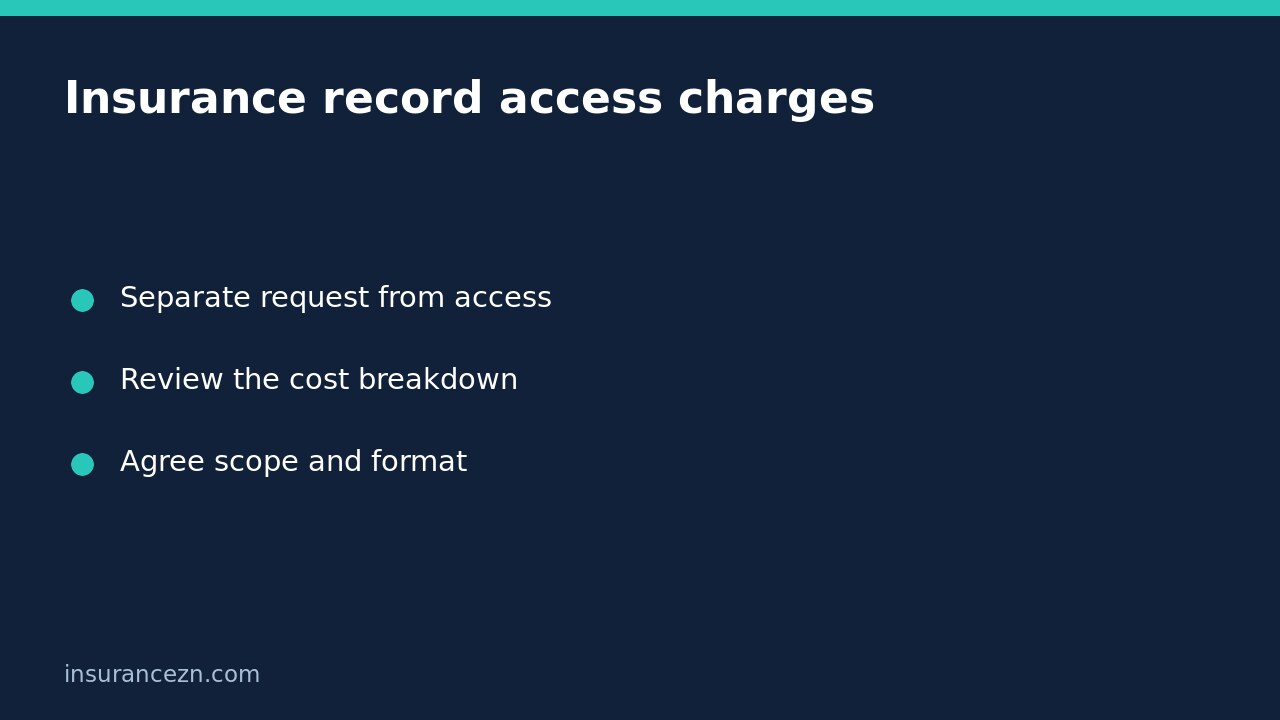

A fee quoted for access to your personal insurance information is not automatically invalid, but it deserves a clear explanation before you agree. Australian privacy guidance distinguishes making a request, which is free, from providing access, for which an organisation may charge a non-excessive amount.
The useful next step is a written cost-and-scope review: establish what the fee covers, whether a more suitable format would reduce it and which information you still need. This is different from comparing premiums or paying an insurance excess.
Check which rule the quote is using
The Office of the Australian Information Commissioner (OAIC) says an organisation may charge for providing access to personal information, but the charge cannot be excessive or used to discourage a request. The organisation must tell you about the charge and explain its reasons. The separate rule that an agency cannot charge for access should not simply be applied to a private insurer.
Also identify what you requested. A privacy access request concerns your personal information, not an unrestricted right to every commercial document held by an insurer. If the quote mixes a privacy request with another paid service, ask the organisation to identify each component and the basis for charging it.
Ask for a usable cost explanation
The OAIC lists possible access costs such as staff searching for and retrieving information, reproducing and sending it, postage or materials, and an intermediary where necessary. That list is not an automatic approval of any amount an organisation chooses.
Ask what work is proposed, which records or date range the estimate covers and which delivery method has been assumed. Establish whether the amount is an estimate or a fixed quote, and request notice before additional work creates extra charges. Do not invent a universal fee cap: the OAIC consumer guidance describes a non-excessive-charge standard rather than a single dollar ceiling for every request.
- Which personal information is included in this quote?
- Which search, copying or delivery costs make up the amount?
- Can an electronic copy or inspection reduce the charge?
- What information would be excluded if the request were narrowed?
Reduce avoidable work without losing the question
Write down what you need the records to establish before shrinking the request. For example, you may need to compare the personal contact details recorded at two dates, rather than obtain every document created during a long membership. Specify the relevant period and information accurately, acknowledging any uncertainty.
Changing delivery from post to email may reduce some costs, as the OAIC notes, but it does not guarantee that searching or retrieving records becomes free. Ask which savings actually apply. If you accept a narrower scope, retain both versions of the request and the written explanation of what will no longer be supplied.
For organising what you already hold, see our insurance policy document map. Finding an existing copy may help you identify gaps, but it does not prove that your own file matches every record held by the insurer.
Use a side-by-side decision note
Consider a hypothetical customer who requested all personal information for several years but now needs records of one address-change exchange. Their decision note could show the original broad request, a proposed narrower date range, the preferred electronic format and the insurer’s revised quoted cost. No invented savings figure is needed: compare the actual responses.
Before approving the revised option, ask whether it includes the particular personal information needed to investigate the issue. A cheaper pack that omits the relevant exchange may not solve the problem. If broader information remains necessary, explain why and ask the organisation to reconsider the proposed charge rather than describing every access fee as unlawful.
Keep payment, delivery and outcome distinct
Confirm the accepted scope, format, quoted amount and next step in writing. If payment is requested, verify the recipient through an established insurer contact route. A payment receipt does not show that access has been provided. When material arrives, check it against the agreed scope and note missing information without altering the originals.
If the charge remains unexplained or appears excessive, ask for a review and the organisation’s privacy complaint process. The OAIC guidance also describes lodging a privacy complaint when dissatisfied with an access decision. Do not assume that challenging a charge pauses an insurance settlement or other deadline.
Quick questions before you agree
Is this a free request followed by a clearly explained access charge? Does the quote identify the information and delivery method? Have you compared practical alternatives? Have you preserved the records needed for your actual question? Receiving the information still does not establish that an insurance decision is wrong or that a benefit is payable.
Source: OAIC: access methods, charges and complaint options.
This is general information for Australian readers, not personal financial advice. It is not legal advice. Insurance cover and claim outcomes depend on the applicable policy/PDS, terms and circumstances; paying an access charge does not establish entitlement.