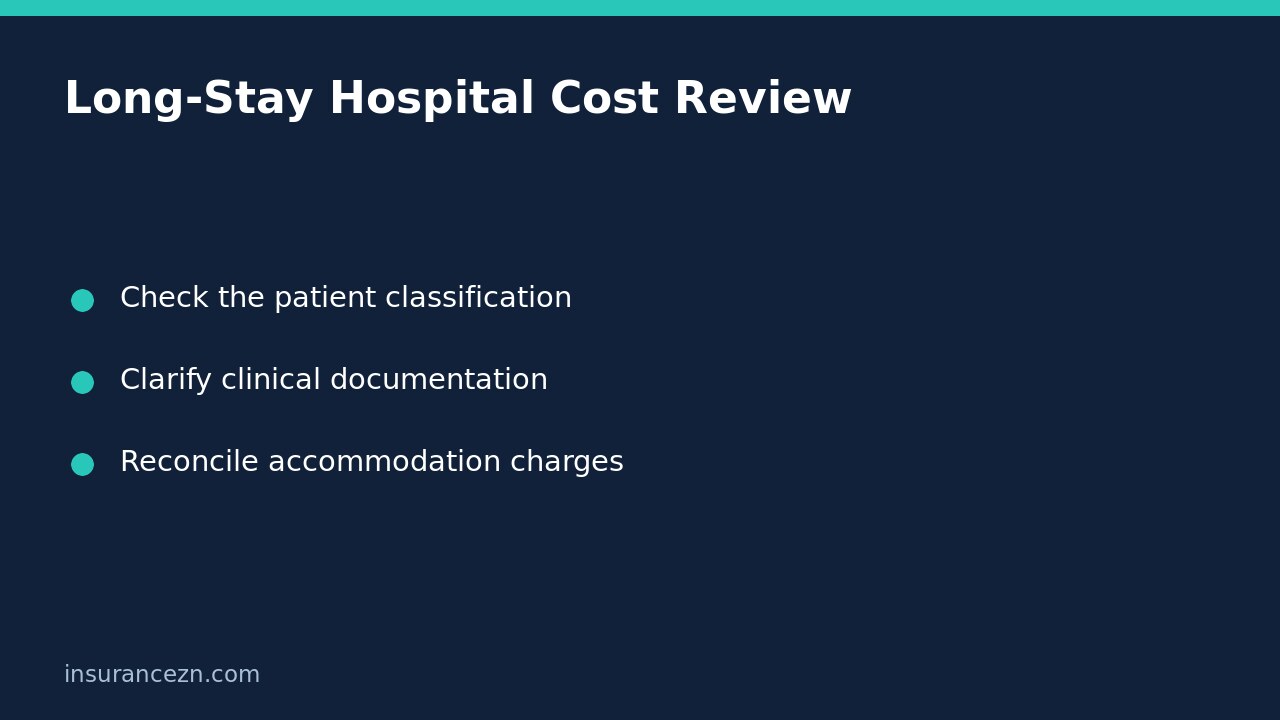

If a private hospital admission becomes a long stay, do not assume the original accommodation estimate remains the whole cost picture. Ask the hospital and health insurer whether a long-stay or nursing home type patient classification is relevant, what clinical documentation is needed and whether a separate patient contribution is proposed. This is a different question from your ordinary policy excess or daily co-payment.
This is general information for Australian readers, not personal financial advice. Benefits and charges depend on your circumstances, policy, fund rules, applicable PDS and hospital arrangements. This article does not establish a personal classification or quote. Treatment and discharge decisions should be discussed with the clinical team, not driven by an unverified insurance calculation.
Understand why an extended admission needs another check
The Australian Government’s PrivateHealth.gov.au coverage overview flags hospital stays exceeding 35 days in succession. It describes long-stay or nursing home type patients, a doctor-related qualification to that classification, and an additional accommodation cost that health insurance regulations do not allow insurers to insure. Do not turn that overview into a claim that every patient automatically owes the same amount on a particular day.
The useful next step is to ask the hospital whether the classification applies to the actual admission and what its answer depends on. The overview is not a patient-specific determination, a current dollar-rate schedule or an explanation of every certification requirement. Ask the hospital to identify the applicable rule and provide its calculation rather than filling those gaps with assumptions.
Ask the clinical team about the supporting record
Ask who is responsible for assessing the patient’s clinical status and completing any relevant documentation. Find out whether a certificate or other medical record is needed, whether it has been completed and which period it addresses. A planned appointment to review the patient is not evidence that the documentation has already been supplied or accepted for billing.
Family members should describe the situation accurately, not try to select a diagnosis or wording to obtain a financial outcome. If the patient cannot manage administration, ask the hospital and insurer how an authorised contact can assist. Consent to discuss clinical care and permission to discuss insurance accounts may involve separate processes.
Get a dated accommodation-cost explanation
Request an itemised written estimate showing when the proposed charge starts, its charging unit, the period covered and who receives payment. Ask whether the amount is an estimate or an already processed account. If the hospital is still awaiting clinical information, have that uncertainty clearly marked rather than treating the figure as settled.
Keep separate lines for ordinary policy excesses, daily co-payments, any proposed long-stay contribution, room-upgrade charges and doctors’ accounts. Ask whether each figure is additional to the others or already included in another subtotal. Do not add two descriptions of the same charge, or assume a cap on one contribution also limits another.
For a separate accommodation issue, read the single-room upgrade cost checklist. An optional room charge is not the same as a charge arising from patient classification, even if both appear on the hospital account.
Reconcile changing information without assuming a refund
Consider a hypothetical administrative situation: the hospital sends an estimate while clinical documentation is outstanding, then later receives a completed record. Keep both versions and ask whether the new information changes the classification, dates or proposed contribution. Do not assume that receiving a document automatically cancels an invoice or produces a refund.
If an account changes, request the revised itemised statement, how any payment already made has been allocated and whether a credit or refund has actually been processed. Ask the insurer separately whether its own benefit assessment needs review. A hospital correction and an insurer correction are distinct steps; one does not prove the other has occurred.
Questions for the hospital and insurer
- What patient classification is recorded, and for which dates?
- What clinical documentation is required, and what remains outstanding?
- Which charge is being proposed and under what rule?
- Does the estimate separate insurer benefits from patient contributions?
- Who will confirm the final account and any processed adjustment?
Does comprehensive hospital cover remove this issue? Do not assume so. The official overview identifies limitations on long-stay costs separately from the range of treatments included in a policy. Ask about the particular charge rather than relying on a product’s marketing label.
Should the patient leave hospital to avoid the charge? Do not make an unsafe discharge decision on that basis. Raise financial concerns with the hospital’s patient liaison or accounts team and the treating clinicians, ask what support or payment discussions are available, and obtain appropriate advice if the classification or account remains disputed.