
If you have surgery booked, do not approve a cheaper hospital policy solely because the hospital already checked your current membership. Ask your insurer how the exact proposed change would affect that admission, including its effective date, treatment category, exclusions, restrictions and patient contributions. An estimate based on the old policy is not confirmation of benefits under the replacement.
This is general information for Australian readers, not personal financial advice. Benefits depend on the applicable policy rules, PDS where relevant, membership documents, waiting periods and treatment circumstances. A booking, referral or premium quote does not establish insurer benefit approval. Do not delay urgent clinical care to complete insurance administration.
Start with the actual booked treatment
Record the planned admission date, hospital, treating doctors and proposed procedure or item numbers available from the providers. Ask whether the proposed treatment has changed since the original estimate. A broad description such as knee surgery may not identify everything needed for a reliable benefits enquiry.
Keep your current product name and the proposed replacement product alongside those details. If a cheaper quote removes treatment categories or introduces restrictions, ask the insurer to identify the effect on this particular admission rather than simply confirming that the product is hospital insurance.
Distinguish exclusions from restricted benefits
The Australian Government’s Managing your policy guidance explains that premiums are only part of the comparison. Exclusions, restricted benefits, excesses and co-payments can materially change what you pay for treatment.
For an excluded service, the guidance says the insurer does not pay hospital or medical benefits for that treatment as a private patient. Restricted benefits mean limited cover, potentially leaving considerable costs. Neither arrangement should be described as equivalent to the current policy merely because the monthly premium looks attractive.
Ask the insurer to classify the booked treatment under both products. If the answer is restricted rather than excluded, obtain a service-specific benefit estimate; do not interpret the word included as a promise of a fully funded private-hospital stay.
Get the effective date and admission consequences in writing
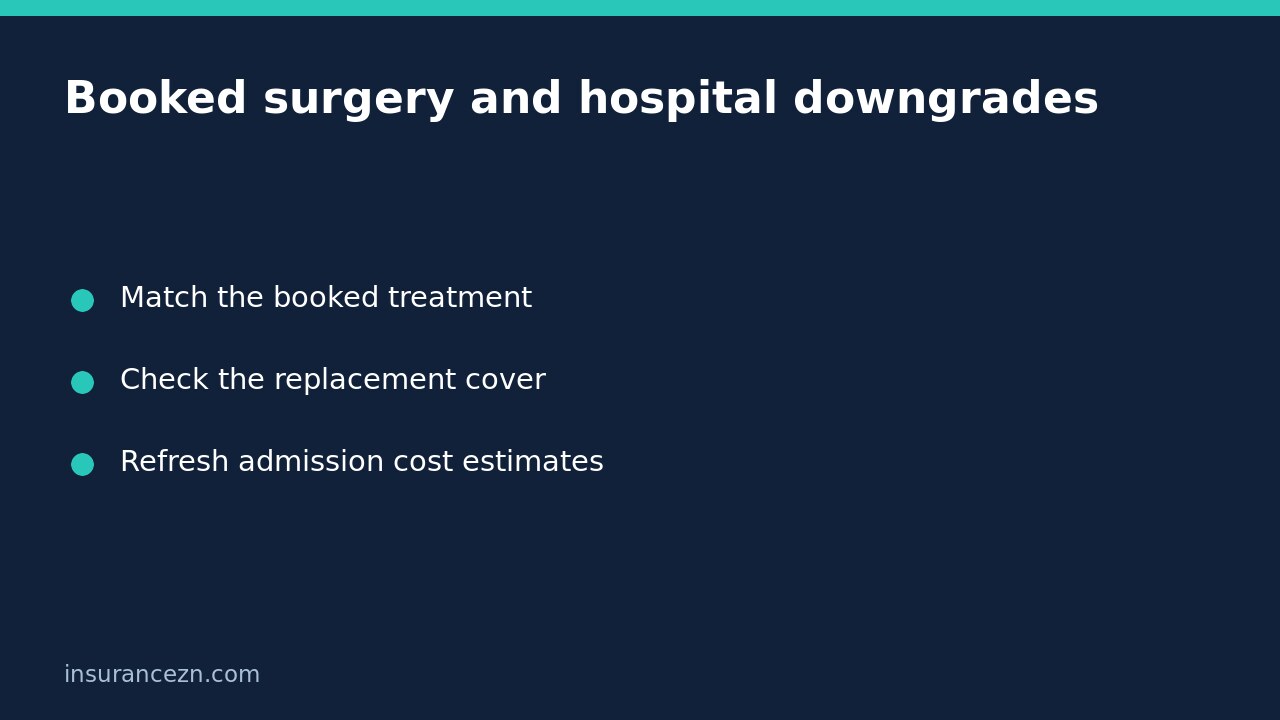
Before authorising the change, ask which policy would apply to the proposed admission date and whether any other dates or conditions affect the assessment. Request a response that names both products, the treatment details supplied and the proposed change date. Do not assume a hospital booking locks in the old level of cover.
A hypothetical patient has an admission estimate based on their current product, then receives a cheaper replacement quote. The useful next step is not to subtract the premium saving from the old estimate. It is to ask the insurer and hospital to refresh their respective estimates using the same replacement product and admission details.
If a response is conditional or information is missing, record exactly what remains unresolved. A submitted downgrade request is different from a processed membership change, and neither establishes the final amount payable on a claim.
Do not treat upgrading again as an instant undo button
The government guidance explains that upgrading to remove exclusions or obtain higher benefits can involve waiting periods before the additional benefits are available. Therefore, do not downgrade on the assumption that you can restore everything immediately just before surgery.
Ask the insurer about the consequences of returning to the previous level, including any waiting periods for the higher benefits. Obtain an answer for your membership history rather than relying on a general switching slogan. If the original downgrade has already been processed, ask about the actual correction options and dates; do not assume a phone enquiry reversed it.
Refresh the whole cost picture, not just the premium
Request updated hospital charges and insurer benefits, then separately check doctors’ estimates and any excess or co-payment. Keep each version dated so an earlier approval or estimate is not mistaken for a current answer. If an optional accommodation charge is involved, our guide to single-room upgrade costs explains why that is another separate question.
Compare the premium saving over your chosen review period with the possible additional patient costs disclosed in the refreshed estimates. Those estimates are not guarantees of the final account, and affordability should not be judged by premium alone.
What if the change is already active? Confirm the processed product and date, tell the hospital about the change, and obtain fresh estimates promptly. Ask the insurer what options remain rather than presenting the old confirmation as proof of current benefits.
What should I keep? Save the original estimate, proposed product documents, written treatment response, change confirmation and revised provider estimates. A useful finished check is that every party is working from the same policy and treatment details, with unresolved costs clearly identified.