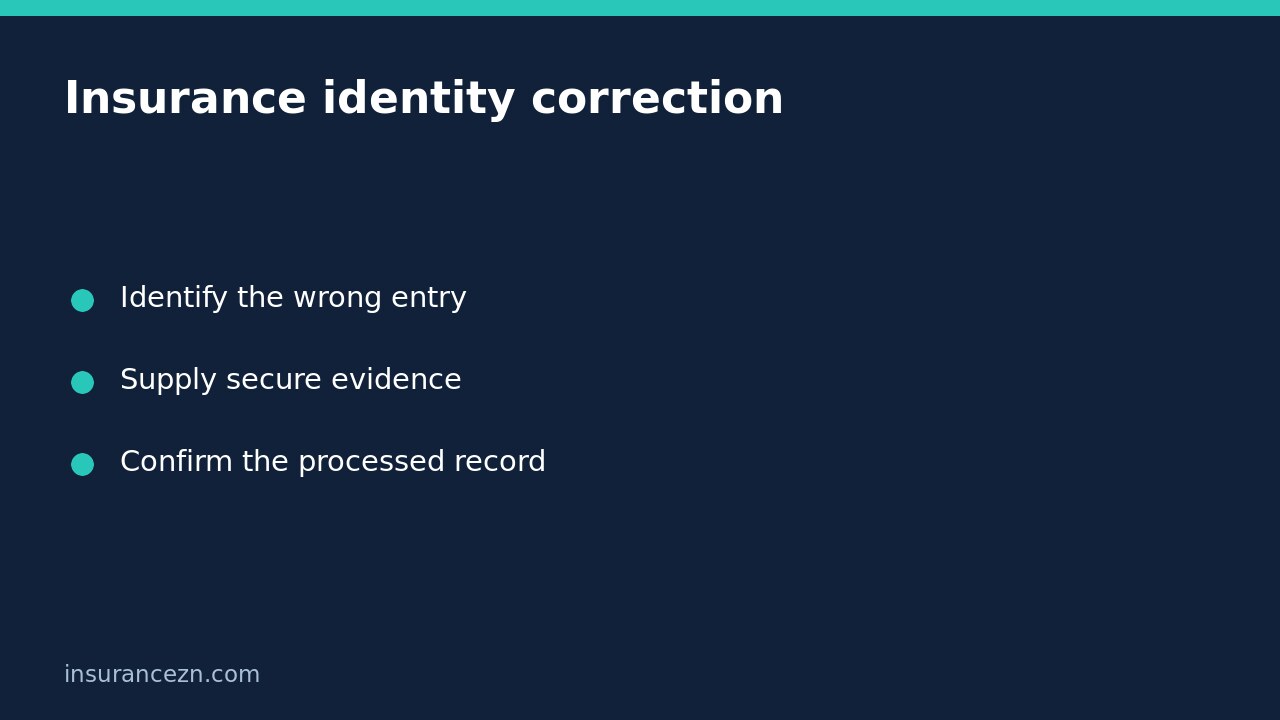

If your insurance paperwork shows the wrong date of birth, request a correction through the insurer’s verified channel and obtain confirmation of the processed record. A submitted form or uploaded identity document does not prove that every relevant policy record has been corrected.
Keep the factual correction separate from its possible consequences. A corrected birth date does not by itself establish a refund, a different premium, eligibility for a particular benefit or acceptance of an existing claim. Ask the insurer to explain those matters separately under the applicable product terms.
Establish which record is wrong
Compare the policy schedule or membership document with reliable identity evidence. Note the policy number, document issue date and exact field that is inaccurate. If the online account and issued schedule differ, record both rather than assuming that one is the master record.
The Office of the Australian Information Commissioner (OAIC) says Australian privacy law gives people the right to correct personal information that is inaccurate, out of date, incomplete, irrelevant or misleading. Its guidance explains the correction process; it does not establish the pricing or benefit rules of an insurance product.
Do not replace an uncertain date with another guess. If source documents disagree, tell the insurer there is a discrepancy and ask what evidence it needs. Preserve the old document as part of the explanation instead of silently altering a downloaded PDF.
Use a secure, specific correction request
Contact the organisation holding the information, using details on its official website or existing policy documents. Ask how it verifies identity and which secure upload channel to use. Avoid attaching full identity documents to an unverified message or including sensitive details in a public complaint.
- Identify the policy or membership and the person whose record needs correction.
- State the current incorrect entry and the evidence-backed replacement.
- Identify the document or account screen where the error appears.
- Ask what supporting evidence is required and how to supply it securely.
- Request written confirmation of the resulting record and any outstanding steps.
The OAIC explains that only you or a person you authorise can request the correction, and the organisation must be satisfied about identity and authority. Being a relative or paying the premium is not a reason to assume unrestricted authority to amend someone else’s personal information.
Ask about linked records without assuming automatic updates
A practical request might say: ‘My policy schedule dated [date] shows an incorrect date of birth. Please correct the identified entry using the evidence supplied through your secure channel. Please confirm which policy and customer records have been updated and identify any separate action needed for an open claim or linked membership.’
Ask whether a revised schedule or other written confirmation will be issued. If there is a pending quote, renewal or claim, identify it explicitly. Do not assume an account-profile update automatically changes a previously issued document or the information being used by another team.
In a hypothetical example, an insurer acknowledges an upload but the next schedule still shows the old birth date. The next step is to reference the original correction request, identify the continuing mismatch and ask whether processing is complete. Repeatedly opening new requests can make the history harder to follow.
Reconcile consequences separately from the factual change
Ask whether correcting the information changes any product-specific premium, eligibility assessment or administrative requirement. If the insurer says it does, request the applicable reason, relevant period and written calculation or explanation. Do not assume the correction must either reduce the price or leave it unchanged.
A bank credit, revised quote and updated policy record are different pieces of evidence. If a refund is proposed, check whether it has actually been processed and how it relates to the revised account. If a claim is underway, ask what information the claims team will use and whether further assessment is required; correcting identity information is not claim approval.
For organising the resulting documents, use our insurance policy document map. Keep the original and revised versions, with dates and the insurer’s explanation of which document applies.
If the organisation refuses the correction
The OAIC says correction requests must receive a response within a reasonable period and that there is no charge for correction. It also explains that legal retention requirements can limit amendment or deletion of particular information. A correction request is not a guarantee that the original historical record will disappear.
If the organisation refuses, the OAIC guidance says it must explain its reasons in writing, the right to request an associated statement and how to complain. An associated statement can record that you consider the information inaccurate without pretending that the requested replacement has been accepted. Seek appropriate advice if an urgent policy or claim decision depends on the disputed entry.
Completion checklist
Before closing the task, check the correct person, corrected field, affected policy records, revised document and outstanding actions. Has the insurer confirmed the processed change, rather than only receiving your evidence? Have any premium or benefit consequences been explained independently?
Source: OAIC guidance on correcting personal information.
This is general information for Australian readers, not personal financial advice. It is not legal advice. Policy terms, the PDS, eligibility rules and individual circumstances determine cover and benefits; a personal-information correction does not guarantee a refund or claim payment.