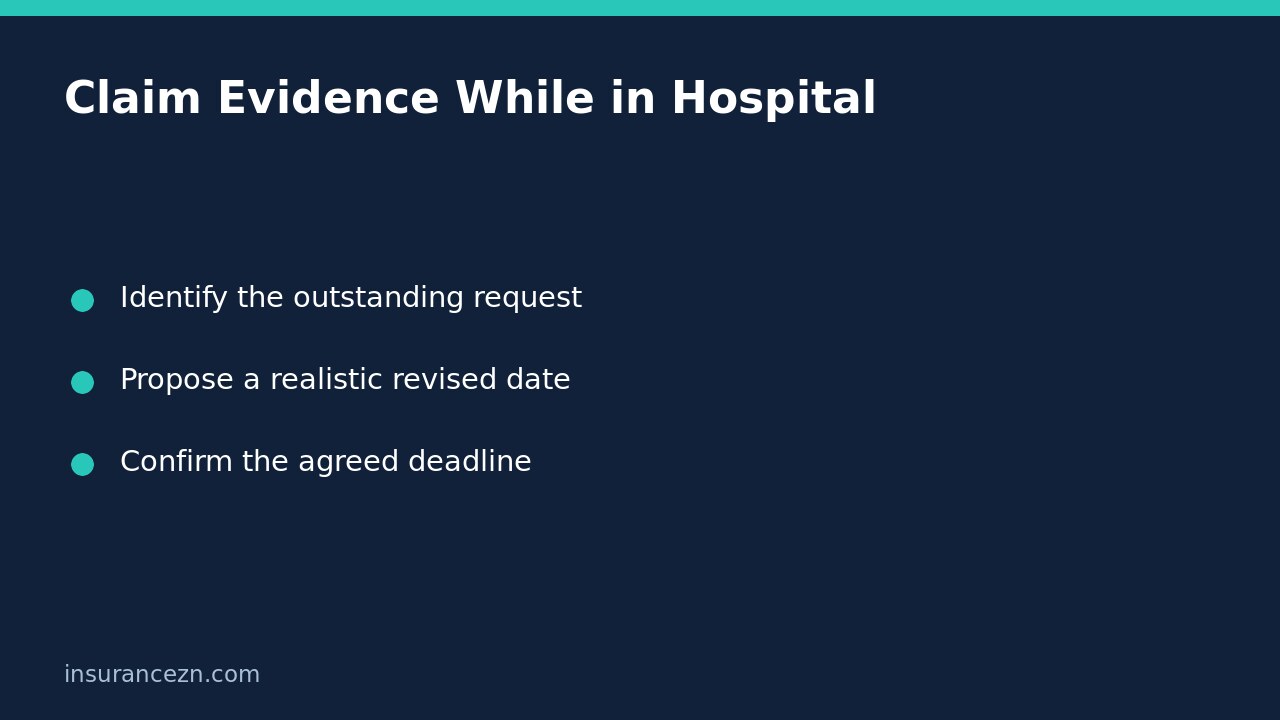

If you are in hospital and cannot meet a home insurance claim’s evidence request, contact the insurer through a verified channel as soon as reasonably possible. Identify the exact request, explain the practical obstacle and ask for a specific revised date. A message saying you are unwell is not confirmation that a deadline has changed.
This is general information for Australian readers, not personal financial advice. Your policy, PDS, claim circumstances and applicable requirements determine your position. This checklist does not establish an automatic extension, suspend any deadline or guarantee claim acceptance. Do not delay urgent medical care to organise insurance paperwork.
Identify which date you actually need changed
Find the insurer’s original letter, email or portal message. Record the claim reference, requested documents, stated due date and any explanation of what happens next. Distinguish an evidence request from an assessor appointment, settlement-offer expiry or external complaint deadline. Changing one does not establish that another has changed.
Make a short list of what is already available and what cannot currently be obtained. For example, you might have photographs on your phone but purchase records stored at home. Explain that difference rather than describing everything as unavailable. Do not guess purchase dates or recreate receipts to make the file look complete.
Ask for practical support, not just sympathy
Suncorp’s home-claim instructions say customers can advise the insurer of vulnerabilities later in lodgement and describe extra support for different personal circumstances. They also explain ways to supply documents to an existing claim. Those statements support asking for help; they do not promise that every requested extension or communication arrangement will be granted.
Keep your explanation proportionate. Describe how hospital treatment affects the task: limited access to records, inability to inspect belongings safely, or restricted availability for calls. Ask what information the insurer actually needs before sending sensitive medical documents. Use its verified secure channel rather than posting health information in a public comment or sending it to an unverified caller.
Send a specific, bounded request
A useful message might read: “For claim [reference], your message dated [date] asks for [documents] by [original date]. I am currently in hospital and cannot access [records]. I can supply [available evidence] now. Please confirm whether you agree to [proposed date] for the remaining material, and whether anything else is required meanwhile.”
Use an honestly achievable proposal. If your discharge date is uncertain, say so and ask whether a review date would be more appropriate. Do not present a speculative discharge estimate as a medical fact. If no response arrives before the original deadline, follow up through an official contact channel and retain the attempt records; silence is not acceptance.
Separate help from representative authority
A relative may be able to locate receipts or organise filenames, but that does not automatically authorise the insurer to disclose claim information to them or accept decisions from them. Ask how to record the precise permission needed. Avoid sharing account passwords or granting broader authority than intended.
Specify whether the helper may upload evidence, receive routine correspondence or discuss the request. Confirm the insurer has recorded the arrangement and any end date. For communication barriers as well as temporary illness, this site’s accessible claim-call handover checklist covers a separate task: agreeing how the conversation will work.
Read back the actual agreement
Save the insurer’s response alongside the original request. Check the revised date, exactly which documents it covers, any interim actions and the channel for submission. An acknowledgement that your message was received is not an agreed extension. A support flag on your profile is not proof that the claim team’s document timetable has been amended.
When you send the outstanding evidence, retain the submitted files and receipt. Ask about correct allocation to the existing claim where necessary. Document receipt is not assessment acceptance, repair authority or payment approval. Do not lodge another claim merely to obtain a new evidence timetable.
Quick questions before closing the task
- Which original requirement remains outstanding?
- Has the revised date been expressly agreed and recorded?
- Are any separate appointments or deadlines unchanged?
- Does a helper have the necessary recorded permission?
- Have the final documents reached the correct claim?
What if the insurer refuses? Ask for the reason, any alternative evidence it will consider and the available review or complaint process. If a consequential deadline is approaching, seek appropriate independent advice promptly rather than assuming that a support request protects your rights.