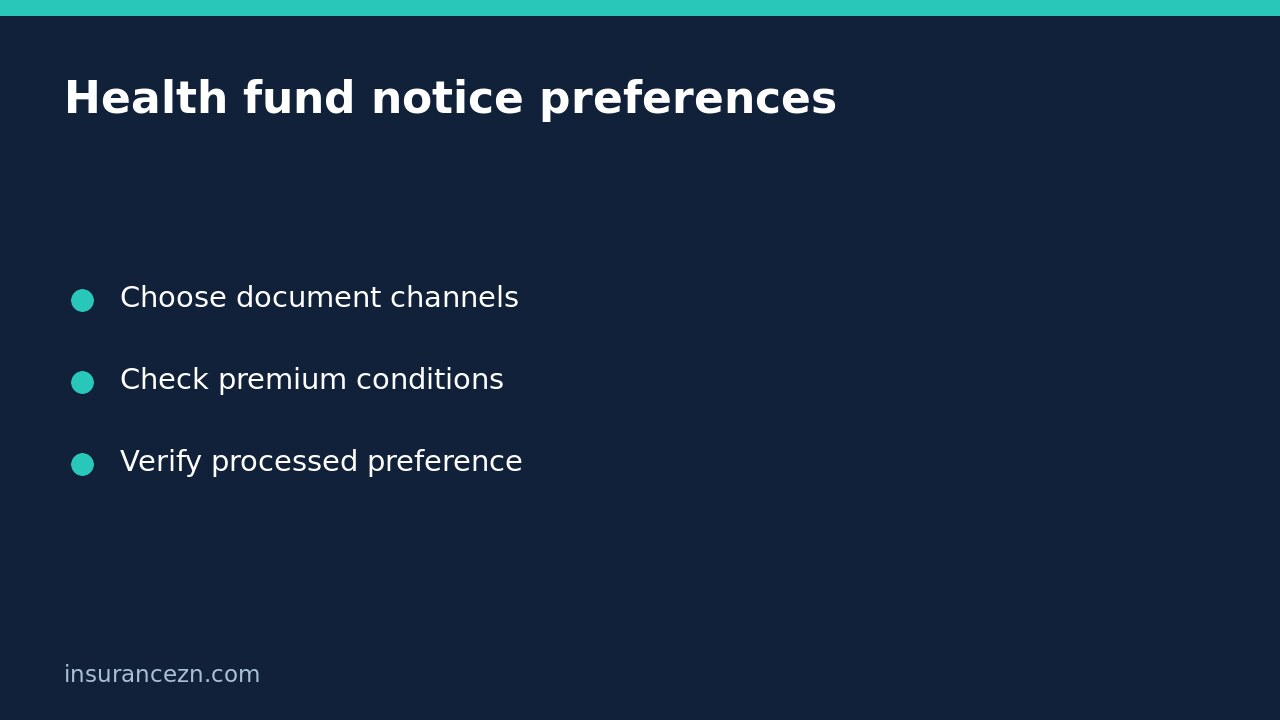

If you want your health fund to send paper letters instead of emails, ask which documents the change covers, whether it affects a discount and when the preference will actually take effect. A submitted request is not proof that every notice has changed channel. Keep access to the old channel while the fund confirms its record.
This is general information for Australian readers, not personal financial advice. Delivery options, discounts and benefit rules depend on the insurer’s policy documents, membership rules and any applicable PDS. Changing correspondence preferences does not establish treatment eligibility or resolve an existing missed notice.
List the documents you want to receive differently
Be specific about the problem. Perhaps emails are difficult to read, an old mailbox is no longer accessible, or another household member has been receiving correspondence. Ask the fund about the options it actually offers rather than assuming that a single paper preference applies to everything.
Prepare a list covering premium notices, policy-change letters, claim statements and other membership documents you need. Ask separately about portal-only documents, payment reminders and any messages still sent electronically. Request confirmation of which document types will change and which will not.
A request to stop marketing emails is not necessarily a request to change essential membership correspondence. Likewise, updating an email address does not necessarily select postal delivery. Ask the fund to describe the setting recorded against your membership in plain language.
Check any discount condition before agreeing
The Australian Government’s Managing your policy guide says insurers may offer discounts to people who agree to electronic communication and claims. It recommends checking eligibility with the insurer. This does not establish that your fund offers such a discount, that you currently receive one, or that paper correspondence will necessarily remove it.
Ask: ‘Is any part of my current premium conditional on electronic correspondence or electronic claiming? If I change these specific notices to paper, what amount will I pay, from what date, and will my claiming method need to change?’
Keep the correspondence choice separate from benefit changes. If a staff member offers a different product during the conversation, request a separate comparison before accepting it. You should be able to identify whether any price difference comes from delivery conditions, a product change or another adjustment rather than guessing.
Confirm the address and appropriate recipient
The government guide also stresses keeping contact details current so that policy-change notifications reach you. Read the intended postal address back to the fund, including unit details and postcode. Ask which membership contact receives the relevant documents and what authority is needed if someone else is helping you.
Paper delivery can create privacy problems in shared or insecure mail arrangements. Consider who can access the mailbox, while electronic delivery raises its own account-access questions. Do not provide another person’s email or postal address without considering consent and the fund’s requirements. A correspondence preference should not be treated as authority for a helper to discuss claims or change cover.
Verify processing before abandoning the old channel
Save the request and acknowledgement. Ask for the processed preference, effective date and any resulting premium adjustment in writing. Clarify how documents already generated or queued for delivery will be handled. Do not assume a later preference change reroutes an earlier notice.
For a hypothetical example, a member asks for paper premium notices while retaining electronic claim statements. The meaningful confirmation identifies those two different choices and their start date. A generic ‘details updated’ message leaves open whether the requested document settings were actually recorded.
Check the next expected document through the agreed channel. If it does not arrive, contact the fund through a verified ordinary service channel and request a copy. Do not ignore a payment or response obligation simply because you are waiting for the delivery preference to settle. Ask what remains due and resolve uncertainty promptly.
Recover earlier notices as a separate task
Changing future delivery does not automatically retrieve letters or emails you missed. Ask for copies, issue dates, any stated effective dates and outstanding actions. Our guide to recovering health insurer notices sent to an old address explains how to keep that recovery task separate from correcting contact records.
Nor does a contact update prove that missed-notice consequences have been reversed. Request a specific explanation if you believe a premium, membership or benefit record is wrong, preserving the original notice and the fund’s response.
Quick questions before closing the request
- Which documents are now postal, electronic or portal-only?
- Is the recipient and address correct for each document type?
- Has the fund confirmed any discount or premium effect?
- What is the processed effective date?
- Are older missing notices and outstanding actions separately accounted for?
Does choosing paper stop online claiming? Do not assume either outcome. Ask how your fund separates correspondence and claiming preferences and whether its discount conditions link them. Confirm the accepted arrangement rather than relying on a general description.