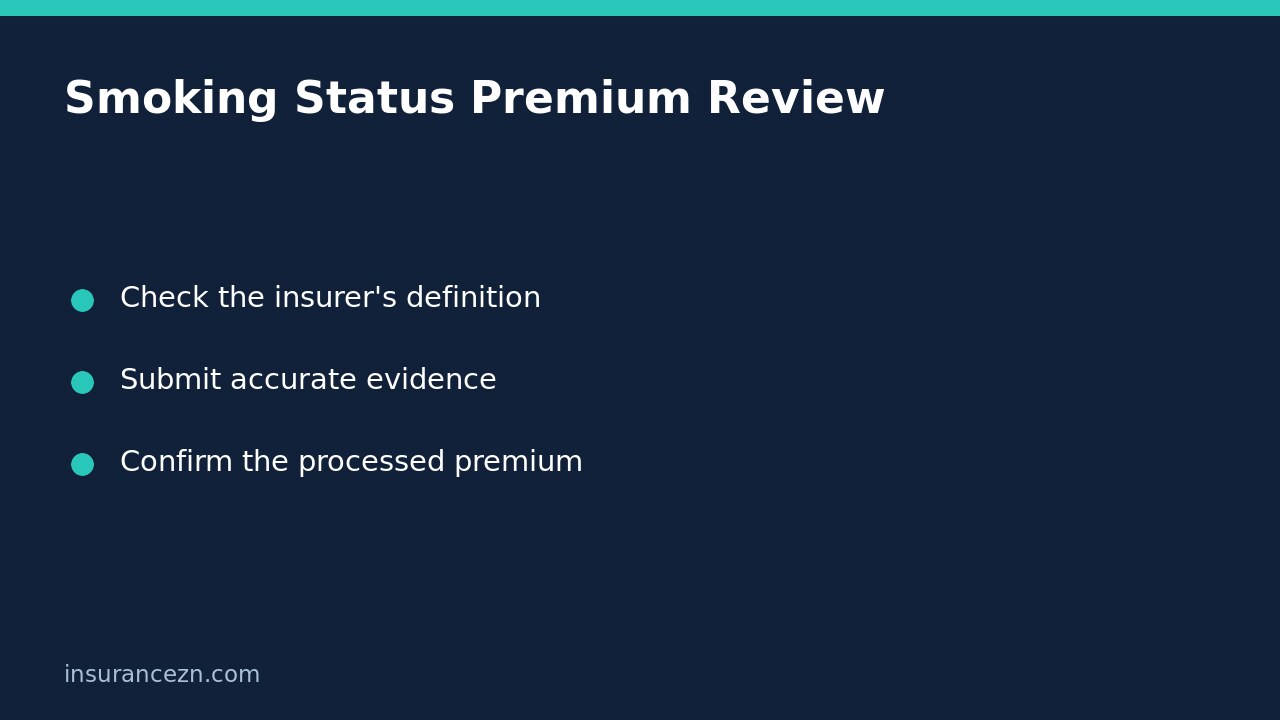

If you have stopped smoking, ask your life insurer whether it can review the smoking classification used for your existing policy. Do not assume that stopping automatically changes the premium, and do not reduce a direct debit yourself. The useful outcome is a written decision explaining the accepted classification, affected cover and effective premium date.
This is general information for Australian readers, not personal financial advice. Your policy terms, applicable PDS, underwriting requirements and insurer’s assessment determine whether an adjustment is available. This article does not prescribe a qualifying period or promise savings.
Check whether your existing policy can be reviewed
In its insurance FAQs, TAL says customers whose circumstances improve, including those who have quit smoking, could be entitled to a lower premium and can request a policy alteration. This supports asking about an existing-policy review; it does not establish that every insurer uses the same rules or that every request succeeds.
Contact your insurer through a verified service channel, or your financial adviser where relevant. Give the policy number and ask which benefits currently have a smoking-related classification. If your insurance is held through super, ask the fund which process applies rather than assuming a retail insurer’s alteration process transfers directly.
Ask how the insurer defines the change
Explain your actual circumstances and ask for the current definition and evidence requirements in writing. Do not choose a date or answer merely because it seems likely to qualify. If a question is unclear about vaping, nicotine products, occasional use or a lapse after stopping, describe the facts and ask how to answer accurately.
- Can this existing policy be considered for a different smoking classification?
- What period and forms of use does the insurer ask about?
- Which declaration, medical information or other evidence is required?
- Does the request involve an alteration only, or a proposal for replacement cover?
- Which benefits and premiums would a decision affect?
There is no universal qualifying interval established by the FAQ cited here. Obtain the rule for your actual contract instead of applying a number found on another insurer’s website. Keep a copy of the questions and your complete answers.
Compare the same cover, not just the headline price
Request a before-and-after illustration using the same insured amounts, benefits, payment frequency and relevant options. Otherwise an apparent saving might partly reflect reduced insurance rather than the classification change you requested.
Ask whether indexation, an anniversary increase, another discount or a separate rate change will occur at the same time. A lower classification-related component does not necessarily mean the next total debit will be lower than last year’s. Request an itemised explanation rather than predicting the saving.
If the discussion turns into replacing the policy, pause and distinguish that proposal from an alteration. TAL’s FAQ warns that replacement can involve new health questions, different terms, restarted qualifying periods and lost accrued benefits. Do not cancel existing protection merely because a cheaper quotation has been produced.
Track the request through to the payment record
Consider a hypothetical customer, Alex, who sends a smoking-status declaration while an annual renewal is being prepared. An acknowledgement confirms receipt, but it does not confirm that the renewal invoice has changed. Alex asks for the assessment outcome, the effective date, the revised premium and whether an already-issued invoice will be replaced.
If a debit has already occurred, Alex asks whether any adjustment is applicable and, if so, whether it will be refunded or credited and when. This is a paperwork example, not a promised refund rule. Keep paying amounts properly due unless the insurer confirms another arrangement; cancelling a payment instruction does not implement a classification change.
Retain the original schedule, submitted evidence, decision and revised payment notice. Check that the processed records describe the intended cover. For another distinct existing-policy review, see our article on requesting an occupation premium review after moving to a desk job.
Questions before closing the file
Does submitting the form secure a lower premium? No. Ask for the actual assessment outcome and payment details.
Should I change my medical care to satisfy an insurance definition? Discuss smoking cessation and any treatment with your health professional. Insurance administration is not clinical advice.
What if the premium appears unchanged? Ask whether the request remains pending, was declined or was accepted but offset by another change. Obtain the reasons and processed figures before assuming the insurer ignored it.