
An income protection policy that can pay until a particular age does not necessarily assess your ability to work against the same occupation throughout a claim. Before a long-running claim reaches a review point, check whether the definition changes, what evidence is needed and which benefit is being assessed. The potential payment duration and the conditions for continued payment are separate questions.
This is general information for Australian readers, not personal financial advice. Eligibility depends on your own policy, applicable PDS, schedule, exclusions and claim evidence. The provider example below is not a rule for every Australian income protection contract.
Read the occupation test alongside the benefit period
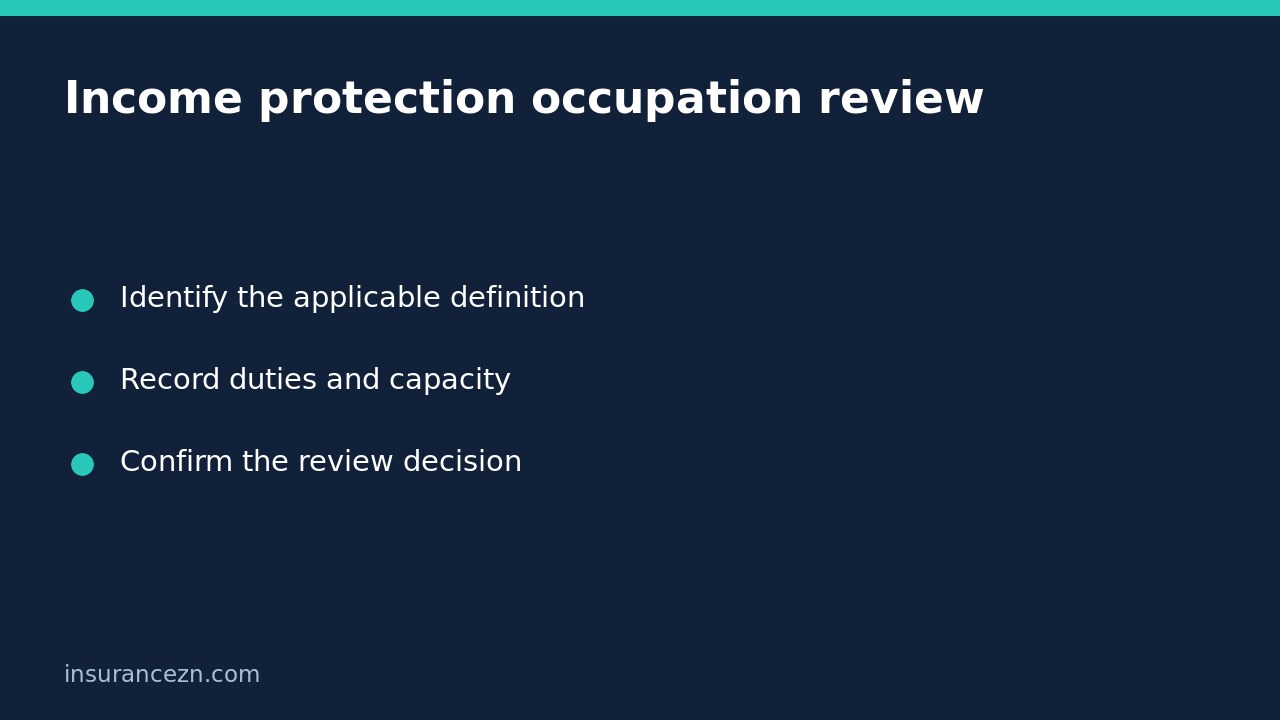
Start with the documents that actually govern your cover, not a current sales page alone. Record the product name, policy commencement details, selected benefit period and any special conditions. Then locate the definitions used for total and partial inability to work, including any change during the claim period.
TAL’s income protection overview provides a useful product-specific contrast. It describes IP Focus as using an Own Occupation definition throughout the selected benefit period. For IP Extend, it describes Own Occupation in the first 24 months of a claim and Any Occupation after that. The longer possible duration under Extend therefore must not be read as a promise to pay whenever the person remains unable to do their previous job.
TAL explains that its Any Occupation assessment considers work experience, training, education and transferable skills. Its detailed definition also addresses suitable alternate occupations requiring specified upskilling and says availability of employment is not the deciding factor. Read the full definition applicable to your contract rather than assuming that not finding a vacancy proves inability to work.
Prepare evidence about duties, not just a job title
Ask the claims consultant which definition will apply at the next review and the exact date the insurer expects it to change. Ask how the claim period is calculated and whether any earlier payments affect that calculation. Do not substitute your own calendar anniversary for the insurer’s confirmed assessment date.
Prepare a factual work-capacity summary with your treating practitioner where appropriate. Useful information may include:
- The actual duties you performed before disability, including physical and cognitive demands.
- Qualifications, previous roles and transferable skills relevant to the assessment.
- Current functional restrictions, treatment and expected changes in capacity.
- Any reduced duties, hours or earnings, accurately described rather than rounded into an assumption of full recovery.
- Documents the insurer has specifically requested and the date each was supplied.
A medical diagnosis and inability to return to one former role do not, by themselves, resolve every contractual test. Equally, an insurer requesting information is not a final decision that benefits will stop. Keep evidence receipt, review progress and the actual entitlement decision distinct.
Separate total-benefit and partial-benefit decisions
Consider a hypothetical worker who still cannot perform their previous physically demanding duties but may have capacity for another role. Under a contract with a changing occupation definition, the assessment after the change may differ from the earlier assessment. That does not establish the outcome for this worker: the exact definition, medical evidence and other terms remain essential.
TAL’s overview expressly distinguishes eligibility for its Totally Unable to Work Benefit from possible eligibility for its Partially Unable to Work Benefit after the occupation change. Ask which benefit the insurer is considering, what further evidence is required and how any work or earnings affect the calculation. Do not assume partial benefits are automatic or equal the full insured monthly amount.
Request a written explanation identifying the relevant clauses, evidence considered, effective date and proposed payment consequences. If something is factually wrong, identify the specific error and provide supporting records under the existing claim reference. Ask about the insurer’s review or complaint process if the explanation remains unclear.
Update the budget only when the payment position is clear
Keep a separate record of the benefit period remaining, ongoing eligibility and the amount actually assessed. A long end date on a schedule is not a confirmed stream of deposits. For the separate issue of payment timing, see our guide to why the waiting period is not the bank-payment date.
Questions before the review
Does every policy change its test after two years? No universal change should be inferred from the TAL example. Check your own contract.
Does sending an updated report confirm continued payment? No. Ask whether the report has been reviewed and obtain the actual decision.
Should I stop treatment or change work plans to fit a definition? Do not alter clinical care for insurance administration. Discuss safe capacity with your treating practitioner and give the insurer accurate information.