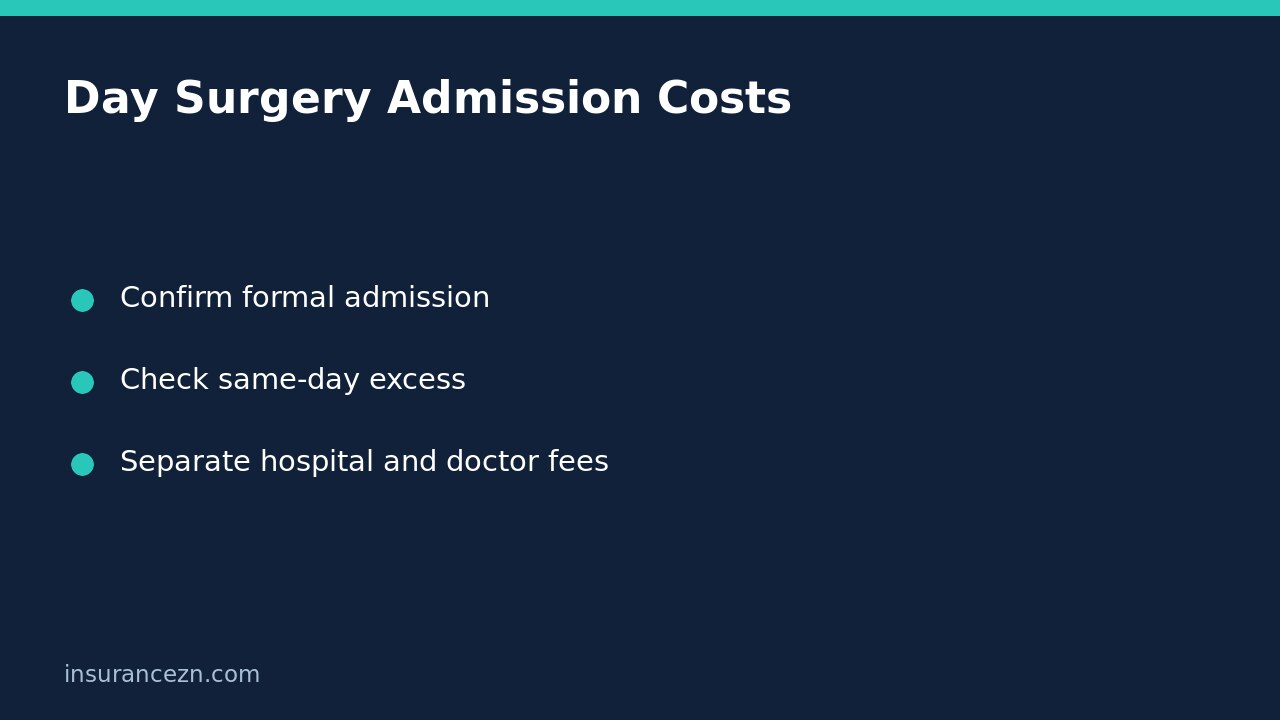

Going home on the day of an operation does not automatically make you an outpatient or remove your hospital excess. For a planned day procedure, confirm whether you will be formally admitted and then ask the health fund which same-day excess rule applies to your exact policy. The length of the visit alone does not tell you the benefit or personal cost.
This is general information for Australian readers, not personal financial advice. Cover depends on your policy, applicable PDS or fund rules, exclusions, restrictions, waiting periods and actual treatment. Cost checks are not medical advice; never delay urgent care for insurance paperwork.
Understand the same-day admission definition
The Australian Government’s private health insurance glossary defines a same-day patient as someone admitted, treated and discharged on the same day. It also defines an inpatient as a person formally admitted to a hospital or day facility. An overnight bed is therefore not the defining feature of every admission.
Ask the facility to confirm the administrative status of your booked procedure. Do not decide from the words clinic, hospital or day centre on the appointment letter. A consultation at a hospital is not automatically an admission, while a short procedure at a day facility can be one. Confirm the actual service and status rather than relabelling an account yourself.
Ask for the policy’s day-surgery excess rule
The glossary explains that the excess can depend on the type of hospitalisation. A policy may apply a different amount to day surgery and overnight treatment, but that is not a universal entitlement to a reduced excess. Another policy may apply the same excess to both. Only the rule for your product can settle the question.
Give the fund your membership number, patient details, facility, procedure information and planned date. Ask for a written explanation addressing:
- What excess applies to this same-day admission?
- Does an earlier admission or payment affect the amount due?
- Is a co-payment or another hospital patient charge also relevant?
- Who collects the excess, and when is payment expected?
- Would an unexpected overnight stay change the calculation?
Do not assume that an excess described as annual, per person or per admission means the same thing across products. Ask the fund to identify which prior payments it has actually counted. A bank receipt is evidence of a payment, not proof that the insurer’s excess record has been reconciled.
Keep the facility’s charges separate from doctors’ fees
The government’s out-of-pocket costs guidance distinguishes hospital charges from the medical fees of treating practitioners. A same-day admission can involve theatre and other facility charges as well as separate bills from a surgeon, anaesthetist or another provider. Leaving without an overnight stay does not erase those components.
Ask the facility for its written estimate and confirm its agreement status with your fund. Obtain estimates from separately billing doctors and ask whether each will use the fund’s gap arrangement for this episode. A facility agreement does not confirm every doctor’s fee, and paying an excess does not settle all accounts. Our explanation of why an agreement hospital does not mean no gap covers that separate issue.
Build a same-day and overnight contingency record
Imagine a hypothetical patient, Jordan, whose booking letter expects discharge that afternoon. Jordan records the fund’s confirmed same-day excess, the hospital estimate and each doctor’s estimated patient balance in separate entries. Unknown benefits remain marked unknown rather than being treated as zero-cost care.
Jordan also asks what administrative and financial checks would be needed if clinical circumstances required an overnight stay or a transfer. This does not predict that either will occur or that another excess will necessarily apply. It identifies who can explain the actual revised episode if the original assumptions change.
After treatment, keep the admission and discharge details alongside itemised accounts and assessments. If the hospital requests an amount different from the estimate, ask which status, service or policy rule changed. Request reconciliation with the insurer before assuming the charge is either correct or duplicated. Do not request inaccurate billing descriptions to obtain a different benefit.
Quick questions before the appointment
Does same-day mean no excess? No. Confirm the policy-specific amount and any prior-payment credit.
Does formal admission guarantee cover? No. The treatment must still meet the product’s eligibility and benefit rules.
Is the booking confirmation a final cost approval? No. Keep the facility’s booking, the insurer’s benefit advice and the doctors’ estimates distinct, and clarify outstanding conditions before relying on them for a planned admission.