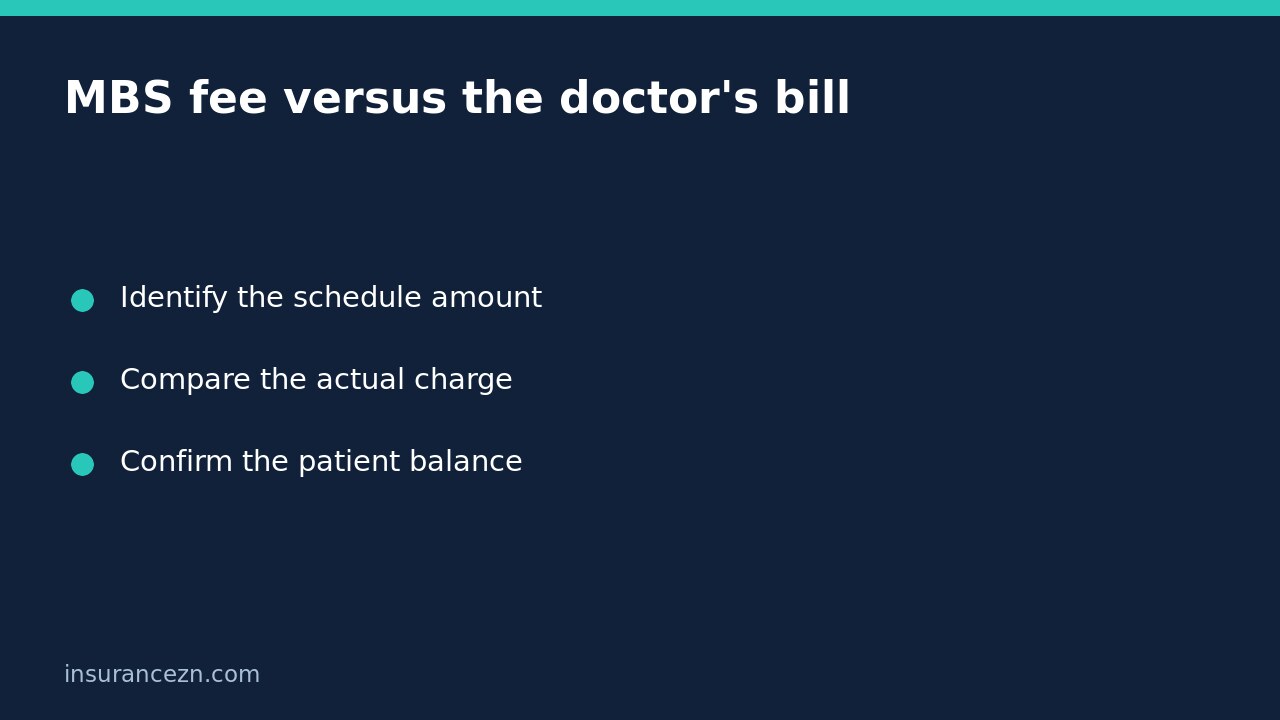

A statement that benefits add up to 100% of the Medicare Benefits Schedule (MBS) fee does not mean the whole invoice will be paid. The percentage applies to a schedule amount, not necessarily the doctor’s actual charge. Before planned private hospital treatment, ask which amount the percentage uses and reconcile the resulting benefit with the written fee estimate.
This is general information for Australian readers, not personal financial advice. Your policy, applicable PDS or fund rules, treatment eligibility, exclusions and waiting periods determine benefits. The example below is hypothetical and does not quote a current MBS item, provider fee or personal entitlement.
Identify the denominator behind the percentage
The Australian Government’s out-of-pocket costs guidance explains the usual eligible private inpatient arrangement: Medicare pays 75% of the MBS fee and the insurer pays the additional 25%, provided you are eligible for those items under your policy. Those percentages refer to the same schedule amount.
The guidance also explains that doctors can charge above that amount. Adding 75% and 25% therefore reaches the full schedule fee, not automatically the full price selected by the practitioner. Do not read a benefit statement’s percentage without checking the dollar figure to which it applies.
This explanation concerns eligible admitted private-patient medical services. Do not transfer it to an outpatient consultation, a hospital accommodation account or an extras service. A hospital appointment is not necessarily an admission, and a service’s location does not establish the billing arrangement.
Work through a deliberately simple invoice
Suppose a fictional eligible inpatient service has a schedule fee of $400 and the doctor’s charge is $650. Assume the standard schedule-based benefits apply, without any additional gap-scheme payment:
- Medicare’s 75% of the $400 schedule fee is $300.
- The insurer’s 25% of that schedule fee is $100.
- The combined schedule-based amount is $400.
- The difference between the $650 charge and $400 in benefits is $250.
In that simplified example, 100% of the schedule fee is paid but $250 remains against the doctor’s charge. It would be wrong to calculate the insurer’s 25% using $650 while calculating Medicare’s share using $400. It would also be wrong to add a second $400 benefit to the combined amount.
Actual assessments can differ because eligibility, item numbers, applicable billing rules and accepted gap arrangements matter. Use the example to understand the denominator, not to predict your claim.
Ask whether a gap arrangement changes the result
A fund’s medical gap arrangement may provide additional benefits, but participation is not automatic for every doctor or episode. The government guidance says doctors can decide case by case whether to use an insurer’s gap arrangement. Ask the practice whether it will use the arrangement for your particular treatment, then check the expected benefit and patient amount with the insurer.
Get an estimate from each separately billing practitioner, including an anaesthetist or assistant surgeon where relevant. One doctor’s answer does not confirm another doctor’s fees. Similarly, a hospital agreement concerns a different part of the cost picture; see why an agreement hospital does not mean every bill is gap-free.
Turn a percentage explanation into a usable estimate
Ask the practice for the proposed item numbers, total charge, expected patient contribution and any conditions on the estimate. Give the insurer the same treatment details and ask it to explain the benefit in dollars. If the practice and fund use different figures, request clarification before assuming either estimate is final.
Make one row for each medical account, with columns for the actual quoted charge, the relevant schedule amount, expected Medicare benefit, expected insurer benefit and patient balance. Mark an unconfirmed benefit as unknown, not zero and not guaranteed. Keep hospital charges, excesses and co-payments in separate rows so they are neither omitted nor counted twice.
Quick checks before relying on the number
Does an MBS item guarantee full insurance payment? No. An item number helps identify the service; eligibility and the actual charge still need checking.
Does a quote guarantee the final assessment? No. Retain the dated estimate and ask what changes could affect it. If the eventual account differs, compare the service details and assessment rather than assuming a percentage was applied incorrectly.
What about urgent treatment? Do not delay necessary care for billing calculations. Ask for cost information as soon as practicable and seek help from the hospital, practice or insurer with unresolved financial questions.