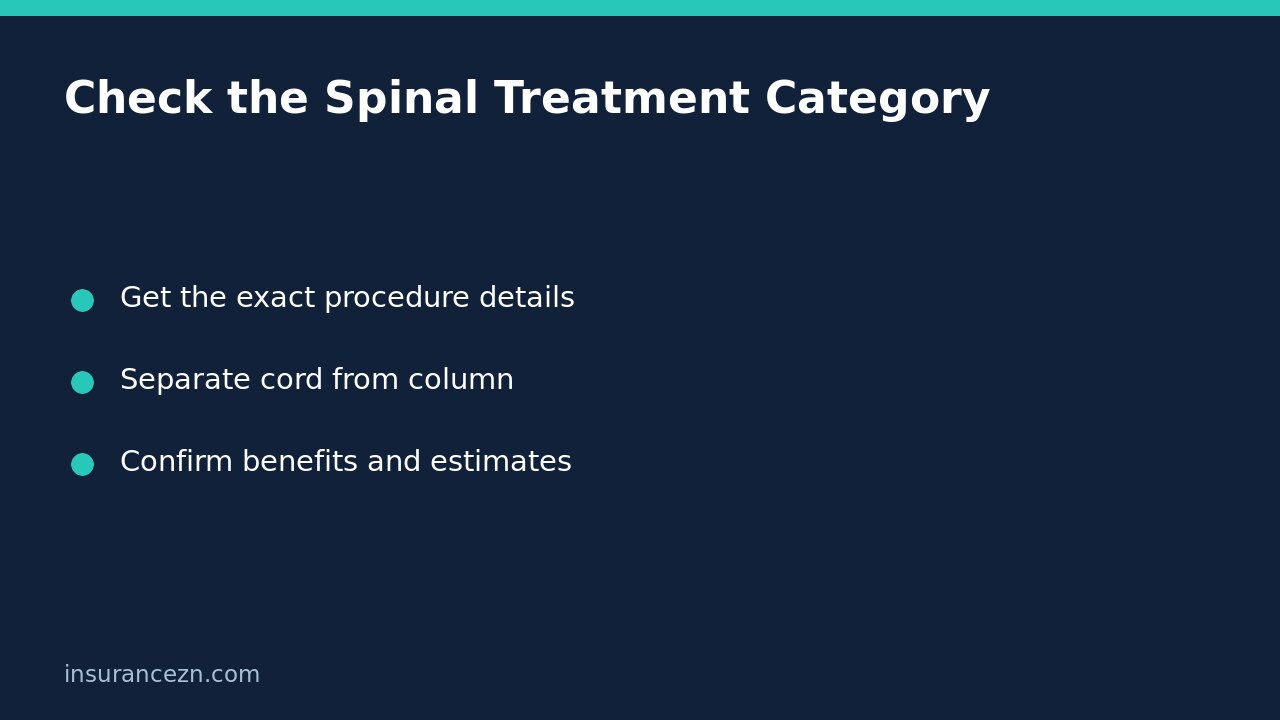

A hospital policy’s back, neck and spine category does not mean every treatment involving the spine falls within it. Australia’s clinical category descriptions distinguish the spinal column from the spinal cord. Before a planned admission, obtain the actual procedure details and ask your insurer which category applies to that treatment.
This distinction is about insurance classification, not diagnosing symptoms. Do not decide whether you have a cord or column condition from pain location or an internet description. Your treating team should explain the diagnosis and proposed care. Never delay urgent assessment or treatment while sorting out insurance paperwork.
Read the cord-versus-column distinction
The Australian Government’s clinical categories reference describes back, neck and spine as hospital investigation and treatment of the back, neck and spinal column, including spinal fusion. It gives examples such as sciatica, herniated discs and spinal curvature disorders. It explicitly lists spinal cord conditions separately under brain and nervous system.
The brain and nervous system category describes hospital investigation and treatment of the brain, brain-related conditions, spinal cord and peripheral nervous system. Its examples include brain or spinal cord tumours, head injuries, epilepsy, stroke and Parkinson’s disease. It directs spinal column conditions to back, neck and spine instead.
These descriptions explain why an everyday phrase such as spinal treatment is too broad for a reliable cover enquiry. Neither the location of a scan nor the specialty on an appointment letter identifies all the insurance benefits relevant to an admission.
Get procedure-level information from the treating practice
Ask the specialist’s rooms for a written description of the proposed operation or investigation, any expected Medicare Benefits Schedule item numbers, the proposed hospital and the admission arrangements. If the plan contains several procedures, obtain details for each. Ask how the practice will notify you if those details change.
You can then ask the insurer: Which clinical category applies to these proposed services, and is it included, restricted or excluded on my exact product? Give the fund the procedure information rather than simply asking whether back surgery is covered. Request a dated response or enquiry reference and keep it with the treatment estimate.
- Record the policy and product name currently held.
- List the actual procedure descriptions and available item numbers.
- Identify the proposed hospital and date.
- Ask about applicable waiting periods and restrictions.
- Request clarification of any service the fund cannot classify from the supplied information.
Use a hypothetical change of treatment to test the enquiry
Suppose a person initially discusses a spinal fusion with their specialist. Spinal fusion is specifically mentioned in the government’s back, neck and spine description. That is a useful starting point for the insurance enquiry, not confirmation of payment for the individual admission.
Now suppose further investigation leads the treating team to propose treatment for a spinal cord tumour instead. The official description lists spinal cord tumours under brain and nervous system. The earlier answer about fusion should not be reused as approval of the new treatment. Send the revised procedure details to the insurer and request a fresh response.
The example does not suggest a likely medical progression or recommend a treatment. It demonstrates the administrative risk of keeping an old cover answer after the clinical plan changes. Even within one anatomical region, the reader task is to reconcile the proposed care with the correct category, not choose a category first and fit the diagnosis to it.
Pain management can raise another category question
The same government reference lists pain management separately from back, neck and spine. It also distinguishes pain management without insertion or surgical management of a device from pain management with a device, such as an infusion pump or neurostimulator.
If a proposed plan includes a pain procedure or device, ask the practice and fund whether that service needs checking under another category. Do not assume a device is covered because the underlying pain affects the back. Likewise, do not infer that every component of a combined admission follows the category assigned to its main operation.
Confirm the financial estimate after classification
A category answer is not a final itemised bill or a promise of no out-of-pocket costs. Ask the fund to explain the benefits and conditions applying to the proposed admission, including any restrictions, excess or co-payment and hospital arrangements. Obtain separate practitioner estimates and ask which charges the hospital estimate does and does not include.
If considering an upgrade, ask when the relevant higher benefits would become available before relying on them. Do not cancel existing cover solely because a new product name sounds more comprehensive. For a related example of why anatomical shorthand is unsafe, read our explanation of the eye-versus-cataracts category boundary.
Short questions to keep with your notes
Does back cover automatically include spinal cord treatment? No. The official descriptions place spinal cord conditions under brain and nervous system.
Is an item number alone final benefit approval? No. Give the fund the full admission details and ask what further information or conditions apply.
What if the specialist changes the procedure? Preserve the earlier estimate, obtain the revised plan and repeat the benefit enquiry rather than assuming the original answer carries over.
This is general information for Australian readers, not personal financial advice. It is not medical advice. Benefits depend on your exact policy/PDS and fund rules, category inclusion, restrictions, exclusions, waiting periods and assessment of the actual services. Ask the treating team about care and the insurer about benefits; no example guarantees payment.