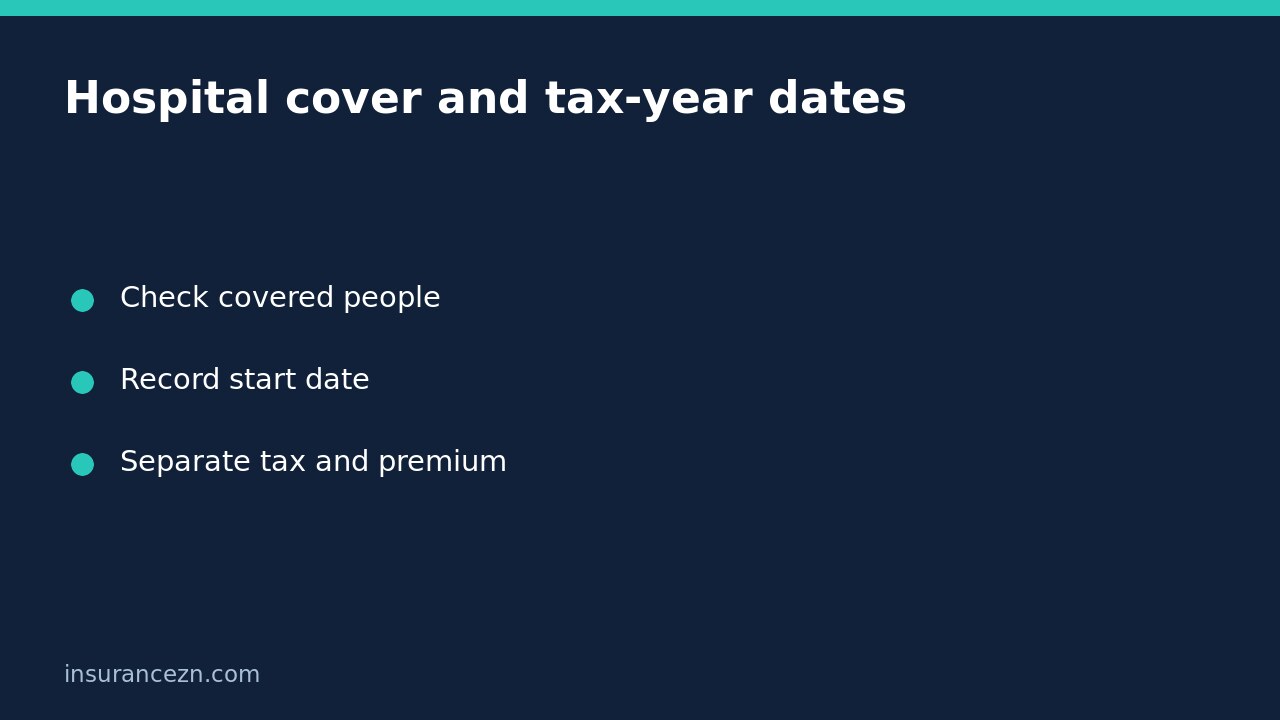

Buying Australian private hospital insurance partway through a financial year does not automatically remove Medicare Levy Surcharge liability for earlier uninsured days. Before accepting a premium on the assumption that it will eliminate your whole year’s surcharge, separate three questions: what cover you are buying, when the relevant people become covered, and how your tax position is assessed.
This is general information for Australian readers, not personal financial advice. Cover and claims depend on the policy, its terms and applicable PDS or other policy documents. Obtain tax guidance for your circumstances rather than treating an insurance quote as a tax calculation.
Understand what the premium actually buys
A premium is the price of insurance. The Medicare Levy Surcharge is a separate tax measure. The Australian Government’s PrivateHealth.gov.au explains that holding hospital cover for part of the year provides only a partial exemption from the surcharge, with uninsured days remaining relevant. It also distinguishes the surcharge from the ordinary Medicare levy.
A salesperson’s annual premium figure therefore does not tell you your final tax outcome. Nor does buying extras-only cover provide the hospital-cover exemption. The government page lists general treatment without hospital cover among the types that do not provide an exemption.
Start with your actual healthcare requirements. A policy bought mainly for a tax consideration may still have exclusions, restrictions, waiting periods and out-of-pocket costs. A tax-related reason for purchasing it is not evidence that an upcoming procedure will be paid.
Build a dated coverage record before comparing costs
- Identify the relevant Australian financial year, rather than using a calendar-year budget.
- List each person whose coverage may matter to your surcharge position. Tax definitions of dependants require separate checking; do not assume they match every insurer’s membership definition.
- Record existing hospital-cover dates, any cancellation or suspension, and the proposed new policy commencement.
- Ask the insurer to confirm the exact product’s suitability for surcharge purposes, including the applicable excess arrangements.
- Keep the accepted commencement confirmation and subsequent insurance tax information. A submitted application or paid quote alone is not the complete coverage record.
If income or household circumstances changed during the year, take that dated information to the ATO or a registered tax agent. An online quote cannot resolve all those changes simply by displaying an annual price.
Use two separate columns in your budget
Consider a hypothetical person taking out hospital cover after several months without it. Their worksheet should have an insurance column showing the actual premiums payable from commencement, and a tax-review column recording the earlier uninsured period for assessment. Do not put zero in the tax column merely because the policy is active by the end of the financial year.
Request the actual amount due now, subsequent debit dates and any quoted rebate assumption. An annualised premium is useful for comparing ongoing costs, but it need not equal the cash paid in the remaining part of this year. Keep those measures labelled separately.
The rebate upfront versus at tax time cash-flow comparison explains another separate decision. A rebate applied to premiums and an exemption from the surcharge are not interchangeable entries in your budget.
Check suspensions and family coverage separately
PrivateHealth.gov.au says that temporarily suspended hospital cover does not provide surcharge exemption for the suspended days. Do not treat continuous membership history as proof that every day was actively covered for this purpose. Other tax exemptions can depend on personal circumstances and require their own assessment.
The government guidance also explains that relevant family members need hospital cover where the family surcharge rules apply. One adult buying a policy is not enough evidence that the whole household’s position has been addressed. Check the people and dates rather than relying on the word family in a quote.
Questions to resolve before accepting the quote
- Is this hospital cover, not just extras or another insurance product?
- Who is included, and from what accepted date?
- What amount will actually be debited, and which rebate assumption is included?
- What uninsured or suspended periods must still be considered at tax time?
- What restrictions, waiting periods and potential medical gaps remain?
Does buying now fix earlier uninsured days? Do not assume so: the government’s part-year guidance expressly keeps those days relevant. Does tax suitability mean treatment is immediately covered? No. Obtain a separate service-specific benefit check before planned treatment, and never delay urgent care for insurance administration.
Source
PrivateHealth.gov.au: Medicare Levy Surcharge explains part-year cover, suspension, dependants and qualifying hospital insurance. Check the applicable financial year’s rules and your personal position before calculating an amount.