
A vaccination certificate can be necessary for a journey without proving that your travel insurer will cover an illness, cancellation or denied boarding. Conversely, buying travel insurance does not supply missing health-entry documents. Australian travellers should check entry requirements, clinical advice and policy conditions separately, then bring the answers together in a practical departure file.
This is general information for Australian readers, not personal financial advice. Insurance benefits depend on the policy, PDS, exclusions and your circumstances. This article is not medical advice; ask a qualified healthcare professional about vaccination suitability and timing.
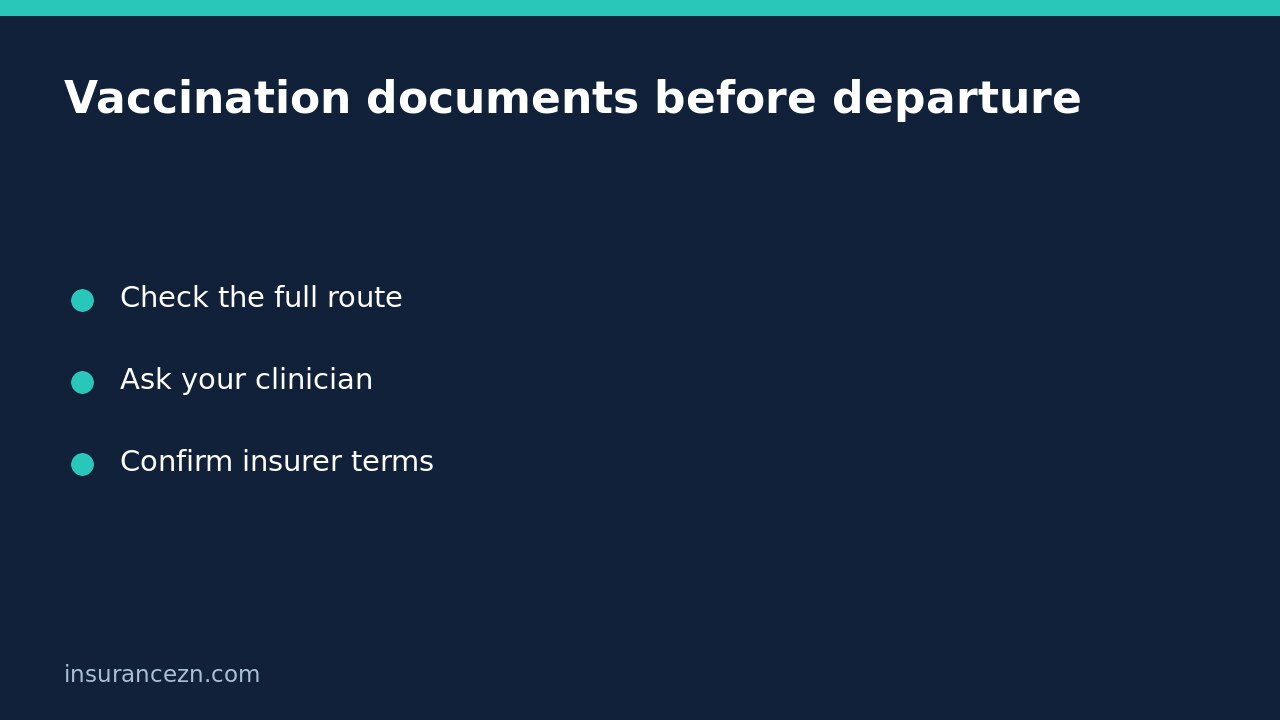
Start with the route, not just the holiday destination
Smartraveller’s infectious-disease guidance explains that proof-of-vaccination rules vary between countries and directs travellers to the destination’s embassy or consulate in Australia. It gives yellow fever as an example: certificate requirements can depend on arrival from, transit through or recent presence in an affected area. An airline may prevent boarding without the required certificate.
Write down every country on the itinerary, including transit stops and a later side trip. Record the intended dates and any recent travel that authorities ask about. A certificate check for the final destination alone may not answer the question created by the whole route.
Use current official destination and consular information for the actual itinerary. Do not convert the existence of a yellow fever rule somewhere into a claim that every country, airport transfer or passenger faces that rule.
Ask the clinician about health, timing and the right record
Smartraveller recommends discussing travel vaccines and routine boosters with a doctor, and notes that some vaccines take time to work or need several doses. Arrange this conversation early enough to consider your itinerary and medical circumstances. A travel booking confirmation does not establish that a vaccine is suitable for you.
For yellow fever, the guidance specifically refers travellers to an approved clinic and the international vaccination certificate. Confirm the applicable timing and documentation with the clinic and relevant authorities. Do not assume a pharmacy receipt, appointment reminder or generic screenshot is the required international certificate.
If a clinician says a vaccine is unsuitable, ask what clinical documentation can be provided. Then ask the relevant destination authority and airline how they treat that documentation. A medical letter is not automatically an accepted entry exemption, and an insurance purchase cannot create one.
Read the insurance questions as a separate task
Find the relevant sections of your PDS on medical expenses, cancellation, exclusions and any health-related duties. Ask the insurer a precise question that identifies the destination, dates, proposed travel and relevant circumstances. Do not assume that the government’s general health advice describes your insurer’s contractual rules.
For example, ask which provisions would apply if you lacked a required entry certificate, rather than simply asking whether you have medical cover. If the insurer needs further information or an accepted policy amendment, keep that request separate from a generic customer-service acknowledgement.
A vaccination record is evidence of a health intervention. It does not prove that an illness claim will be accepted. Equally, a vaccination appointment invoice does not establish reimbursement under travel insurance. Obtain an answer about the specific benefit instead of treating all health-related expenses as one category.
Build a document file that shows what was actually confirmed
- Save the complete itinerary and the official entry information checked for it.
- Keep the required certificate in the form specified by the relevant authorities, plus a secure backup where appropriate.
- Record clinical advice and appointment details without putting unnecessary medical information into a shared itinerary.
- Keep insurer responses with the policy number, PDS version and question asked.
- Record unresolved requirements explicitly rather than marking them completed when an enquiry has merely been sent.
For a hypothetical journey with a new transit country added after booking, repeat the route-specific entry check, review health advice with your clinician where needed, and check any policy implications with the insurer. The old document pack may no longer answer the revised itinerary. Our travel insurance transit-stop checklist helps organise that route review.
Quick questions before departure
Does having the certificate guarantee boarding? No. It addresses a particular requirement; airlines and border authorities may have other checks. Does the insurer’s email replace an entry document? No. Insurance acceptance and government entry permission are different decisions.
What if I become unwell overseas? Seek appropriate medical care promptly and follow emergency guidance. Contact the insurer’s assistance service when practical, but never delay urgent treatment while searching for paperwork or waiting for an insurance response.
Authoritative source
Smartraveller: Avoiding infectious disease covers travel vaccination planning, proof requirements and yellow fever certificates. Use its links and the relevant authorities to check your current itinerary rather than relying on another traveller’s experience.