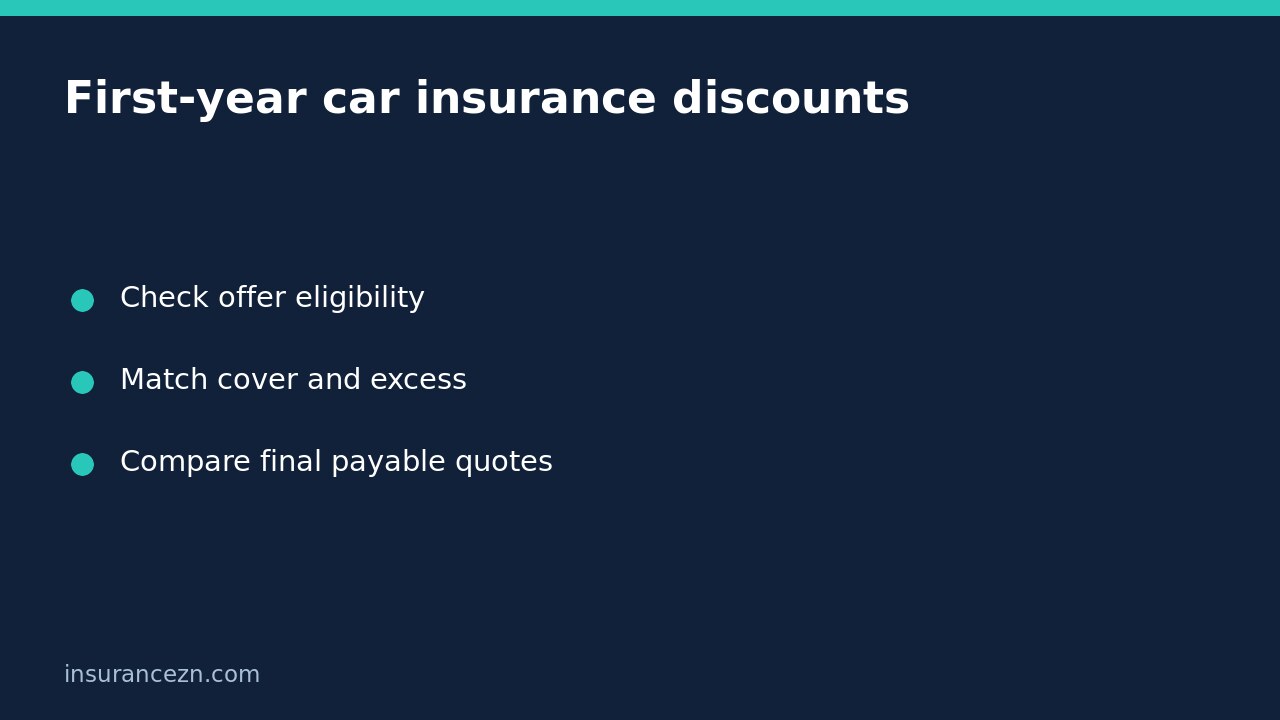

A first-year online car insurance discount is a condition attached to a quote, not proof that the policy is cheaper than another insurer’s offer. Compare the final payable premium for the same vehicle, drivers, dates, cover and excess. Then check whether the offer applies to your purchase channel and whether it continues after the first year.
This is general information for Australian readers, not personal financial advice. Cover depends on the applicable Product Disclosure Statement (PDS), certificate, exclusions and accepted amendments. An advertised discount does not establish suitability, claim entitlement or future renewal pricing.
Separate the advertised saving from the actual price
A discount describes a reduction from the insurer’s own pricing basis. It does not reveal what another insurer would charge for equivalent cover. Nor does a percentage or dollar headline tell you whether taxes, charges or optional benefits are included in the displayed amount.
For a concrete provider example, Suncorp’s car insurance page describes online discounts on the first year’s premium for new customers who apply and buy online. Its notes say subsequent discounts are applied to the already discounted premium, before government taxes and charges. Those are Suncorp-specific conditions, not a rule for every Australian insurer. Check the offer attached to your own quote rather than assuming the same treatment elsewhere.
Save the quote summary and applicable offer terms together. A promotional banner alone may omit the eligibility details you need to explain the final price.
Build a matched quote before comparing discounts
Use one written specification for every quote. Record the vehicle variant, drivers, actual use, usual parking location, insurance period and payment frequency. Answer each insurer’s questions accurately; changing an answer simply to unlock a lower price undermines the comparison.
- Keep the cover type consistent: comprehensive and third party property damage are not interchangeable.
- Match the insured-value basis and any specified amount as closely as the products allow.
- Compare the standard excess and identify additional driver-related excesses.
- Record optional glass, hire-car and roadside benefits separately.
- Use the total payable for the same period, not one monthly instalment against an annual amount.
Suncorp’s page distinguishes multiple comprehensive levels and optional benefits. That matters because selecting a different level can change what is included, even when both quotes carry an online-discount label. Ask the insurer to identify material differences that prevent a like-for-like comparison.
Check whether you actually qualify
Read who must apply, where the purchase must be completed, which products qualify and which policy period receives the discount. Ask what happens if an online quote needs staff assistance before purchase. Do not assume a saved quote, telephone enquiry or existing customer login automatically satisfies an online-purchase condition.
If two offers appear relevant, ask whether they can be combined and how the insurer calculates the reduction. Do not add advertised percentages yourself or subtract a headline saving again from a price that already includes it. Request the payable amount with the eligible offer applied, including the selected options and applicable charges.
Use a comparison record with no invented renewal price
For each shortlisted policy, write down the quote reference, expiry date, cover specification, total payable, discount conditions and unanswered questions. Mark any first-year-only offer clearly. This is a record of the current purchase decision, not a forecast of next year’s premium.
Ask whether the discount ends at renewal and where that condition appears. Even if an insurer explains the discount’s duration, that does not establish next year’s underlying price. Avoid a two-year cost projection that assumes unchanged premiums or simply adds the advertised saving back to today’s total.
Keep a discount comparison separate from changes to insured value. Our guide to comparing car insurance renewal quotes without losing agreed value explains another important comparison boundary: a lower price may accompany a different insured amount rather than represent the same protection for less.
Questions before you accept the quote
Does the largest discount mean the lowest price? No. Compare final matched quotes and the protection each buys, not the headline reduction.
Will the discount appear again next year? Confirm the offer’s duration, but treat any future renewal premium as unknown until quoted.
What should I keep after purchase? Save the accepted quote, offer terms, payment confirmation and issued certificate. Check that the processed policy shows the agreed drivers, options, excess and dates. A payment receipt alone does not resolve a mismatch in the insurance documents.