
Navigating the complex landscape of health insurance can feel like deciphering a foreign language. For most policyholders, the fine print regarding cost-sharing mechanisms often goes unread until a medical emergency occurs or a chronic condition requires ongoing management. This confusion can lead to unexpected financial burdens at the pharmacy counter or the doctor’s office. To truly understand your coverage and protect your finances, you must grasp three fundamental concepts: deductibles, copays, and out-of-pocket maximums. These terms dictate exactly how much of a medical bill you pay versus what your insurance company covers.
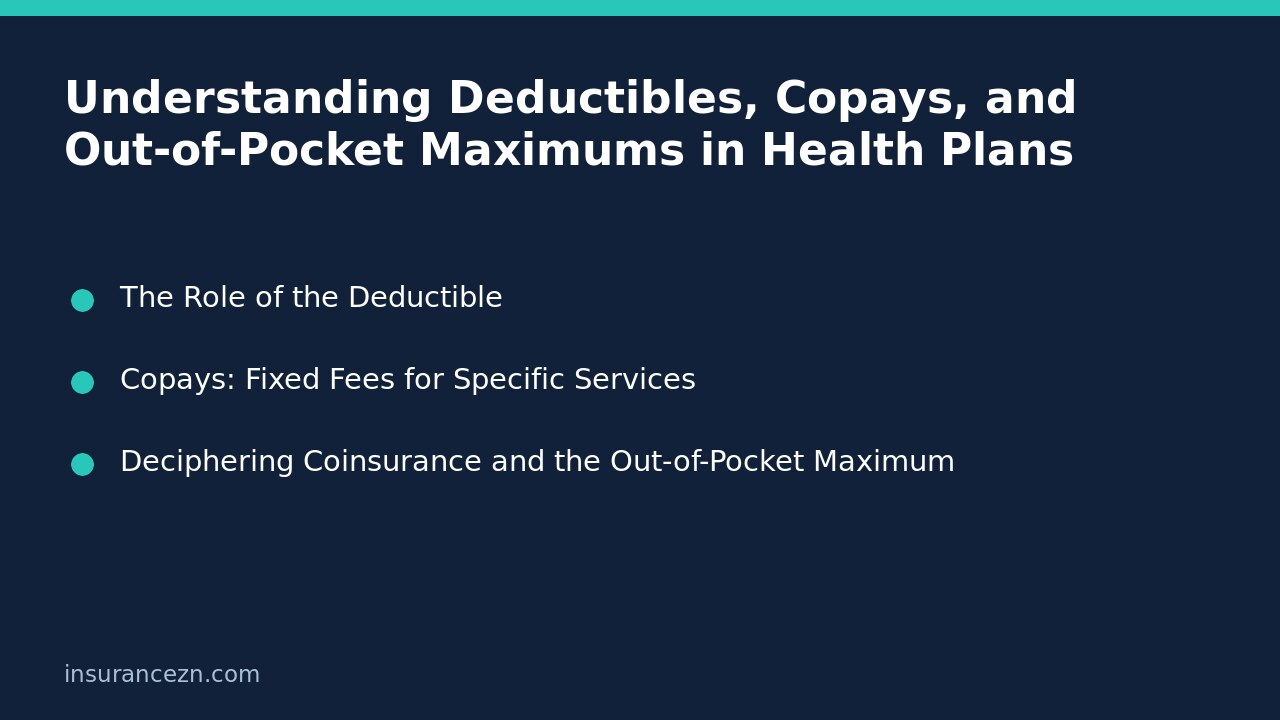
The Role of the Deductible
A deductible is the specific amount of money you must pay for covered healthcare services before your insurance plan starts to pay its share. Think of it as an annual savings account that you build up by paying for your own care until you hit a target number defined in your policy. Once you reach this threshold, your insurance begins to cover a portion or all of the costs for subsequent services, depending on whether they require coinsurance.
It is crucial to understand that not all medical expenses count toward your deductible. Typically, preventive care services recommended by the U.S. Preventive Services Task Force—such as annual physicals, vaccinations, and cancer screenings—are covered at 100% by insurance plans under the Affordable Care Act (ACA) and do not require you to meet your deductible first. However, routine visits to a primary care physician for non-preventive issues, specialist consultations, lab work, hospital stays, and prescription drugs usually do count toward your deductible.
Copays: Fixed Fees for Specific Services
While the deductible represents a threshold of spending, copayments (or copays) are fixed amounts you pay for specific services or prescriptions at the time of service. These fees are distinct from deductibles because they often apply regardless of whether you have met your deductible yet. For example, if your plan specifies a $20 copay for a primary care visit, you pay that $20 immediately when you see the doctor. Your insurance company then pays the remainder of the allowed amount for that visit.
Copays are most commonly associated with office visits to specialists, emergency room visits, and urgent care centers. They also frequently apply to prescription medications. A common structure might be a $10 copay for generic drugs and a $30 copay for brand-name drugs. Unlike deductibles, which can accumulate over the course of a year, copays are paid per encounter. You could theoretically pay dozens of copays in a single year, but these payments usually do not count toward your out-of-pocket maximum, although this can vary by specific plan design.
Deciphering Coinsurance and the Out-of-Pocket Maximum
Once you have satisfied your deductible, many health plans shift to a coinsurance model. Coinsurance is a percentage split of costs between you and your insurer. For instance, if your plan has an 80/20 coinsurance ratio after the deductible is met, you pay 20% of the cost of covered services, and the insurance company pays the remaining 80%. This continues until you hit your out-of-pocket maximum.
The out-of-pocket maximum is the most critical safety net in any health insurance policy. It represents the absolute limit on how much you will have to pay for covered services in a plan year. Once your total spending on deductibles, copays, and coinsurance reaches this cap, your insurance company pays 100% of the cost of covered benefits for the rest of the year. This protection is vital during times of severe illness or injury when medical costs can skyrocket unexpectedly.
However, it is important to note that premiums—the monthly amount you pay just to keep your coverage active—and any costs for services not covered by your plan (like cosmetic surgery or certain experimental treatments) never count toward your out-of-pocket maximum. Additionally, while copays often do not count toward the maximum, some plans may structure them differently, so reviewing your specific Summary of Benefits is essential.
A Real-World Scenario: Calculating Your Annual Costs
To illustrate how these components interact, consider the following hypothetical scenario involving “Patient Alex,” who has a health plan with a $1,500 deductible, a 20% coinsurance ratio, and a $6,000 out-of-pocket maximum.
Alex visits their primary care physician for a check-up that costs $150 in total allowed charges. The plan requires a $30 copay for this visit. Alex pays the $30 immediately. Since this is not a preventive service requiring no deductible, the remaining $120 applies toward Alex’s deductible. Later, Alex needs surgery costing $20,000. After meeting the $1,500 deductible through various visits and procedures earlier in the year, the insurer takes over. With an 80/20 split, Alex pays 20% of the remaining balance. If Alex’s total spending reaches $6,000 before the surgery is fully billed, the insurance company covers the rest of the surgery cost without Alex paying another dime for that procedure. This mechanism ensures that no single patient bears an unmanageable financial burden for medical care in a given year.
Common Mistakes to Avoid When Managing Costs
Many policyholders make preventable errors when managing their health insurance costs. One frequent mistake is assuming that seeing a specialist automatically incurs a copay or that all visits count toward the deductible. Some plans have different rules for in-network versus out-of-network providers; visiting an out-of-network doctor can result in bills that are not subject to the out-of-pocket maximum, potentially leading to catastrophic debt.
Another error is neglecting to track spending. Because deductibles and out-of-pocket maximums reset every calendar year (typically on January 1st), failing to monitor your cumulative costs can leave you surprised when you think you have coverage but actually haven’t met your deductible yet. Always ask the billing department if a service has been applied to your deductible or if it was a copay before leaving the facility.
Final Checklist for Policyholders
To ensure you are maximizing your benefits and avoiding surprise bills, consider keeping this checklist handy:
* Review your Summary of Benefits: Locate your specific deductible amount, coinsurance percentage, and out-of-pocket maximum in your plan documents.
* Verify Network Status: Confirm that every provider you see is listed as “in-network” to ensure costs count toward your maximums.
* Ask About Preventive Care: Utilize annual screenings and vaccinations before the deductible needs to be met for those services.
* Track Your Spending: Use insurer portals or apps to monitor how much of your deductible you have satisfied throughout the year.
* Understand Prescription Tiers: Check if your medications are on a formulary tier that requires a copay rather than meeting the deductible first.
Remember, insurance terms, availability, eligibility, laws, and prices depend heavily on the specific insurer, the policy details, and your jurisdiction. Always consult your specific plan documents for the most accurate information regarding your unique coverage.