
When traveling abroad, the most terrifying scenario is not a minor scratch or a lost passport; it is a sudden medical crisis that requires immediate removal from a remote location. In these high-stakes moments, the difference between life and death often hinges on the speed of the response team rather than just the total dollar limit of coverage. This guide cuts through the marketing noise to explain how emergency medical evacuation works, why response times vary significantly among carriers, and which types of policies are best suited for travelers prioritizing speed over cost savings.
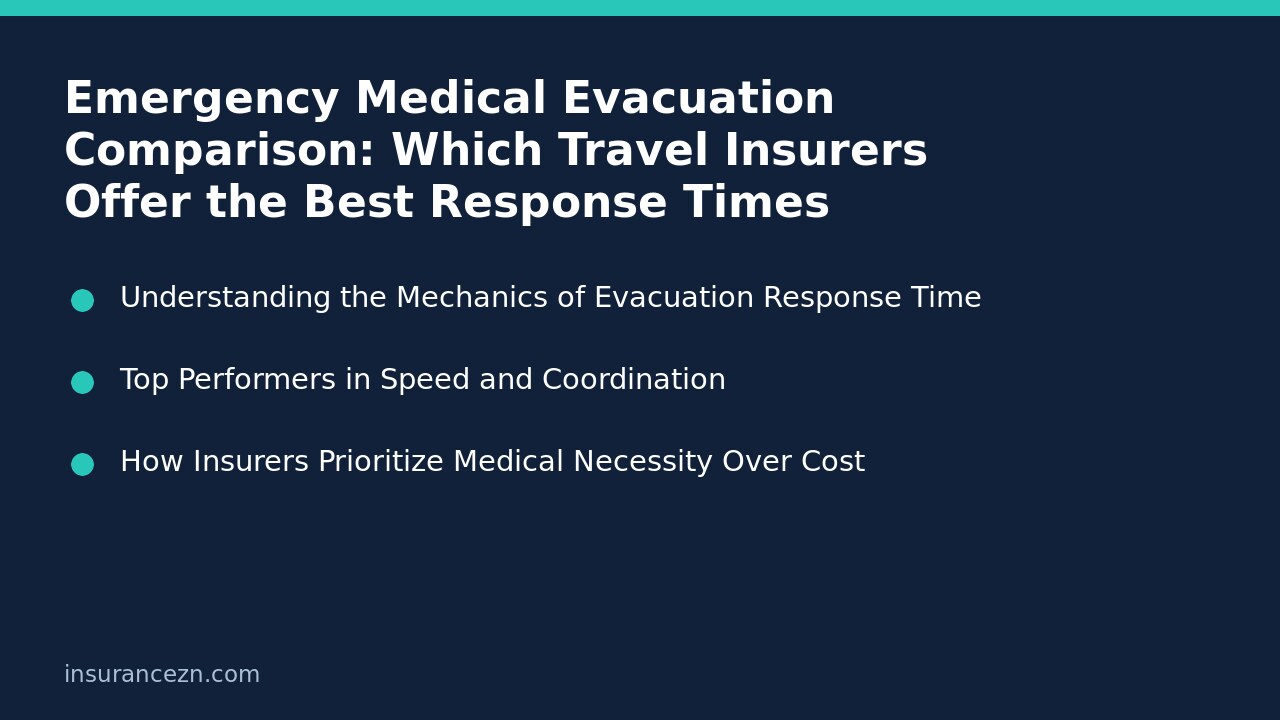
Understanding the Mechanics of Evacuation Response Time
Emergency medical evacuation is a specialized service distinct from standard ambulance transport. It involves coordinating complex logistics, including air ambulances, helicopter extraction, ground vehicles in conflict zones, and repatriation flights to a facility where you can receive appropriate care. The “response time” metric is not merely about how fast an insurer approves a claim; it is about the actual clock starting from the moment of injury until a plane touches down at your location or near your hospital.
Several critical factors dictate these timelines:
* Network Presence: Insurers with local partners in remote areas (such as mountain lodges, cruise ships, or safari camps) can dispatch assets faster than those relying solely on third-party brokers who must locate available providers in a new country.
* Pre-Authorization Speed: The administrative process of verifying coverage and determining medical necessity can delay evacuation by hours if the claims team is understaffed or requires extensive documentation before releasing funds to the operator.
* Asset Availability: Some insurers maintain standing contracts with specific air ambulance firms that guarantee availability 24/7, while others operate on an “as available” basis depending on global capacity.
Top Performers in Speed and Coordination
While specific response times fluctuate based on location and circumstances, certain carriers have established reputations for rapid deployment due to their operational models.
Allianz Care is frequently cited as a benchmark for speed. Their “Global Assistance” network operates 24/7 with local representatives in many countries, allowing them to bypass long-distance communication barriers. They often coordinate directly with local hospitals and air ambulance providers without requiring the traveler to negotiate rates or permissions during a crisis.
AXA Assistance (part of AXA XL) also boasts a robust global network that emphasizes rapid decision-making. Their system is designed to approve pre-determined evacuation scenarios quickly, reducing the time spent on administrative hurdles. When a policyholder contacts them, they typically have established protocols for immediate release of funds to the evacuation operator.
Travelers International and Cigna Global are other entities known for strong operational capabilities. While their public marketing may not always emphasize “speed” as a primary metric, their underlying infrastructure often supports fast deployment because they manage large volumes of complex cases daily. Their teams are trained to make rapid triage decisions regarding medical necessity, which is the primary bottleneck in evacuation scenarios.
It is important to note that “best” can be subjective. A carrier that is fastest in Europe might take longer in Southeast Asia due to different regulatory environments and partner networks. Therefore, travelers should verify the specific network coverage in their destination region rather than relying solely on global brand reputation.
How Insurers Prioritize Medical Necessity Over Cost
A common misconception is that insurance companies delay evacuation to save money or wait for full documentation. In reality, most major insurers have strict guidelines that require immediate action if a condition is deemed life-threatening. However, there is a gray area regarding “expensive” evacuations versus “necessary” ones.
If an insurer determines that a specific type of aircraft (e.g., a chartered wide-body jet) is medically necessary but not cost-effective under their policy limits, they may delay authorization while seeking alternative options. This is where the quality of your pre-trip communication matters. Some policies offer a “concierge” level of service where a dedicated specialist monitors your case before you even leave home, ensuring that all logistics are pre-negotiated.
Conversely, budget-friendly plans often rely on general liability networks. If a situation arises in a region where no partner network exists, the insurer must call in international contractors. This external coordination can add 2 to 4 hours to the response time compared to an insurer with a standing local contract. Always check if the policy includes “expedited claims processing” for emergency situations, as this is often a clause that overrides standard waiting periods.
Real-World Scenario: The Alpine Rescue
To illustrate the practical impact of these differences, consider a hypothetical scenario involving a traveler in the Swiss Alps who suffers a severe fall and requires immediate extraction to a major trauma center in Zurich.
- The Slow Response: A traveler on a budget plan contacts their insurer at 6:00 PM local time. The call goes to an automated menu, followed by a transfer to a general claims department. The representative requests photos of the scene and a detailed doctor’s note before authorizing any flight. By the time this paperwork is processed (a full 12-hour delay), the traveler has deteriorated, and the window for safe helicopter extraction closes due to weather or fuel constraints.
- The Fast Response: A traveler on a premium plan calls their dedicated emergency line at 6:00 PM. The call connects to a live specialist who immediately contacts the local Swiss air ambulance partner. Because the policy has a pre-established contract, the insurer releases funds instantly. The helicopter arrives within 45 minutes of the initial assessment, and the flight is coordinated while the patient is still stabilizing in the clinic.
The outcome in both cases might be the same regarding medical survival if time permits, but the margin for error is significantly wider with the fast-response insurer. In the real world, weather conditions or the severity of an injury can change rapidly; a 12-hour delay can mean the difference between a safe extraction and a fatality.
Checklist for Evaluating Evacuation Coverage
When comparing policies in the “Compare Travel Insurance” section, do not just look at the maximum payout amount (e.g., $500,000 vs. $1,000,000). Use this checklist to evaluate response capabilities:
- Network Location: Does the insurer have a physical office or a local partner in your destination country? Look for mentions of “local representatives” in their FAQ.
- Direct Billing Capability: Will the insurer pay the evacuation provider directly, or will you have to pay upfront and seek reimbursement? Direct payment eliminates the financial stressor during a crisis.
- 24/7 Live Support: Verify that the emergency number connects to a live human being, not just an email form or chatbot. Ask specifically about language availability if traveling to non-English speaking regions.
- Pre-Authorization Policy: Read the fine print regarding how quickly they authorize non-emergency evacuations (e.g., moving from a remote clinic to a better hospital). Delays here can ruin treatment plans.
- Reputation Reviews: Search for independent reviews or news articles regarding specific evacuation incidents in your destination region. An insurer praised for speed in Europe may have no presence in Africa.
Conclusion: Speed is an Intangible Asset
Emergency medical evacuation is an intangible asset that you only hope to use once, but if you need it, you cannot afford to wait. The “best” travel insurance for this specific purpose is not necessarily the cheapest or the one with the highest aggregate limit, but the one with the most robust local network and the fastest administrative approval process.
When comparing options, prioritize carriers that explicitly advertise 24/7 live support and have a documented history of rapid deployment in your intended travel regions. Remember that terms, availability, eligibility, laws, and prices depend on the specific insurer, policy details, and jurisdiction. Always read the full policy wording regarding evacuation definitions before purchasing, as exclusions can vary wildly even among top-tier brands. Your safety depends on choosing a partner who acts quickly when it matters most.