
Submitting a claim for travel insurance can feel overwhelming, especially when an unexpected incident occurs halfway around the world. The difference between a smooth reimbursement and a denied request often lies in the quality and completeness of your documentation. Many travelers mistakenly believe that buying a policy is enough to cover any mishap, failing to realize that insurers require rigorous verification before releasing funds. This article outlines exactly what documents you need to gather before you leave home and immediately after an incident occurs. By understanding these requirements, you can avoid common pitfalls that lead to claim denials or delayed payments.
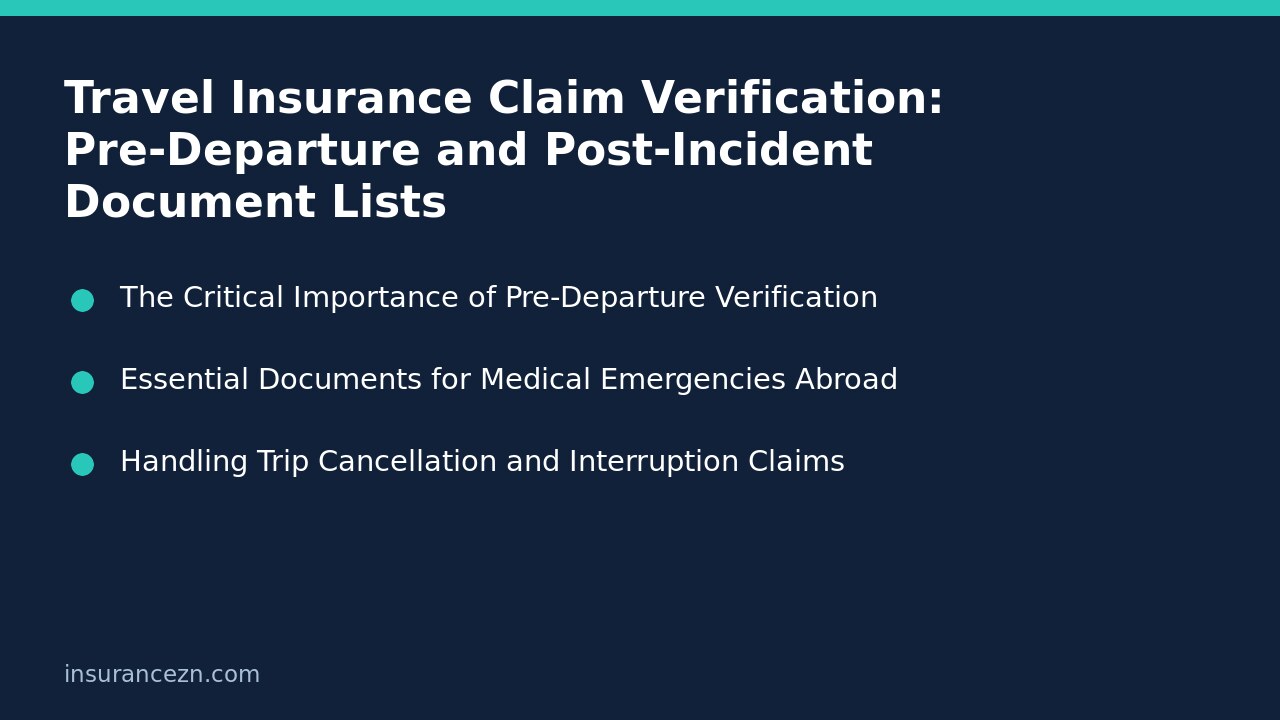
The Critical Importance of Pre-Departure Verification
Before your trip begins, the most effective step you can take is to review your policy’s specific “proof of loss” requirements. Every insurance provider has a unique set of rules regarding what constitutes valid evidence for a claim. Some companies require digital copies uploaded via an app, while others prefer physical originals sent by mail. Ignoring these nuances at the start of your journey is a common mistake.
A frequent error occurs when travelers assume that their home address or phone number on file is sufficient. However, if you are traveling internationally, insurers often require proof of identity that includes your passport details, not just your driver’s license. Similarly, emergency contact information must be updated to reflect local numbers where available. If your policy requires a specific emergency assistance card to be carried at all times, failing to carry it can complicate the initial reporting process.
Consider the scenario of a traveler who books a flight but forgets to download their digital ID or update their emergency contact list. When an accident happens, the lack of immediate access to verified identity documents slows down the entire claim investigation. Insurers prioritize fraud prevention; therefore, they need to be certain that the person reporting the incident is the policyholder. Pre-departure verification ensures that your identity and coverage details are current, streamlining the process when you need it most.
Essential Documents for Medical Emergencies Abroad
Medical emergencies are the most common reason travelers file claims. To verify a medical claim, insurers typically require a comprehensive packet of documents immediately after the incident. The first critical item is a detailed medical report from the treating physician or hospital. This document should not just state the diagnosis; it must include a chronological list of treatments, procedures performed, and dates of admission and discharge.
Next, you will need original itemized bills from every healthcare provider involved. These bills must show the breakdown of costs for medications, surgery, laboratory tests, and room charges. A single lump-sum invoice is often rejected because it lacks the transparency needed to verify that services were actually rendered under your policy. Additionally, if any treatment was paid out-of-pocket by you or a third party, you must provide proof of payment, such as credit card statements or bank transfer receipts.
In many jurisdictions, especially in countries with complex healthcare systems, a “letter of guarantee” from the local hospital is required before they will release you. This letter confirms that medical treatment was completed and that no further care is needed. Without this specific document, insurers may argue that the incident is still ongoing and refuse to pay. It is also crucial to obtain a translation of all medical records if they are not in your home language or English. Most international policies require certified translations for claims processing.
Handling Trip Cancellation and Interruption Claims
If you must cancel or cut short your trip due to a covered reason, such as a family emergency, severe weather, or jury duty, the documentation required differs significantly from medical claims. The cornerstone of these claims is a formal notification letter from the relevant authority. For example, if a family member dies, you need an official death certificate issued by the registrar. If your employer requires you to return home for work, you need a written notice or leave cancellation letter on company letterhead.
Weather-related cancellations require specific proof. A simple photo of rain is rarely sufficient. You generally need an official severe weather warning issued by a national meteorological agency or a news report citing the specific closure of your destination airport or hotel due to the event. The report must clearly link the weather event to your travel dates and location.
Furthermore, you must provide proof that you attempted to minimize the loss. Insurers often look for evidence that you tried to rebook flights or extend your stay if possible before filing a claim. Receipts for non-refundable expenses like airline tickets, hotel bookings, and tour packages are mandatory. These receipts should show the original price paid and the amount refunded (if any). If an expense was not refunded at all, you must provide bank statements showing the charge on your credit card to prove the financial loss.
Managing Lost Baggage and Personal Property Claims
Lost or stolen luggage presents a unique set of documentation challenges. The most immediate step is to report the loss to the airline or transport provider within their specified timeframe, usually 24 hours. You must obtain a Property Irregularity Report (PIR) or a police report for theft. These official reports serve as the primary verification document that your belongings were missing and not simply misplaced.
When claiming for lost personal items like electronics, cameras, or jewelry, you must provide proof of ownership and value. This is often where claims fail. A generic receipt from five years ago may not be accepted if it does not match the specific item lost. Ideally, you should have recent purchase receipts, credit card statements showing the transaction date, or manufacturer warranty cards. For high-value items like jewelry, a pre-trip appraisal or an inventory list kept at home is essential.
If your baggage is delayed rather than lost, airlines often provide temporary essentials. However, if you need to claim for these necessities under your travel insurance, you must keep every single receipt. Insurers will audit these receipts to ensure the items were necessary and within reasonable limits defined by your policy. Do not throw away any packaging or receipts until the claim is fully resolved.
Practical Steps to Accelerate Claim Verification
To ensure your claim is processed quickly, adopt a disciplined approach to document management. Create a dedicated digital folder on your phone or cloud storage labeled with your trip dates and destination. Inside this folder, store scanned copies of your policy, emergency contact numbers, passport copy, credit card statements, and travel itineraries. Take photos of physical documents as soon as you receive them; paper receipts can fade or get lost in luggage.
Immediately after an incident, notify your insurer via their preferred channel—app, website, or phone line. Do not wait until you are back home to start the process. Provide a clear, concise summary of what happened and attach all available documents in the initial submission. Follow up regularly on the status of your claim but avoid being pushy; allow the adjuster time to verify information with third parties like hospitals or airlines.
Real-World Example: The Snowstorm Scenario
Imagine a traveler named Sarah who is skiing in Switzerland when a sudden avalanche closes the resort. Her policy covers trip interruption due to severe weather. Upon returning home, Sarah realizes she does not have the official closure notice from the Swiss Ski Association. She only has a photo of a news article on her phone. Without the official document, her claim is initially rejected. Had she saved the PDF notification sent by the resort management or the local tourism board before leaving, her claim would have been approved immediately. This example highlights that pre-departure preparation and immediate documentation capture are vital for successful verification.
Conclusion
Navigating the world of travel insurance claims requires more than just hope; it demands a strategic approach to documentation. By verifying your details before departure and meticulously gathering specific documents after an incident, you protect yourself from the most common reasons for claim denial. Remember that terms, availability, eligibility, laws, and prices depend on the insurer, policy, and jurisdiction. Always refer to your specific contract for exact requirements. With the right preparation, turning a stressful travel mishap into a resolved financial issue becomes a manageable reality rather than a nightmare.