
Travel plans are notoriously unpredictable. Whether it is a sudden medical emergency, an unexpected family death, or even just a severe change of heart regarding your itinerary, the ability to recover your non-refundable deposits can be the difference between a manageable setback and a financial disaster. This is where travel insurance cancellation coverage comes into play. However, not all cancellation policies are created equal. The primary debate among savvy travelers revolves around choosing between standard trip cancellation coverage and the premium “Cancel for Any Reason” (CFAR) upgrade. Understanding the distinct mechanics, eligibility requirements, and payout limitations of each is essential before purchasing a policy.
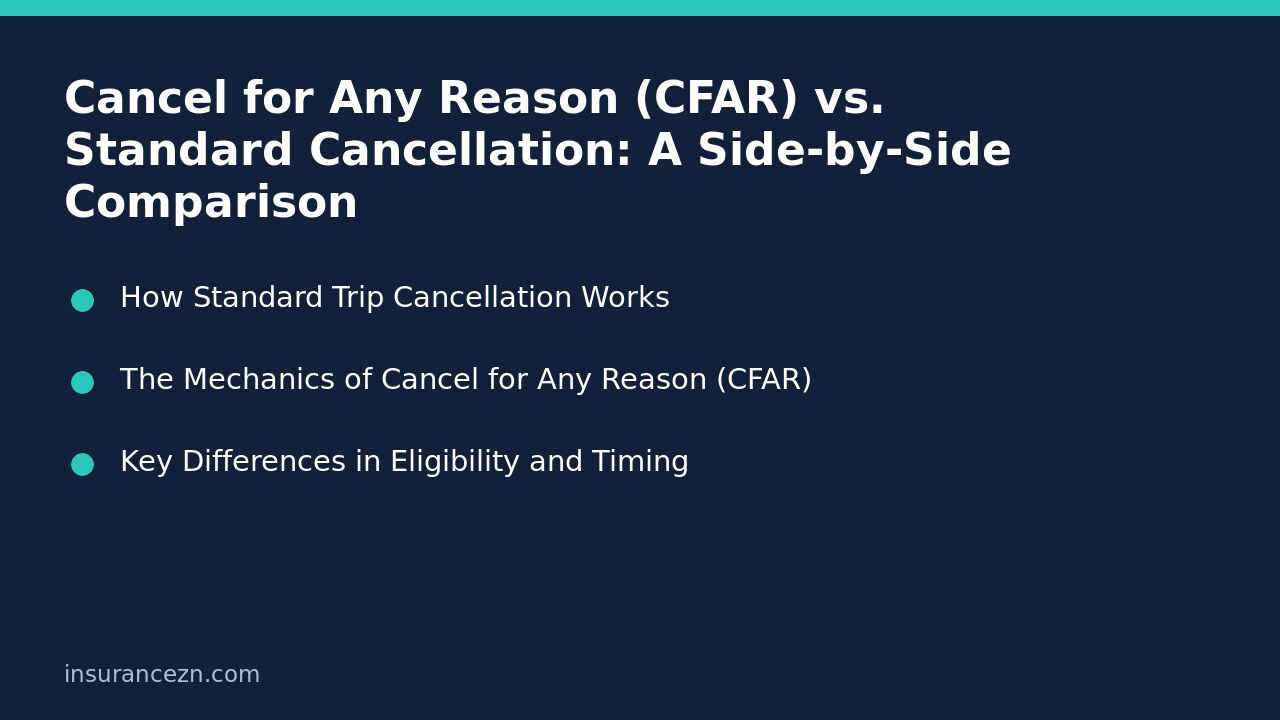
How Standard Trip Cancellation Works
Standard trip cancellation insurance is the foundational layer of most travel protection policies. It operates on a strict “named peril” basis. This means you will only be reimbursed for your non-refundable pre-paid expenses if a specific event listed in your policy occurs prior to your departure date. These events typically include:
* The death, illness, or injury of the traveler, a family member, or a traveling companion.
* Unforeseen business emergencies requiring your presence at work.
* Severe weather conditions that make travel impossible or unsafe.
* Natural disasters occurring at your home or destination within a specified timeframe before departure.
Crucially, standard coverage requires you to provide proof of the event. If you are sick, you must obtain a doctor’s note stating the diagnosis and dates of incapacity. If your employer cancels your trip, you may need documentation from HR. If the airline cancels your flight due to weather, the carrier usually handles the refund, but insurance might cover additional costs like hotel stays if the cancellation happens days before departure.
The benefit of standard coverage is its lower cost and broad acceptance by insurers. However, it is rigid. If you simply decide not to go because you had a terrible time at your last vacation, or because you found a better deal on a different destination, standard insurance will pay nothing. The “reason” for cancellation must be covered under the policy terms.
The Mechanics of Cancel for Any Reason (CFAR)
Cancel for Any Reason (CFAR) is an optional upgrade that expands the scope of coverage significantly beyond named perils. As the name suggests, this benefit allows you to cancel your trip for reasons not listed in standard policies, provided those reasons are not excluded by law or public policy. Common exclusions usually involve acts of terrorism, war, or pre-existing medical conditions unless a waiver was purchased separately.
With CFAR, you do not need to prove that a covered event occurred. You simply need to demonstrate that you are canceling for a reason other than the specific named perils covered by standard insurance. For example, if you decide your wedding is no longer happening and you want to cancel your honeymoon, or if you realize you don’t want to go to a destination due to political unrest that wasn’t severe enough to trigger a “political instability” clause in a standard policy, CFAR may apply.
However, this flexibility comes with strict conditions. Most policies require you to purchase the CFAR upgrade within a short window of your initial trip insurance purchase, typically 10 to 21 days after paying your first deposit. If you wait until two weeks before your flight to buy insurance hoping to cancel if you change your mind, you will not qualify for CFAR. Furthermore, CFAR policies often limit the reimbursement to a percentage of your total trip cost, commonly 50% or 75%, rather than the full amount of non-refundable expenses.
Key Differences in Eligibility and Timing
One of the most critical distinctions between the two options lies in the timing of the purchase relative to the cancellation event. Standard cancellation coverage is often retroactive regarding the timing of the incident, provided the policy was bought within the “look-back” period required for pre-existing condition waivers (usually 14-21 days). If you get sick today and cancel your trip next week, standard insurance covers it if you bought the policy before you got sick.
CFAR, conversely, is almost entirely dependent on when the policy was purchased relative to the initial trip deposit. Insurers view CFAR as a high-risk product because they cannot predict future life changes or whims. Therefore, they mandate an early purchase date. Additionally, CFAR often requires that the decision to cancel be made within a specific timeframe before departure, such as 48 hours or 72 hours prior to leaving. If you buy CFAR insurance three months before your trip and decide to cancel one month before, you may find the policy voided because you did not adhere to the “within X days of departure” cancellation window often associated with certain interpretations of CFAR terms, though this varies by carrier. Always read the specific “time of cancellation” clause in the fine print.
Financial Implications and Reimbursement Limits
When comparing the financial aspect, standard cancellation offers full reimbursement (100%) of non-refundable costs like flights, hotels, and tours, minus any deductible if applicable. This makes it the superior choice for protecting your hard-earned money in case of a tragedy or serious illness.
CFAR, while offering peace of mind regarding why you are canceling, limits the financial return. Most providers cap the payout at 50% to 75% of the total trip cost. For instance, if your non-refundable expenses total $10,000 and you purchase CFAR with a 50% limit, you will receive $5,000 back even if you cancel for a valid reason not covered by standard terms. This limitation is why many financial planners recommend purchasing the maximum amount of CFAR coverage available (often 25% more than the base policy cost) to ensure you have enough coverage to reach your desired reimbursement percentage.
A Real-World Scenario: The Unexpected Job Transfer
To illustrate the practical difference, consider a traveler named Sarah who has booked a $6,000 all-inclusive resort trip in Mexico. Six months after booking, her company unexpectedly transfers her to a new office in another state, requiring her to cancel immediately.
If Sarah purchased standard cancellation coverage: She would check the policy. Most standard policies cover “unforeseen business emergencies.” However, they often require proof that the job transfer was involuntary or occurred within a very short window of the booking (e.g., less than 24 hours). If her contract allows for flexible scheduling and the company says she can technically work remotely, the insurer might deny the claim as not being an “emergency.”
If Sarah purchased CFAR coverage early in the process: She would be eligible to cancel because a job transfer is a reason not explicitly listed in standard terms. However, she would only receive 50% of her $6,000, or $3,000, back. If she had bought extra CFAR coverage to increase the limit, she might have received closer to $750 or even the full amount depending on the insurer’s structure and total premium paid.
Checklist for Evaluating Your Needs
Before adding this expensive upgrade to your policy, ask yourself these questions:
1. What is my risk tolerance? Can I afford to lose the non-refundable deposit if I simply change my mind?
2. When am I buying insurance? If you are booking a trip now for next year, standard cancellation is usually sufficient as long as you buy soon after the first deposit. CFAR requires buying very close to the initial deposit date.
3. What is my budget? Does paying 40-50% more for an extra premium make sense given that you will only get back a fraction of your money?
4. Are there specific fears? If you are worried about missing out on a trip due to a minor illness or a family vacation mishap that isn’t a death/illness event, CFAR is the answer.
Conclusion
Choosing between standard cancellation and Cancel for Any Reason depends entirely on your specific travel risks and financial situation. Standard cancellation is the logical choice for most travelers who want full reimbursement for covered emergencies like illness, death, or severe weather without paying a premium for flexibility they may never use. CFAR is a niche product reserved for those who demand maximum flexibility, are willing to accept a partial refund, and can commit to purchasing the policy immediately after their first trip deposit. By understanding these distinctions, you can ensure your travel investment is protected against the realities of an unpredictable world.