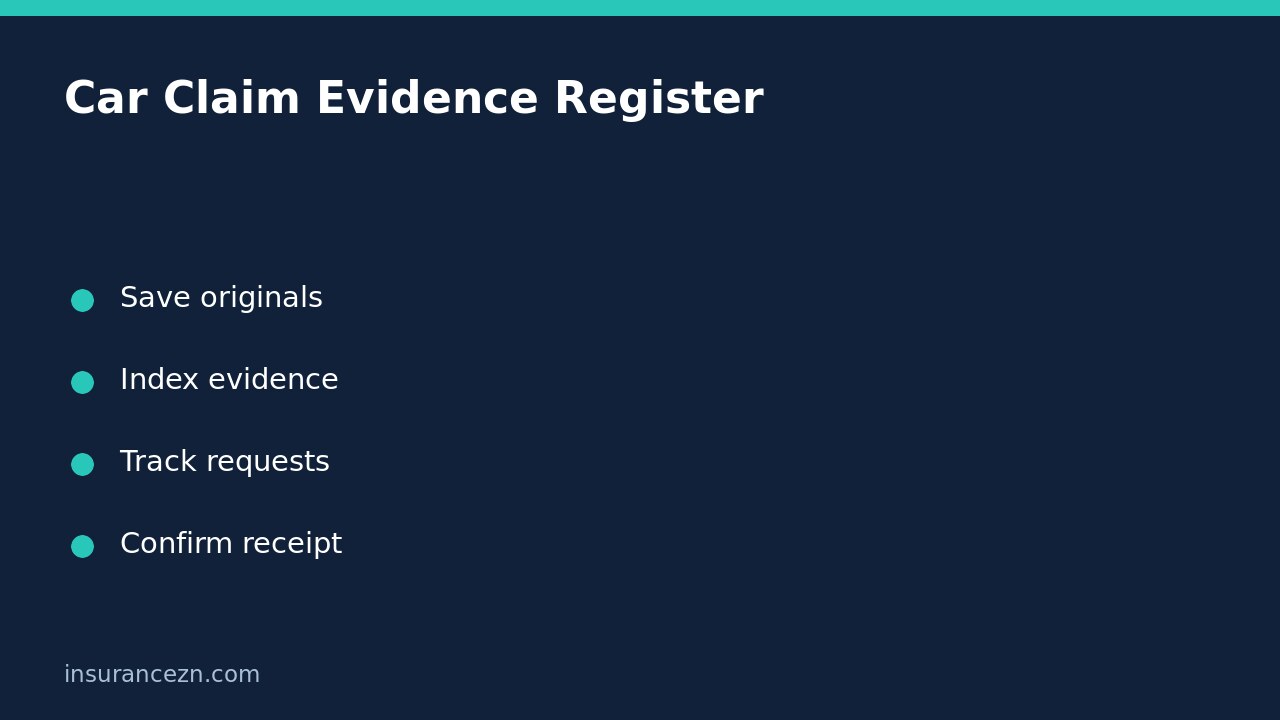

A car accident claim evidence register is a short index showing what you have saved, what it supports and what still needs collecting. Start with a spreadsheet or notebook; you do not need specialist software. Keep original files separately and use the register to track copies sent to your insurer. This helps prevent missing attachments and confusion between an estimate and a final invoice.
This is general information for Australian readers, not personal financial advice or legal advice. Cover, excesses, exclusions and claim requirements depend on your policy, schedule and Product Disclosure Statement (PDS). The legal sources below concern NSW; reporting duties and legal procedures can differ elsewhere.
Collect safely before organising files
Prioritise injuries and immediate safety. Do not stand in traffic or return to an unsafe location to obtain a better photograph. Once safe, preserve the details and evidence you already have. Legal Aid NSW’s car accident guidance recommends collecting evidence promptly about responsibility, damage, losses and repair costs.
Useful records may include photographs, the other driver’s details, witness contact information, dashcam footage, towing paperwork and repair estimates. Record a police event reference if one exists; do not invent a report number or assume every accident requires the same reporting process. Check your state’s requirements separately.
Create six columns that answer practical questions
- Reference: assign a stable identifier such as PHOTO-01 or QUOTE-01.
- Item and date: describe the document and distinguish the incident date from the date you received it.
- What it shows: for example, damage to the left rear panel, rather than an unsupported conclusion about fault.
- Original location: identify the folder, email or physical envelope.
- Submission record: note when and how you sent a copy, and the claim reference used.
- Next action: identify missing pages, an outstanding request or a receipt confirmation.
Keep driver licence numbers, addresses and other sensitive information out of filenames. A name such as PHOTO-01-rear-panel-original.jpg is easier to track than a camera’s automatically generated number without revealing unnecessary personal details.
Use a worked example to separate evidence from assumptions
Imagine a parked vehicle is damaged and you later obtain a repair quote. Your register could contain PHOTO-01, showing the damaged panel; NOTE-01, recording when you discovered it; and QUOTE-01, listing the repairer’s proposed work. If nobody witnessed the impact, write that the cause is unconfirmed. A photograph of damage does not by itself identify who caused it.
For QUOTE-01, the next action might be: ‘Ask insurer whether an assessment is needed before authorising repairs.’ Do not mark the quote as an approved repair or paid loss. If a revised quote arrives, save QUOTE-02 and label the first one superseded, rather than overwriting it.
Keep the insurer’s instructions alongside these entries. Legal Aid NSW’s insurance guidance says to contact your insurer for its claim process and information requirements. Your register supports that process; it does not replace a required form.
Preserve originals and document each submission
Copy dashcam footage promptly if the device routinely overwrites recordings. Preserve the original recording and keep any cropped clip clearly labelled as a copy. Avoid editing images to remove potentially relevant details. Store a backup in a secure location, with access limited to people who genuinely need it.
Before uploading, check that each attachment opens, every page is present and text is legible. Use the insurer’s verified portal or confirmed contact channel, not a link from an unexpected message. Save the upload receipt or confirmation email and record which references were included. If the portal fails, ask for an approved alternative instead of repeatedly sending sensitive files to uncertain addresses.
For a broader preparation overview, see our vehicle-owner claim document preparation guide.
Final checklist and common questions
- Does each record have a description and original location?
- Are facts clearly separated from guesses?
- Have requested documents been matched to the insurer’s actual request?
- Are missing items identified honestly, with an agreed next step?
- Have you saved submission confirmations and backed up originals?
Should I wait until every document is ready? Do not assume so. Contact the insurer about notification requirements and ask whether missing evidence can follow. Do not describe an incomplete submission as complete.
Will an organised register guarantee payment? No. It helps explain and track evidence, but acceptance depends on the policy and circumstances. Ask for clarification when a requested item is unavailable rather than creating a substitute that misrepresents what happened.