
Selecting an auto insurance deductible is one of the most significant decisions you make when purchasing a car policy. It represents a direct trade-off between your monthly premiums and the amount of cash you must pay out of pocket when a claim occurs. Many drivers default to the lowest available option, often unaware that this strategy can lead to financial strain during an accident or increased costs if they file multiple minor claims. Conversely, choosing a high deductible drastically lowers monthly bills but exposes you to significant risk if you are not prepared for an unexpected large expense. The optimal choice depends entirely on your personal financial situation, the value of your vehicle, and your tolerance for risk.
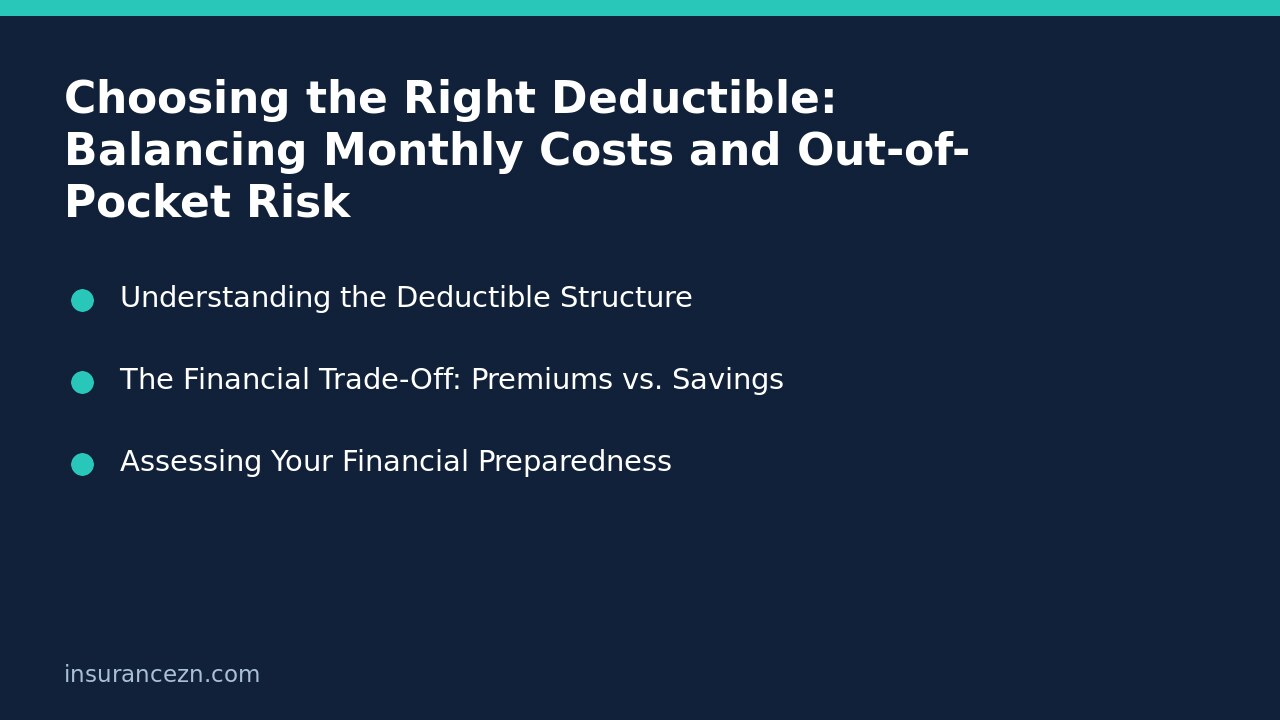
Understanding the Deductible Structure
To make an informed decision, you must first understand how a deductible functions within an insurance policy. A deductible is the specific amount of money you agree to pay toward covered damages before your insurance company begins to pay its share. This figure applies to each separate claim, not the total cost of the accident. For example, if you have a $500 collision deductible and suffer damage totaling $4,000, you would pay $500, and the insurer would cover the remaining $3,500.
It is crucial to distinguish between collision and comprehensive coverage. Collision covers damage from accidents involving another vehicle or object, while comprehensive covers non-collision events like theft, vandalism, falling trees, or hail. Most policies allow you to set different deductibles for these two types of coverage. For instance, you might choose a $500 deductible for collision and a $250 deductible for comprehensive. This flexibility allows you to tailor your risk exposure based on the frequency of events in your area; if you live in a region prone to hail storms, a lower comprehensive deductible might make sense, whereas a higher collision deductible could be preferable if you are careful with parking.
The Financial Trade-Off: Premiums vs. Savings
The primary function of a deductible is to shift the risk from the insurer to the policyholder. Insurance companies operate on a model where they pool risks; by agreeing to pay a portion of every claim, they spread the cost across many drivers. When you increase your deductible, you are telling the insurer, “I will handle the first $500 (or $1,000) of any loss myself.” In exchange for assuming this risk, the insurer lowers your monthly premium.
However, this relationship is not linear in a way that guarantees massive savings. Increasing your deductible from $250 to $500 might save you $5 to $10 per month. While that seems small, over a year, those savings add up. The real question is whether the annual savings justify the potential loss of hundreds or thousands of dollars in a single accident. If you have a $250 deductible and your premium is $100 higher than with a $500 deductible, you are effectively paying $1,200 extra annually to avoid having to pay $250 out of pocket. Mathematically, this breaks even quickly if you never file a claim, but it becomes a losing proposition the moment an accident occurs that exceeds your emergency fund.
Assessing Your Financial Preparedness
Before finalizing your deductible, you must conduct a honest audit of your finances. Ask yourself: “If I had to pay my full deductible today, could I do so without selling assets or going into debt?” If the answer is no, selecting a high deductible is dangerous regardless of how much it saves on paper.
Consider your emergency savings. A robust emergency fund should cover not just rent or mortgage payments for three months, but also large unexpected expenses like car repairs. If you have $10,000 in liquid savings, a $1,000 collision deductible is likely manageable. However, if your savings are minimal, a $500 deductible might be the maximum safe option.
You should also evaluate your current debt load and monthly cash flow. Drivers with high credit card balances or student loans may find that a lower premium does not offset the stress of a large lump-sum payment. Furthermore, consider the age of your vehicle. If you are driving a car worth only $3,000, paying a $1,000 deductible to repair it might not be financially prudent; in such cases, dropping collision coverage entirely is often a better strategy than raising the deductible.
Real-World Scenario: The Hail Storm vs. Minor Fender Bender
To illustrate the practical implications, let’s look at two distinct scenarios. Imagine you drive a five-year-old sedan worth $18,000 and have two policy options: Option A with a $250 deductible and Option B with a $1,000 deductible.
Scenario 1: Minor Accident
You park in a crowded lot and get rear-ended. The damage is estimated at $600. Under Option A ($250 deductible), you pay $250, and the insurer pays $350. Under Option B ($1,000 deductible), the insurer pays nothing because the damage is less than your deductible. You would have to pay the full $600 out of pocket. If you chose Option B thinking it was cheaper, you might regret it if you are not prepared to pay small claims yourself.
Scenario 2: Major Accident
You are involved in a severe collision causing $8,000 in damage. Under Option A, you pay $250 and the insurer covers $7,750. Under Option B, you pay $1,000 and the insurer covers $7,000. In this case, the difference in your out-of-pocket cost is only $750, but the savings on your premium over three years might have been around $900. Here, the high deductible pays off if you are financially secure enough to handle the initial $1,000 hit.
This example highlights that a “high deductible” strategy is only beneficial for major losses. Frequent minor incidents can negate the monthly savings entirely.
Common Mistakes to Avoid When Selecting a Deductible
Many drivers make specific errors when choosing their deductibles. First, choosing the lowest possible deductible is often driven by fear rather than logic. While it lowers immediate stress, it maximizes your risk exposure. If you are involved in a catastrophic accident, having a $1,000 deductible might be preferable to a $250 one if your savings can handle it, as the premium reduction over time could be substantial.
Second, ignoring state regulations is another pitfall. Some states have minimum mandatory deductibles for certain types of coverage or specific vehicle classes. Always verify local laws before finalizing your policy. Additionally, do not assume that a higher deductible will automatically lower your rate by the same percentage across all insurers; shop around, as different companies calculate risk differently.
Finally, forgetting to update your deductible after life changes is common. If you recently received a inheritance, a bonus, or paid off a mortgage, you may now be able to afford a higher deductible and save money on premiums. Conversely, if you lost your job or incurred significant medical bills, you should reconsider dropping to a lower deductible temporarily until your finances stabilize.
Final Checklist for Your Decision
Before submitting your application, run through this quick checklist:
1. Calculate the Break-Even Point: Determine how many months of premium savings it would take to equal one deductible increase. (e.g., Saving $5/month means you need to go 20 months without a claim to “break even” on a $100 deductible jump).
2. Review Emergency Funds: Ensure your liquid assets can comfortably cover the chosen deductible amount plus any potential medical bills if injured in an accident.
3. Check Vehicle Value: If your car’s actual cash value is close to or below the deductible amount, consider dropping collision coverage entirely rather than paying a high deductible on a worthless asset.
4. Analyze Claim History: If you have filed multiple claims in the last three years, a lower deductible might be wiser to avoid being dropped by an insurer or facing rate hikes later.
Choosing the right deductible is not about picking the cheapest option; it is about finding the balance that aligns with your financial resilience. By carefully weighing your savings against your risk tolerance, you can construct an insurance strategy that protects your wallet both in good times and bad. Remember that terms, availability, eligibility, laws, and prices depend on the specific insurer, policy details, and jurisdiction; always consult with licensed agents to ensure your choices comply with local regulations and meet your unique needs.