
Navigating the landscape of auto insurance can feel like solving a complex puzzle where every piece fits differently depending on where you live. In the United States, there is no single national standard for car insurance; instead, each state has enacted its own specific laws dictating what drivers must carry to legally operate a vehicle on public roads. Understanding these legal requirements is not just about avoiding fines or license suspension; it is about ensuring that you have the necessary financial protection in the event of an accident. This guide breaks down how minimum coverage works across different jurisdictions, explains the nuances of “no-fault” versus “tort” states, and provides a practical checklist to ensure your policy meets local mandates.
Why Minimum Coverage Limits Vary by State
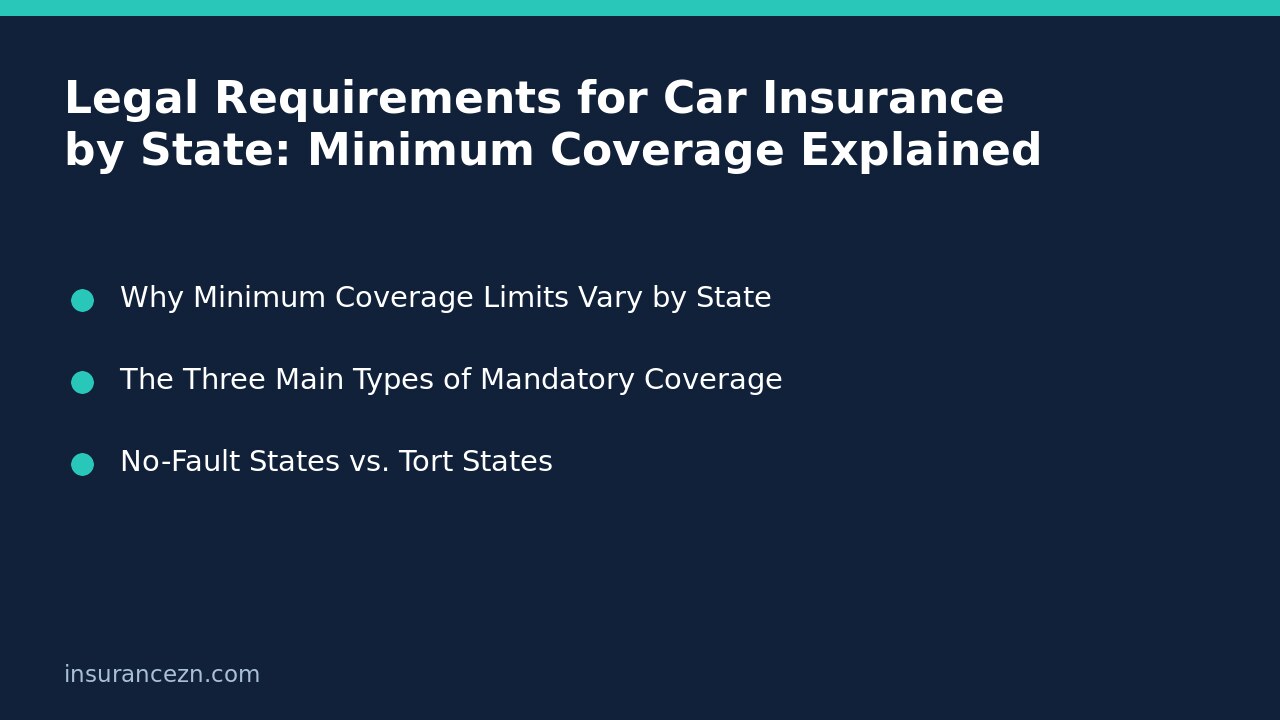
The primary reason for variation in car insurance requirements is that state legislatures balance consumer protection costs against economic factors within their own borders. Some states mandate higher limits because medical costs are generally higher, or because traffic density leads to more frequent collisions. Conversely, other states allow drivers to opt for lower minimums, sometimes down to just $25,000 in bodily injury liability per person.
It is crucial to understand that “minimum coverage” refers strictly to the least amount of insurance an insurer must sell you to comply with the law. It does not mean this is the optimal amount for your personal financial security. If you are involved in a severe accident where damages exceed your state’s minimum limits, you could be personally liable for the difference, potentially leading to wage garnishment or asset seizure.
The Three Main Types of Mandatory Coverage
While specifics vary, most states require three core components in an auto insurance policy: bodily injury liability, property damage liability, and uninsured/underinsured motorist coverage.
Bodily Injury Liability
This coverage pays for medical expenses, lost wages, and legal fees if you cause an accident that injures another person. In many states, this is split into two numbers, such as 25/50, meaning up to $25,000 per person and $50,000 per accident. States like California and Florida have relatively high minimums for bodily injury, whereas states like Virginia or New Jersey may require less.
Property Damage Liability
This portion covers the cost of repairing or replacing another person’s vehicle or property (like a fence or building) that you damage. Minimum limits here are often lower than bodily injury limits but still vary significantly. For instance, one state might require $10,000 in property damage coverage, while another requires $25,000.
Uninsured/Underinsured Motorist (UM/UIM)
This is perhaps the most misunderstood requirement. UM coverage pays for your injuries if you are hit by a driver who has no insurance. UIM kicks in if the at-fault driver’s insurance exists but is insufficient to cover your damages. Not every state mandates this, and those that do often allow it to be waived with a signed statement, though experts strongly advise against waiving it due to the prevalence of uninsured drivers.
No-Fault States vs. Tort States
Another layer of complexity arises from how states handle liability claims after an accident. In “tort” states (the majority of the country), you can sue the at-fault driver for damages exceeding your policy limits. In “no-fault” states, such as Michigan or Pennsylvania, drivers must rely on their own Personal Injury Protection (PIP) coverage to pay for medical bills regardless of who caused the crash.
Consequently, no-fault states often require higher minimum PIP limits because the victim cannot immediately turn to the at-fault driver’s insurance for medical costs. If you move from a tort state to a no-fault state, your current policy may not comply with local laws unless you add specific PIP coverage and adjust your liability limits accordingly.
Common Mistakes Drivers Make Regarding State Laws
One of the most frequent errors is assuming that a policy purchased in one state will automatically be legal when driving in another. While you can drive across state lines, insurance verification happens at the point of registration or during a traffic stop. If you register your vehicle in State A but carry only the minimums required by State B (where you live), you are non-compliant.
Another common mistake is confusing “per person” with “per accident” limits. Drivers often think a $50,000 policy covers a single victim up to that amount, but if the limit is 25/50, the first victim gets capped at $25,000 even if the other victim receives the full $50,000. Failing to read the fine print on these distinctions can leave you underinsured in a multi-victim crash.
Real-World Example: The Impact of State Minimums
Consider two drivers, Alex and Jordan, both involved in a severe collision that injures three people with total medical bills of $150,000 and property damage of $40,000.
Alex lives in a state with minimum liability limits of 25/50 ($25k per person, $50k per accident). His policy matches these minimums. The first two victims receive their maximum allowed under the law ($25k each), totaling $50k. The third victim receives nothing from Alex’s liability coverage because the per-person cap was reached. Alex is personally liable for the remaining medical costs and the full $40,000 in property damage.
Jordan lives in a state with minimum limits of 30/60/25 ($30k per person, $60k per accident, $25k property). With the same accident scenario, Jordan’s policy pays $30k to each of the three victims (totaling $90k for medical), covering all injuries. The property damage limit of $25k is paid out. While Jordan paid a slightly higher premium, they avoided catastrophic personal financial risk that Alex faced. This example illustrates why “minimum” coverage is rarely sufficient for modern economic realities.
Checklist for Verifying Your State’s Requirements
To ensure your policy is fully compliant, follow these steps:
1. Identify your residence state: Legal requirements are based on where you register the vehicle and live, not necessarily where the accident occurs.
2. Check the DMV website: Visit your specific Department of Motor Vehicles (DMV) or equivalent agency site to find the current mandatory limits. These change occasionally.
3. Review your policy declarations page: Ensure the numbers listed match or exceed state mandates. Look specifically for the “UM/UIM” section if your state requires it.
4. Verify PIP requirements: If you live in a no-fault state, confirm that Personal Injury Protection is included and meets the state’s minimum dollar amount.
5. Ask about SR-22 or FR-22: If you have had a DUI or multiple accidents, some states require an SR-22 form to be filed with the DMV. Your insurer must file this directly; standard quotes won’t suffice.
Conclusion
Car insurance minimums are the legal floor, not the financial ceiling. While adhering to state laws prevents administrative penalties, relying solely on those minimums leaves you vulnerable to significant debt if a serious accident occurs. By understanding the distinctions between bodily injury, property damage, and uninsured motorist coverage, as well as the unique rules of no-fault versus tort states, drivers can make informed decisions that protect their futures. Always verify your specific state’s current requirements directly with official government resources or a licensed agent to ensure total compliance.