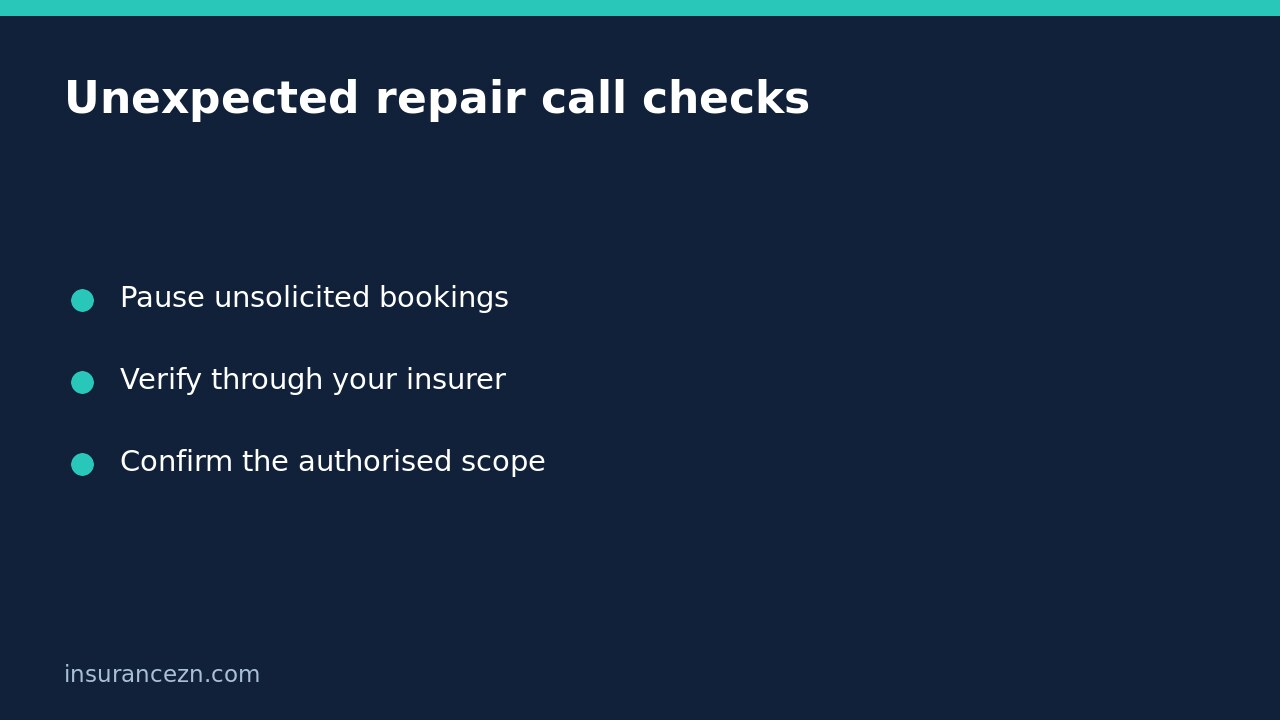

If a company unexpectedly calls after an accident and says it will organise repairs for your insurer, verify that appointment independently before agreeing to collection, signing documents or sharing information. Knowing that you had a crash does not establish that the caller represents your insurer. A real repair business can also be offering a separate service rather than carrying out an insurer-authorised job.
This is general information for Australian readers, not personal financial advice. Your policy, Product Disclosure Statement (PDS), claim decision and repair arrangements determine cover and responsibilities. Verifying a company’s identity does not establish that repairs or associated costs are approved.
Recognise the claim of authority that needs checking
In its insurance scam guidance, Suncorp specifically warns motor customers about third-party companies claiming to arrange repairs on an insurer’s behalf. Warning signs include unexpected contact, pressure to book or pay immediately, and an inability to provide verifiable identification such as a work order or job number.
The same guidance warns that caller IDs and SMS threads can be spoofed. A familiar-looking number, insurer logo or accurate personal detail is therefore not enough. Do not label every unexpected contractor a scammer, but do not use the contractor’s own assurances as independent verification either.
Pause the proposed booking and collect limited details
Ask for the company’s trading name, the caller’s name, the proposed service, the work-order reference and the insurer they say appointed them. Record the proposed collection location and time without confirming the booking. You do not need to provide passwords, one-time codes or remote access to investigate whether a contractor was appointed.
Do not follow a new login link or open unexpected attachments to prove your identity to the caller. Suncorp’s guidance says it will never request passwords, PINs, multi-factor authentication codes or remote device access. Treat that as the provider’s stated practice, not as proof that another organisation has the same process.
Check through the existing claim channel
- End the unsolicited conversation without committing to the service.
- Find your insurer’s contact route independently using saved policy documents or the official website entered directly.
- Provide your existing claim reference and the company details you recorded.
- Ask whether this exact company has been appointed for your vehicle and what task it is authorised to perform.
- Request confirmation of the work order, next appointment and any documents you are expected to sign.
Suncorp’s comprehensive claims instructions describe using the claim number to manage assessments and view details of an authorised repairer. That is a provider-specific route for cross-checking information; another insurer may use a different portal or telephone process. An unfamiliar company need not be fraudulent, but an unresolved mismatch deserves a pause.
Separate identity, appointment and permission to do the work
Consider a hypothetical driver who has an assessment booked, then receives a call offering immediate vehicle collection. Confirming that the caller works for a genuine repair shop answers only the identity question. It does not establish that the insurer appointed that shop, that collection is arranged under the claim, or that the complete repair quote has been approved.
Ask separately who is collecting the car, where it will go, what work is authorised and who would owe any charges. If an independent business offers a private contract, identify that clearly rather than treating it as the insurer’s repair arrangement. For the separate scope issue, read about repairer choice and quote approval rules. Being able to nominate a workshop is not the same as having its entire quote approved.
If you already agreed or shared information
Contact the genuine insurer promptly and explain exactly what happened. Preserve messages, references, signed documents and collection details. Ask the business and insurer what is actually recorded, rather than assuming your request to cancel or amend the booking has been processed. Do not assume a cooling-off right or fee-free cancellation applies to an unfamiliar contract.
If you transferred money or disclosed financial information, Suncorp’s scam guidance recommends contacting your bank immediately. Follow the relevant account provider’s security process if credentials were exposed. Reporting a suspicious approach does not itself cancel a contract, recover money or change the claim decision.
Quick questions before handing over the keys
Does an accurate claim number prove authority? No. Verify the appointment through an independently obtained insurer channel.
Does a confirmed appointment approve every repair? No. Confirm the exact task, scope and payment responsibility separately.
Should urgent safety work wait for a scam investigation? Do not put yourself at risk. Seek necessary emergency assistance through trusted channels, then reconcile insurance arrangements without relying on the unsolicited caller.