
Homeowners insurance is a non-negotiable expense for most property owners, yet it often feels like a flat fee that simply grows larger every year. Many homeowners accept their annual quote without realizing that significant savings are available through specific policy adjustments and risk mitigation strategies. The good news is that you do not need to wait until your renewal date to start lowering your costs. By taking proactive steps today, you can immediately impact the premium calculation or secure a lower rate for your next term. This guide outlines five actionable methods to reduce your homeowners insurance premium, ranging from adjusting your deductible to leveraging local discounts you might have overlooked.
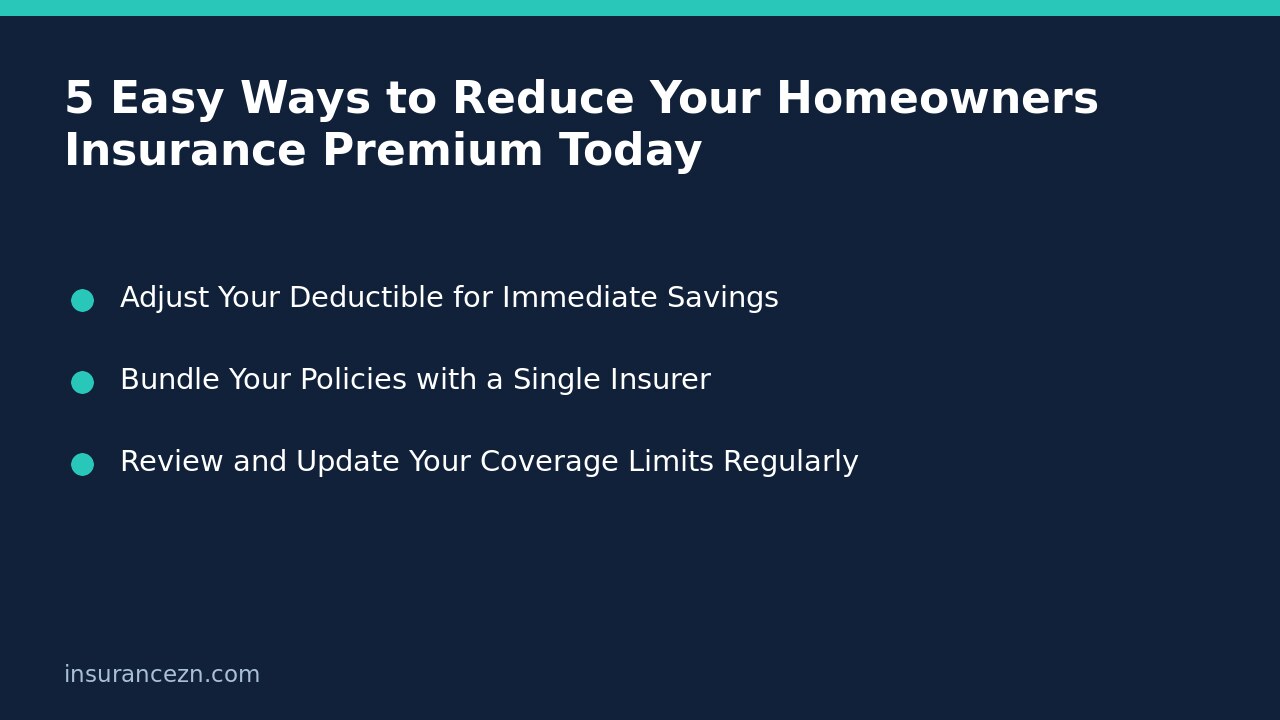
Adjust Your Deductible for Immediate Savings
One of the most effective ways to lower your monthly or annual premium is by increasing your deductible. The deductible is the amount you agree to pay out of pocket before your insurance coverage kicks in when a claim occurs. Insurance companies view policies with higher deductibles as less risky because they reduce the frequency of small claims processing, which saves the insurer administrative costs. In return, they offer a lower premium rate.
For example, if you currently have a $500 deductible and decide to increase it to $1,000 or $2,000, your premium could drop by anywhere from 10% to 30%. To calculate the break-even point, divide the annual premium savings by the difference in your deductibles. If raising your deductible saves you $300 a year but costs you an extra $500 in a potential claim, it is a smart financial move as long as you have the cash on hand to cover that initial expense.
It is crucial to ensure you can afford the higher deductible in the event of a loss. If a storm damages your roof and windows, and your deductible is $2,000, you must be prepared to pay that immediately before filing a claim. Keeping a separate emergency fund for home repairs ensures that you do not have to dip into retirement savings or take out high-interest loans after a disaster.
Bundle Your Policies with a Single Insurer
Insurers frequently offer multi-policy discounts when you combine your homeowners insurance with other types of coverage, such as auto, life, or renters insurance. This is known as bundling. The logic behind this discount is simple: it is more convenient for the insurer to manage one account than multiple separate ones, and the customer loyalty reduces churn rates.
When shopping around, do not just look at the standalone price of your home policy. Compare the total cost of keeping your auto and home policies with the same company versus splitting them up. Sometimes, switching your auto insurance to a different provider might be cheaper, but if that new provider offers a significant bundle discount for adding your home policy, the combined savings could outweigh the difference in rates. Always ask your current agent about their specific “loyalty” or “multi-policy” discount tiers before signing any new contracts.
Review and Update Your Coverage Limits Regularly
Over-insuring your property is a common mistake that inflates premiums unnecessarily. Inflation can erode the value of your home over time, but replacement cost estimates often lag behind market reality. Conversely, you may be paying for coverage limits that exceed the actual cost to rebuild your structure or replace personal belongings.
To optimize this, obtain a professional reconstruction cost estimate from a local builder or contractor. This figure reflects current labor and material costs to rebuild your home from the ground up, distinct from its market value. If your policy limit is set at $300,000 but the reconstruction cost is only $250,000, you are paying for coverage you do not need. Similarly, review your “personal property” limits. These often default to a percentage of the dwelling limit (e.g., 50%), which might be insufficient or excessive depending on your possessions.
Adjusting these limits downward can result in immediate premium reductions. However, never reduce limits below the actual replacement cost determined by a professional assessment. Under-insuring can lead to significant out-of-pocket expenses during a claim, especially regarding “loss of use” coverage, which pays for temporary housing while repairs are made.
Implement Home Security and Risk Mitigation Upgrades
Insurance companies reward homeowners who take steps to prevent theft and damage. Installing approved security systems, smoke detectors, and fire suppression devices can qualify you for substantial discounts. Many insurers offer specific rate reductions for homes equipped with monitored alarm systems, video doorbells, smart locks, and automatic sprinkler systems.
Beyond technology, physical modifications to your home also count. Trimming trees that overhang the roofline prevents debris accumulation and reduces fire risk. Installing hurricane shutters or impact-resistant windows can lower premiums in coastal regions. Even simple actions like moving flammable materials away from the exterior of the house or ensuring proper gutter maintenance demonstrate a proactive approach to risk management. When you make these upgrades, contact your insurer immediately with proof of installation; do not wait for renewal season.
Shop Around and Leverage Competitor Quotes
Perhaps the most overlooked strategy is simply comparing rates. Insurance pricing algorithms vary wildly between carriers because they weigh different risk factors. A neighbor might pay half of what you are paying for a home in the exact same condition, located on the same street, with identical coverage limits.
To execute this effectively, gather your current policy details and request quotes from at least three different insurers. When calling or submitting online requests, explicitly mention that you have received a lower quote from another company. Many agents have the authority to match or beat competitor rates to retain your business. Some carriers even offer “price protection” clauses where they guarantee not to charge more than a competitor for the same coverage.
Remember that insurers are legally required to provide rate information if requested, but this process can be complex. Focus on companies licensed in your specific state, as regulations vary by jurisdiction. Use online comparison tools as a starting point, but always follow up with direct conversations, as agents often have access to unpublished discounts or special programs not visible on public websites.
Conclusion and Final Checklist
Reducing your homeowners insurance premium is a continuous process rather than a one-time event. By adjusting your deductible, bundling policies, verifying coverage limits, upgrading home security, and shopping around, you can significantly lower your annual costs without sacrificing essential protection. These steps require minimal effort but yield tangible financial benefits.
Quick Action Checklist:
* [ ] Calculate the savings of increasing your deductible by $500.
* [ ] Request a quote for bundling with your auto insurance provider.
* [ ] Get a professional reconstruction cost estimate to verify dwelling limits.
* [ ] Audit your home for security system eligibility and upgrade gaps.
* [ ] Contact three different insurers for competitive quotes.
Please note that insurance terms, availability, eligibility, laws, and prices depend entirely on the specific insurer, your policy details, and local jurisdiction. This article provides general informational guidance and does not constitute individualized financial or legal advice. Always review your specific policy documents and consult with a licensed insurance professional before making changes to your coverage.