
Do not assume a hospital policy covering joint reconstruction also covers joint replacement. Australian private hospital insurance uses separate clinical categories for these treatments. Before a planned admission, match the proposed operation to the correct category and ask your insurer to confirm your actual benefits.
The difference matters when a policy summary uses broad language about bones or joints. A category name is a starting point for checking insurance, not a diagnosis or a substitute for advice from your treating specialist.
Understand the three categories people can confuse
The Australian Government clinical categories reference separates joint reconstructions, joint replacements, and bone, joint and muscle. It describes reconstructions as hospital treatment for joint reconstruction surgery, with examples including torn tendons, rotator cuff tears and damaged ligaments.
Joint replacements include replacement surgery and revisions, resurfacing, partial replacements and removal of prostheses. The separate bone, joint and muscle category includes examples such as fractures and joint fusion. Spinal procedures have further distinctions, so a familiar everyday label like orthopaedic surgery is not enough to identify cover.
These are insurance classifications, not instructions about which treatment is appropriate. Ask your specialist to describe the planned procedure and provide any relevant Medicare Benefits Schedule (MBS) item numbers. Avoid selecting a category yourself from symptoms or the body part alone.
Collect the information your insurer needs
Before calling the fund, request a written procedure description from the specialist practice. Have your membership details, proposed admission date and hospital name ready. If multiple procedures are proposed, ask for the details of each rather than checking only the headline operation.
- What is the procedure name and what MBS item numbers are expected?
- Is this planned as an admitted hospital treatment?
- Which hospital and treating practitioners are involved?
- Could the planned treatment change, and how would updated details be communicated?
Share the details with the insurer and ask which clinical category applies. Request confirmation of whether that category is included, restricted or excluded on your current policy, and what that means for the proposed hospital. Keep the response date and reference number.
Work through a hypothetical shoulder operation
Suppose a specialist proposes a rotator cuff repair. The government category description lists rotator cuff tears under joint reconstructions, so that is a useful category to ask about. It is not a promise that a particular claim will be accepted: the precise treatment, policy terms and insurer assessment still matter.
Now suppose the clinical plan instead involves a shoulder replacement. Reusing the earlier reconstruction answer would be unsafe. Replacement sits in a separate category, and the insurer needs the revised procedure details. The same shoulder can therefore generate different insurance questions depending on the actual operation.
In either case, obtain medical advice about treatment choices from the specialist. Do not delay necessary care or choose an operation merely to fit a policy category. Ask the practice and insurer to explain the practical options if the proposed treatment is not covered.
Check costs after the category is confirmed
An included category does not automatically mean a zero-cost admission. PrivateHealth.gov.au explains that policyholders may have out-of-pocket expenses and that waiting periods can apply when purchasing or upgrading cover.
Ask the insurer about waiting periods, excesses, co-payments and the hospital agreement for your proposed admission. Ask the surgeon and other treating practitioners for written estimates, including whether a gap arrangement will apply. Request clarification of any devices or services that may generate separate charges rather than assuming one estimate captures everything.
If you are considering upgrading, ask when the relevant higher benefits would become available. A new policy name or a higher premium does not establish immediate eligibility. Review your current documents before cancelling existing cover, and keep written confirmation of any transfer or upgrade arrangements.
A short admission checklist
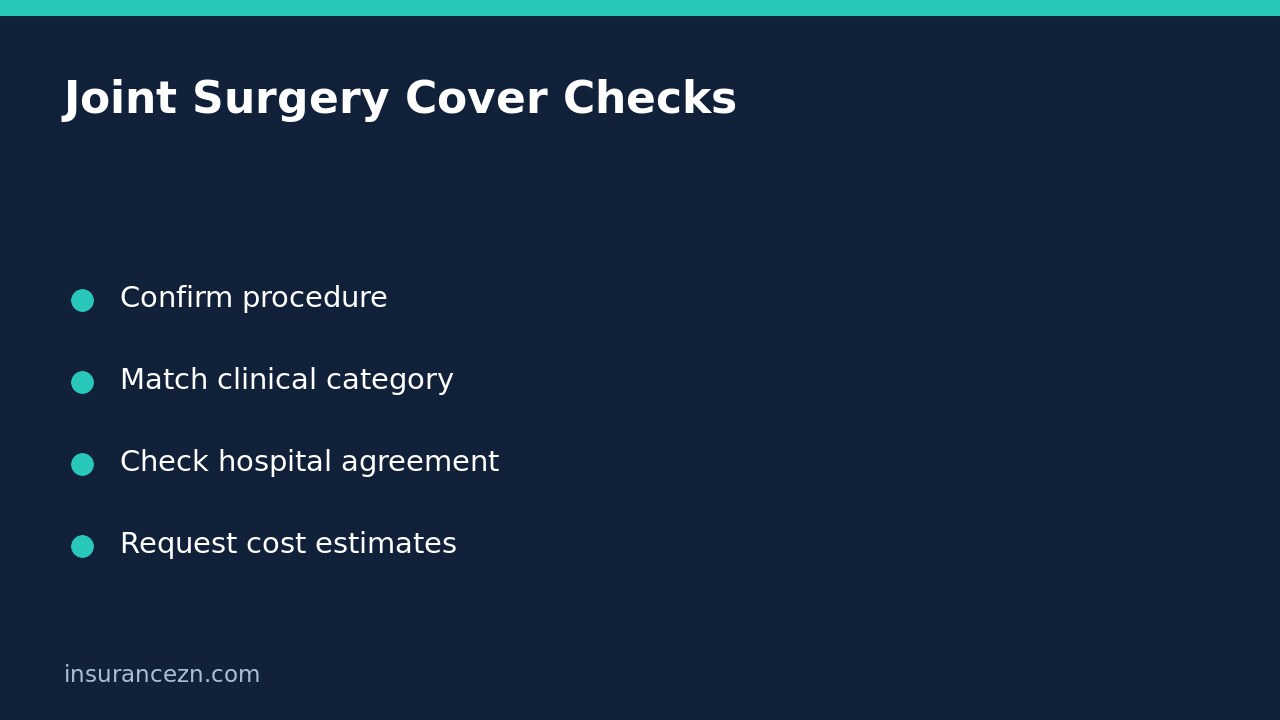
- Confirm the procedure description and expected item numbers with the specialist.
- Match those details to the insurer-confirmed clinical category.
- Check inclusion, restrictions, waiting periods and the proposed hospital.
- Collect separate written cost estimates and benefit explanations.
- Repeat the checks if the operation, hospital or admission date changes.
For a wider policy review, see our health insurance renewal review guide. Keep your procedure-specific notes with those policy records.
Common questions
Does bone, joint and muscle cover every joint operation? No. The official category descriptions list reconstructions and replacements separately.
Is the category alone enough to estimate my bill? No. You also need the policy benefits, hospital arrangements and practitioner estimates.
Important: This is general information for Australian readers, not personal financial advice or medical advice. Benefits depend on your policy documents, applicable policy/PDS terms, exclusions, restrictions, waiting periods and insurer assessment. Ask your treating team about care and your insurer about cover; no example guarantees payment.