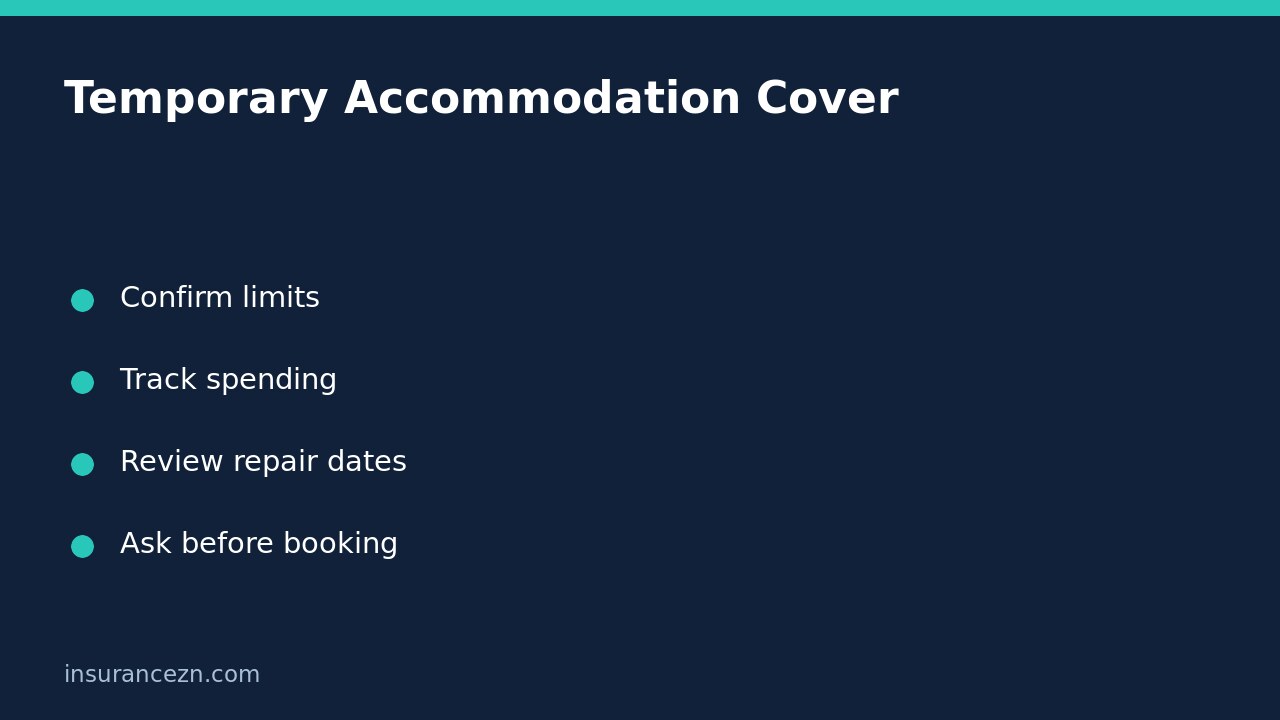

If your damaged home is uninhabitable and temporary accommodation cover is approaching its limit, ask the insurer for a written benefit balance and compare it with the latest repair timetable before extending your booking. A repair delay does not automatically mean accommodation payments will continue indefinitely. Your policy wording and the circumstances of the claim matter.
This is general information for Australian readers, not personal financial advice or legal advice. Cover depends on your policy, Product Disclosure Statement (PDS), schedule, exclusions and claim circumstances. Seek individual advice where needed.
Find out which limit could end the benefit first
Do not rely on the booking confirmation alone. Temporary accommodation can have a dollar limit, a time limit, eligibility conditions or a combination of these. The Legal Aid NSW disaster insurance guide explains that accommodation benefits generally have limits. Its examples are illustrations, not promises about your particular policy.
Read the relevant PDS section alongside your schedule and any written claim approval. Ask the insurer to confirm when the benefit started, what ends eligibility, and which expenses count towards the available amount. Check whether the accommodation allowance is separate from the building sum insured rather than assuming either arrangement.
- What dollar balance remains after paid invoices and outstanding bookings?
- Is there a maximum duration, and how is it measured?
- Does the insurer need to approve each extension or change of address?
- Are moving, storage, pet accommodation or extra travel expenses included, excluded or assessed separately?
Keep a simple accommodation ledger
Create a record with columns for booking dates, supplier, approved charge, amount paid, outstanding commitment and the approval email. Record confirmed costs separately from estimates. This prevents an apparent unused balance from hiding invoices that have not yet been processed.
For a hypothetical planning example, suppose written confirmation shows $12,000 remaining and an approved rental costs $1,000 per week. That suggests twelve weeks at that rental cost alone, before any other eligible expenses charged against the same allowance. It is not a coverage decision: ask whether cleaning charges, booking fees or other approved items reduce that balance. Use your own written figures rather than these illustrative amounts.
Reconcile the ledger with the insurer regularly, particularly before a large payment. Keep receipts, but remember that having a receipt does not make an expense covered.
Compare the benefit with a realistic repair date
Ask the claims manager for the latest expected completion date and the outstanding steps: assessment, scope approval, building approvals, materials and construction. Ask what could change that estimate. A builder saying work starts soon is not the same as confirming when your home will be safe to occupy.
Put the accommodation end date and expected move-back date on the same calendar. If there is a gap, raise it immediately in writing. Request an explanation of the options available under your policy and whether a different approved accommodation arrangement would preserve the remaining allowance. Do not move back into an unsafe property simply because the benefit may expire.
Ask before switching accommodation or accepting settlement
A cheaper rental may help stretch a dollar allowance, but changing accommodation can create extra moving costs or cancellation fees. Obtain written approval before making non-refundable commitments. Tell the insurer about accessibility needs, household size, pets and essential school or work travel so that proposed options can be assessed realistically.
If a cash settlement is proposed, ask specifically how temporary accommodation is treated. Is it included in the amount offered, paid separately, or expected to stop on a stated date? Legal Aid NSW highlights accommodation as a question to resolve before settlement. Do not assume unused accommodation benefits will remain available after signing an agreement; obtain advice about unclear settlement terms.
A short message to send your claims manager
Use this as a starting point: Please confirm my remaining temporary accommodation benefit, including outstanding approved expenses, any time limit and the relevant policy clauses. My current booking ends on [date], while the latest expected repair completion is [date]. Please explain what accommodation options are available if repairs extend beyond my booking or benefit limit, and which costs need approval before I commit.
Attach your ledger and the latest repair update. Save the reply with your claim records. The broader home insurance cost and excess review can help organise related policy documents.
Quick questions before the next booking
Does a delay guarantee an extension? No. Ask for a policy-based decision and explanation of any additional assistance available. If you disagree, use the insurer’s complaints process and consider independent insurance or legal assistance.
What if I stay with family? Ask how the policy treats that arrangement before assuming a commercial rental allowance becomes a cash payment.
What should I keep? Retain benefit confirmations, invoices, approvals, repair updates and booking cancellation terms together. These records make a looming accommodation gap easier to explain and address.