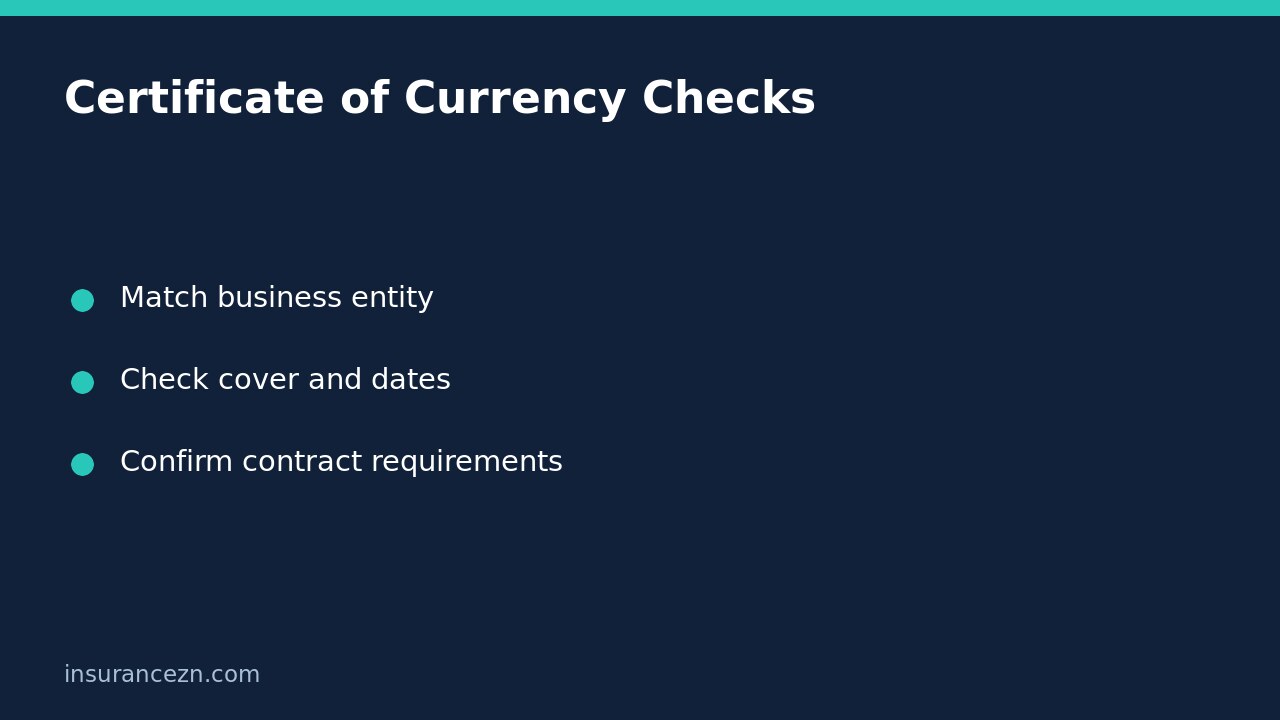

A business insurance certificate of currency is evidence that the named business has the stated insurance in place at a particular date. Before sending one to a client, check that it names the correct entity, describes the requested type of cover and shows relevant policy dates. It is not a substitute for reading the policy or confirming that a particular contract, activity or claim is covered.
For Australian small businesses, this document often comes up when tendering, taking on a commercial customer or applying to trade at an event. A clean document-handling process can prevent avoidable delays without turning an administrative request into an unsupported promise about your insurance.
This is general information for Australian readers, not personal financial advice or legal advice. Insurance responds according to the policy wording, exclusions, conditions, limits and applicable law. Read your policy schedule and relevant Product Disclosure Statement (PDS), where supplied, and ask your insurer or broker about your circumstances.
Understand what the certificate actually confirms
The Queensland Government’s Business Queensland insurance guidance explains that a certificate of currency confirms the covered business entity, the type or scope of cover, and that the policy is active and valid on a particular date. It also notes that a customer may request it in addition to, or instead of, an insurance policy certificate.
The same guidance says your broker or provider can issue the certificate. Request the document through that channel rather than making your own version or editing an old PDF. If information is wrong, ask the issuer to correct it. A certificate showing last year’s dates should not be passed on as proof of today’s insurance.
Run a five-point check before attaching the PDF
- Named entity: compare the insured name with the legal entity doing the work. A trading name alone may not resolve an entity mismatch; ask your broker if the client uses a different name.
- Insurance type: distinguish public liability, product liability and professional indemnity. A document for one does not prove you hold the others.
- Period of cover: check the dates against the proposed work or event. If the engagement runs beyond renewal, arrange a follow-up for the renewed certificate.
- Stated limit and description: compare what appears on the certificate with the client’s request. Ask about unclear descriptions instead of assuming a familiar business label covers every task.
- Issuer and document integrity: use the current document supplied by the broker or insurer and check that all pages are included and readable.
This is a document check, not a guarantee that the cover is adequate. Detailed exclusions, endorsements, sublimits or conditions may be found elsewhere in the insurance documents. Keep those questions separate from whether the PDF is legible and current.
Example: a cleaning business bidding for office work
Consider a hypothetical sole trader who operates a cleaning business and receives a tender request for evidence of public liability insurance. The certificate has current dates, but its activity description appears to cover domestic cleaning, while the proposed job involves commercial premises and specialist floor treatment.
The sensible next step is to describe the actual work to the broker or insurer and ask whether the policy covers it, and whether an update is needed. Simply forwarding the certificate with a message saying “everything is covered” would skip the important coverage question. The business should also check the tender’s insurance requirements rather than treating a customer’s receipt of the PDF as approval of every contract clause.
A certificate does not rewrite a client contract
Clients may request particular liability limits, descriptions or additional arrangements. Ask the broker to review those insurance requirements before agreeing that your policy satisfies them. If a contract asks you to accept broad responsibility for losses, obtain suitable legal advice; the certificate itself does not explain the effect of that promise.
Requirements can differ by industry, activity and jurisdiction. Do not assume that public liability is legally compulsory for every Australian business just because one venue or customer requires it. A contractual requirement and a legal obligation are different questions.
If the request concerns a trading event rather than office work, see our related explanation of market stall insurance and cover beyond the stall fee. An organiser’s paperwork requirements still need to be considered alongside your own activities and policy.
Keep a simple renewal and sharing record
Save the issued certificate with the policy schedule. Record who received it, when you sent it and when updated evidence is due. Set a reminder before renewal if ongoing customers require uninterrupted proof. Avoid sending unrelated financial or identity documents when the customer only asked for a certificate.
- Can I change the insured name myself? No. Ask the insurer or broker to issue the correct document.
- Does paying premiums monthly make the policy dates irrelevant? No. Business Queensland notes that customers may seek current evidence because policies can be cancelled or lapse, including where premiums are paid monthly.
- What if the client rejects the certificate? Ask which specific requirement is unmet and take that question to the issuer. Do not repeatedly resend the same PDF without resolving the mismatch.