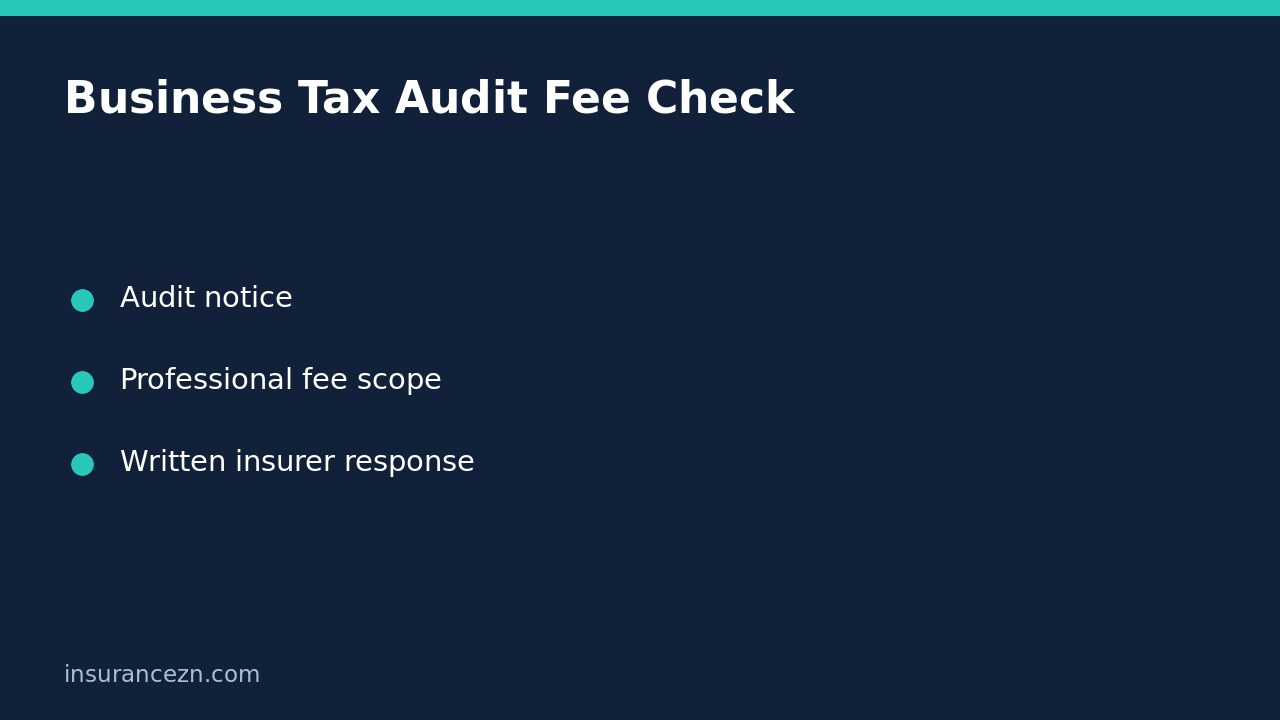

Business tax audit insurance should not be read as a promise to pay whatever an audit says your business owes. Start with the costs the section actually describes. For example, AAMI’s small-business overview describes its optional Tax Probe cover in terms of professional fees reasonably and necessarily incurred when specified authorities audit a business’s financial or tax affairs. That is a different exposure from an additional tax assessment.
This is general information for Australian readers, not personal financial advice or tax advice. Check your own policy/PDS, policy wording, schedule, exclusions and insurer’s written response. The AAMI summary is a provider-specific example, not a description of every Australian business policy or a recommendation of a product.
Separate three different audit-related amounts
A useful review begins by separating money potentially owed to a revenue authority from fees paid to professional advisers. A third group may include penalties, interest or other charges. Do not put everything into one total and assume that a section mentioning audits covers it.
The accessible AAMI overview supports a professional-fees description. It does not establish from that summary alone that an assessed tax debt, penalty or interest is insured. Ask about those amounts explicitly, using the wording of your own contract. Keep an accountant’s advice about tax obligations separate from the insurer’s decision on the professional-fee claim.
Confirm the section was actually purchased
A small-business package can offer several optional covers. Seeing Tax Probe on a sales page does not show that it appears on your schedule. Find the current schedule and wording and check the insured business, policy period, selected section, limit and any excess or other contribution.
Use the business’s exact activities and legal entity when asking the insurer to confirm the cover. A liability certificate is not a substitute for evidence of an optional audit-fees section. The site’s certificate of currency checklist explains why a summary certificate should not be treated as the complete contract.
Match the notice to the policy’s trigger
Keep the original authority notice, attachments and date received. Ask your accountant to identify what the authority has requested and any response deadline. Then give the insurer the actual notice rather than paraphrasing every enquiry as a formal audit.
AAMI’s overview refers to audits by the Australian Taxation Office or a State or Territory department or agency. Other products may define their trigger differently. Ask whether the particular enquiry, review, investigation or audit falls within your section’s definition. Do not infer that routine bookkeeping, voluntary preparation work or a general information request is eligible merely because it concerns tax.
Ask how policy timing, notification requirements and any pre-existing-matter condition apply to your circumstances. Do not assume buying a new section after receiving a notice retrospectively insures the existing matter. Equally, do not decide the claim is excluded without having the actual facts assessed.
Agree the professional-fee scope before costs grow
Ask the accountant for a task-based estimate: reviewing the notice, preparing records, communicating with the authority and any later specialist work should be identified separately. Send the estimate to the insurer and ask which activities, professionals and fee arrangements require consent.
A practical comparison has three columns: work proposed by the adviser, work accepted by the insurer, and costs still unresolved. If extra work becomes necessary, seek an updated response rather than treating approval of the first estimate as unlimited authority. An acknowledgement of uploaded documents is not approval of the fee scope.
Do not ignore an authority’s deadline while waiting for an insurance answer. Discuss a lawful response or extension request with your adviser and notify the insurer promptly. The insurance claim and the tax process are separate workflows; a pending claim does not itself extend the authority’s time limit.
Keep a claim file that can be reconciled
- Save the original notice, schedule and applicable wording together.
- Record the existing insurer claim or enquiry reference.
- Keep fee estimates, written approvals, invoices and evidence of payment.
- Ask advisers to distinguish audit-response work from unrelated accounting tasks.
- Compare each assessment with the approved scope, policy limit and any contribution.
Where the insurer pays less than an invoice, request the calculation and relevant policy provision. A submitted invoice, an approved professional engagement and an actual insurance payment are different milestones. Preserve earlier assessments if a correction is requested, and confirm the processed outcome rather than relying on a submission receipt.
Quick questions for a policy review
Does ordinary business insurance automatically include this? Not on the strength of a product overview. Check the selected sections on your own schedule.
Does cover remove the need to budget for tax? No such conclusion follows from professional-fee cover. Discuss the underlying tax exposure with your accountant separately.
Is the advertised limit the amount I will receive? No. The payable amount depends on an eligible event, accepted fees, contract terms and the final assessment, not just the headline maximum.
Source
AAMI: Small Business Insurance describes Tax Probe among optional covers and directs readers to the PDS and policy wording for terms, limits, conditions and exclusions.