
Yes. For Australian private hospital insurance, a condition can be treated as pre-existing even if you had no diagnosis before joining or upgrading your cover. The important question is whether signs or symptoms existed during the relevant period, not simply when a doctor gave the condition a name. If you are arranging treatment soon after buying cover, ask your insurer about an assessment before assuming the hospital bill will be covered.
This is general information for Australian readers, not personal financial advice or medical advice. Cover depends on your policy, applicable waiting periods, exclusions, restrictions and benefit limits. Read the policy documents, Private Health Information Statement and any relevant Product Disclosure Statement (PDS); obtain individual confirmation before committing to costs.
Why the diagnosis date is not the only date that matters
The Australian Government’s PrivateHealth.gov.au explanation of waiting periods says a pre-existing condition can be an ailment, illness or condition with signs or symptoms in the six months before you joined hospital cover or upgraded to a higher hospital policy. You do not need to have known what the condition was, and you do not need to have seen a doctor during that period.
That makes a simple question such as “Was I diagnosed after joining?” insufficient. Earlier symptoms may matter even if you thought they were minor or unrelated. Conversely, having an old medical record does not let a reader decide the insurance outcome themselves. The insurer’s appointed medical practitioner makes the assessment, taking account of information from your own doctor.
A practical example: symptoms before joining, diagnosis afterwards
Imagine Priya joins hospital cover after several weeks of unexplained abdominal discomfort. Later, a specialist identifies a condition and recommends a hospital procedure. The fact that the diagnosis arrived after the policy began does not, by itself, establish that the condition is new for insurance purposes. The earlier discomfort may be relevant to the assessment.
This is a hypothetical example, not a claim decision. Priya should give an accurate timeline rather than try to label the condition herself. She can ask the treating doctor to help identify when symptoms were first recorded, when investigations occurred and when admission is proposed. The insurer then needs to explain which benefits and waiting-period rules apply to her particular policy.
Build a short timeline before contacting the insurer
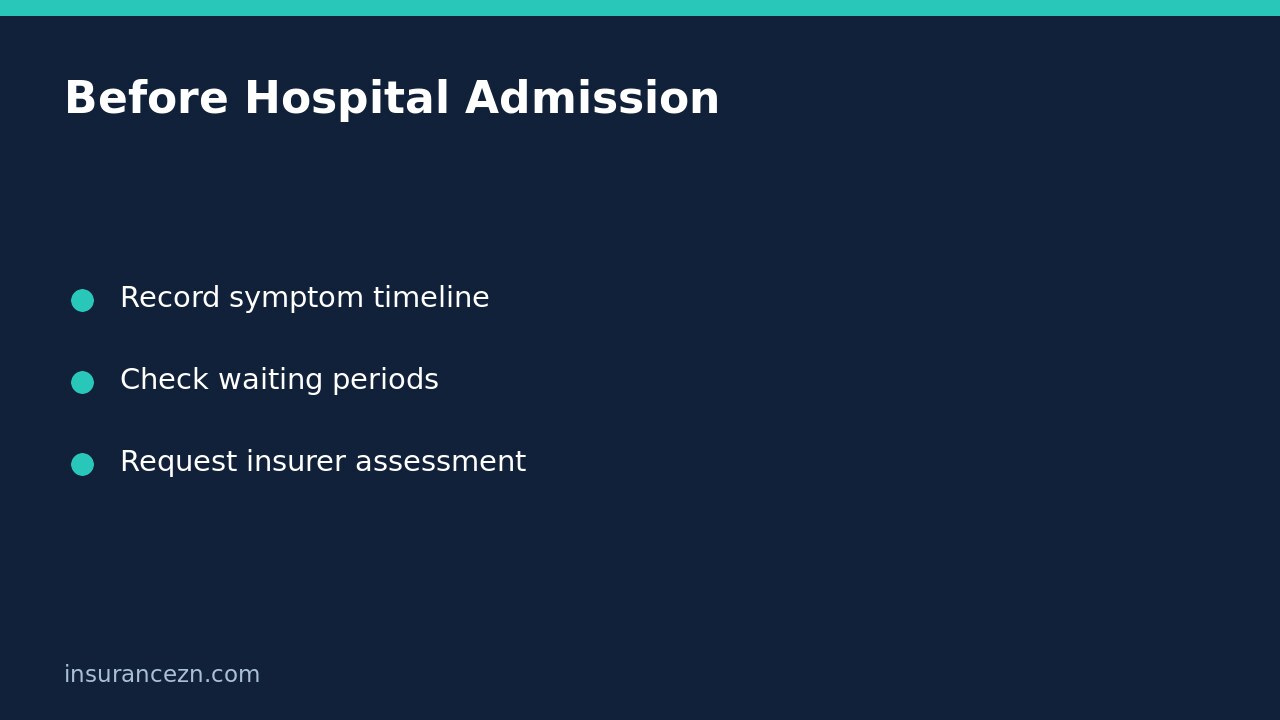
- Record the date hospital cover started and any later upgrade date.
- Write down when symptoms first appeared, including uncertainty rather than guessing an exact day.
- List GP visits, referrals, tests and specialist appointments that relate to the proposed treatment.
- Ask the treating team for the proposed procedure details, likely admission date and relevant item numbers if available.
- Contact the insurer and ask what medical information and consent it needs for its assessment.
Keep copies of correspondence and record any reference number. Ask how long assessment is expected to take and whether further information is outstanding. PrivateHealth.gov.au specifically warns that insurers need time to advise whether a condition is pre-existing, so leave room for that process before an elective admission where possible.
Separate waiting periods from the cover itself
The government sets a maximum hospital waiting period of 12 months for pre-existing conditions. Psychiatric treatment, rehabilitation and palliative care have a maximum two-month waiting period even for pre-existing conditions. Different rules, including a specific psychiatric-care upgrade exemption, can affect some situations; ask the insurer rather than applying a general rule to every service.
Completing a waiting period does not add a treatment category that your policy excludes. Check separately whether the proposed treatment is included, restricted or excluded, and ask about excesses, co-payments and possible out-of-pocket bills. An assessment about waiting periods is not automatically an estimate of every charge from the hospital, surgeon or anaesthetist.
Nor should these hospital rules be assumed to describe extras cover. The same official source explains that insurers set waiting periods for general treatment such as dental and optical services. Use the correct policy section for the benefit you want to claim.
Quick questions before you book
- Does no previous GP visit guarantee cover? No. Signs or symptoms can matter even without an earlier consultation.
- Should I cancel treatment while waiting? Do not delay urgent medical care based on an insurance article. Discuss urgency and treatment options with your clinician while checking funding separately.
- What should I request in writing? Ask for the assessment outcome, the waiting period applied, the relevant policy benefit and any qualifications to the response.
Finally, keep the assessment response with the policy version and your notes. A dated record helps you follow up an unclear answer without repeatedly reconstructing your medical and insurance timeline.