
Before choosing Australian hospital cover for a planned admission, ask whether each treating doctor will use the insurer’s gap arrangement for your specific procedure. Finding a specialist in an insurer’s directory is a starting point, not a promise that your operation will have no medical gap. Compare the policy and the treatment arrangements together.
The Australian Government’s PrivateHealth.gov.au out-of-pocket costs guidance explains that doctors can decide case by case whether to use an insurer’s gap cover arrangement. It also distinguishes medical fees from hospital charges. That distinction is essential when comparing quotes.
Ask about this admission, not just general participation
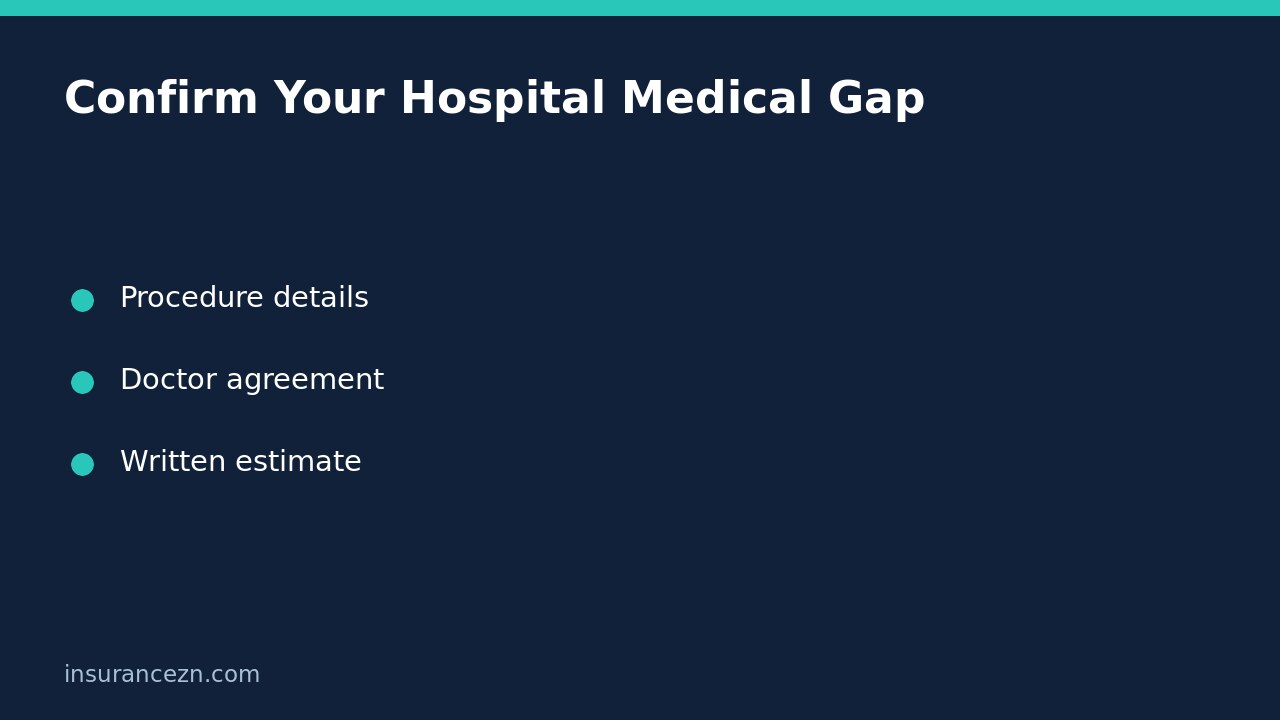
‘Does the specialist participate?’ is an incomplete question. A more useful version is: ‘For my proposed admission, with these expected Medicare Benefits Schedule (MBS) items and this insurer, will you treat me under its gap arrangement, and what will I personally pay?’ Ask for a written estimate.
The insurer can explain its scheme and policy benefits, but it cannot substitute for the doctor’s confirmation about how that doctor intends to bill. Conversely, a doctor’s statement about participation does not establish that your policy covers the procedure or that waiting periods have been served.
Obtain both answers. If either party gives only a general assurance, request clarification against the named patient, procedure, expected admission date and current policy.
Collect the same treatment details for each policy comparison
Start with your specialist’s rooms. Ask for the expected MBS item numbers, proposed fees, intended hospital and details of other clinicians likely to bill separately. The official guidance recommends asking about other treating doctors, such as an anaesthetist or assistant surgeon, and obtaining written estimates where possible.
Then give each shortlisted insurer the same information. Ask it to confirm:
- Whether the expected treatment is covered under the policy’s clinical categories.
- Any exclusions, restrictions or waiting periods relevant to the admission.
- How its medical gap arrangement would apply if each doctor agrees to use it.
- Whether the intended hospital has an agreement with the insurer.
- The applicable excess, co-payments and any other identified hospital charges.
Keep the doctor’s proposed charges and the insurer’s benefit explanation in separate columns. Do not treat a description of the MBS fee as a quote for the doctor’s actual bill.
Check every separately billing clinician
Imagine a planned operation where the surgeon confirms use of an insurer’s gap arrangement. The anaesthetist’s billing position is not yet known. This illustrative situation should be recorded as ‘surgeon confirmed; anaesthetist estimate outstanding’, not ‘operation gap-free’.
Ask the specialist’s office how to contact the anaesthetist and any assistant surgeon. Seek each provider’s expected fee, applicable scheme arrangements and estimated personal payment. If the team is not finalised, note that limitation and ask when confirmation will be available.
Do not add made-up charges to complete a comparison sheet. An unknown amount is genuinely unknown. Keeping it visible is more useful than presenting a misleading total.
Separate medical gaps from hospital expenses
A medical gap arrangement concerns eligible medical bills; it does not automatically remove a hospital-policy excess. PrivateHealth.gov.au explains that an excess or co-payment can still be payable even at a hospital with an insurer agreement. Hospital agreements and doctor gap arrangements answer different questions.
For each policy, maintain three lines: expected medical out-of-pocket costs, expected hospital charges including the excess, and unresolved items. Ask about relevant device costs where applicable. A verbal statement that the hospital ‘accepts your fund’ does not settle every line.
If you are comparing a combined hospital-and-extras package, assess the extras separately. Our guide to using an itemised dental quote to compare extras explains a different benefit-checking exercise; dental rebates should not be confused with hospital medical gap arrangements.
Final questions before changing cover
Can a doctor appear in a directory but decline the scheme for my procedure? The official guidance says participation can be decided case by case. Obtain admission-specific confirmation rather than relying solely on a directory entry.
Does a higher premium guarantee smaller medical gaps? No such guarantee follows from price alone. Compare treatment eligibility, provider billing and applicable agreements, as well as the premium.
Should I switch immediately after receiving a promising quote? First check transfer arrangements, any new or increased benefits and relevant waiting periods with the receiving insurer. Do not cancel existing cover until the replacement and its commencement are confirmed.
Keep dated written estimates and confirmations, and ask for updates if the treatment, hospital, clinicians or admission date changes. Estimates support an informed decision; they cannot guarantee that an unplanned change in care will have no extra cost.
This is general information for Australian readers, not personal financial advice or medical advice. Benefits depend on the policy, PDS where applicable, fund rules, exclusions, waiting periods and actual treatment. Discuss clinical decisions with your treating professionals and confirm insurance benefits directly with the insurer.