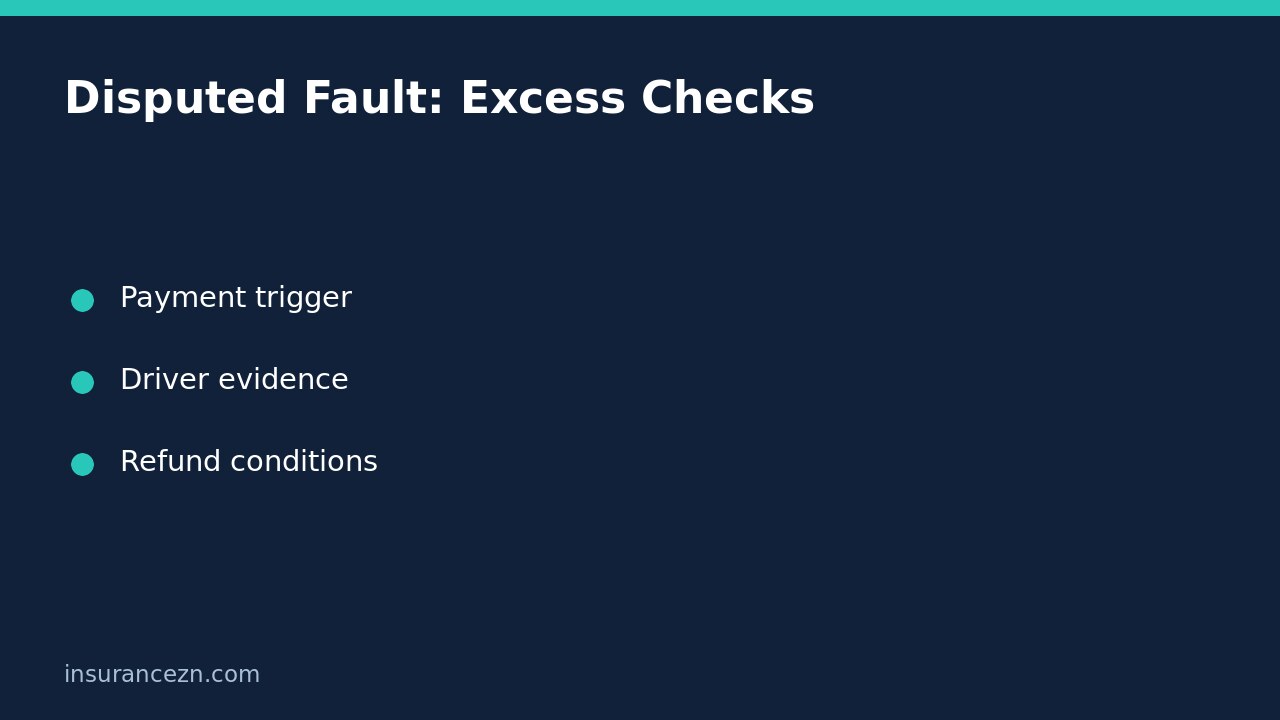

When comparing Australian car insurance, do not assume that saying an accident was not your fault automatically removes the excess. Compare the circumstances in which each insurer requires payment, the evidence it needs and any conditions for waiving or refunding an excess. If responsibility is disputed, those details can matter more immediately than a small difference in the quoted premium.
The useful question is not simply ‘What is the excess?’ It is ‘What would I need to pay while this particular claim is being assessed?’ Obtain the answer against the actual policy wording rather than relying on a comparison-table headline.
Separate accident responsibility from the payment conditions
Responsibility for an accident and the contractual conditions for paying an excess are connected, but they are not interchangeable. An insurer may need information before it can decide how a policy condition applies. Your account of the collision is important evidence, not a guarantee of an immediate waiver.
Legal Aid NSW explains that claiming on a policy may involve an excess and can affect a no-claim bonus or future premiums. Its guidance also distinguishes handling a claim through your insurer from trying to recover losses from another driver. The page concerns NSW; do not assume its court procedures apply throughout Australia.
Build a comparison sheet around one realistic accident
Use the same scenario for every quote: another car changes lanes into yours, both drivers dispute responsibility, and you have photographs and the registration number. This is an illustrative comparison exercise, not a claim outcome or legal conclusion.
For each shortlisted policy, record written answers to these questions:
- When must the basic excess be paid: when lodging, before repairs, or at another stage?
- Which additional excesses could apply to the driver and circumstances?
- What exact conditions allow an excess to be waived?
- What identifying information about the other driver is required?
- If an excess is initially paid, what conditions permit a later refund?
- Who should receive additional evidence, and how can the claim decision be reviewed?
Do not fill a blank answer with an assumption. Mark it ‘confirmation needed’ and ask the insurer to identify the relevant product disclosure statement (PDS) section, policy schedule or supplementary wording.
Check the evidence requirement before choosing a policy
Ask whether a registration number alone is enough for the particular excess condition, or whether other information is required. Compare how the policy deals with incomplete identification rather than assuming every insurer uses the same definition. Never place yourself at risk to obtain information after an accident.
Keep photographs, witness contact details where available, a factual description of vehicle movements and copies of communications. Distinguish what you observed from what you inferred. Evidence helps an assessment; it does not guarantee a finding about responsibility or satisfy every coverage condition.
Also review accident notification rules before buying. Legal Aid NSW notes that a policy may require notification even when you decide not to claim. Notification and a request for an excess waiver are separate issues.
Compare your temporary cash exposure, not just the eventual result
Suppose one insurer confirms that an excess must be paid while it investigates disputed responsibility. Another quote contains a waiver condition, but the available information does not yet establish that you meet it. Neither answer should be recorded as ‘no excess’ merely because you believe the other driver caused the collision.
Instead, list the amount you could need to fund initially, alongside the conditions for any later adjustment. This is a budgeting exercise, not a prediction that the insurer will reject or accept the claim. Consider whether you can meet the potential payment without assuming a rapid recovery from the other driver.
Do not authorise repairs, incur hire-car charges or agree to a private settlement on the assumption that your insurer will reimburse everything. Ask what approval is needed and how taking those steps could affect handling of your claim.
Questions to resolve before accepting the quote
Does comprehensive cover mean an excess never applies? No. The relevant excess and exceptions depend on the contract and circumstances; comprehensive is not a promise of cost-free claims.
Will an excess always be refunded if I say I was not responsible? Do not assume so. Ask which findings, information or recovery conditions the insurer requires and request confirmation in writing.
What if the answer contradicts the PDS? Ask for the discrepancy to be resolved before buying. Keep the quote, applicable document version and written explanation together so you can understand what you are purchasing.
This is general information for Australian readers, not personal financial advice or legal advice. Cover, exclusions, excesses and claim outcomes depend on the applicable policy, PDS, schedule and facts. Obtain advice appropriate to your circumstances where necessary.