
If you are comparing car insurance while advertising your vehicle for private sale, ask one precise question: what happens if a prospective buyer damages the car during a test drive? Permission to drive does not by itself establish insurance cover. Compare the policy’s test-drive conditions, driver restrictions and applicable excess before handing over the keys.
This is general information for Australian readers, not personal financial advice. Cover depends on the particular policy, Product Disclosure Statement (PDS), supplementary documents and certificate of insurance, including exclusions and conditions. An insurer must assess the actual circumstances of any claim.
Start with the private-sale test-drive wording
A comprehensive policy can cover accidental damage without covering every circumstance in which that damage occurs. On its comprehensive insurance overview, AAMI says it does not cover loss or damage during private-sale test drives unless the policyholder or another listed driver is a passenger. That is a provider-specific condition, not a rule that can be assumed for every Australian insurer.
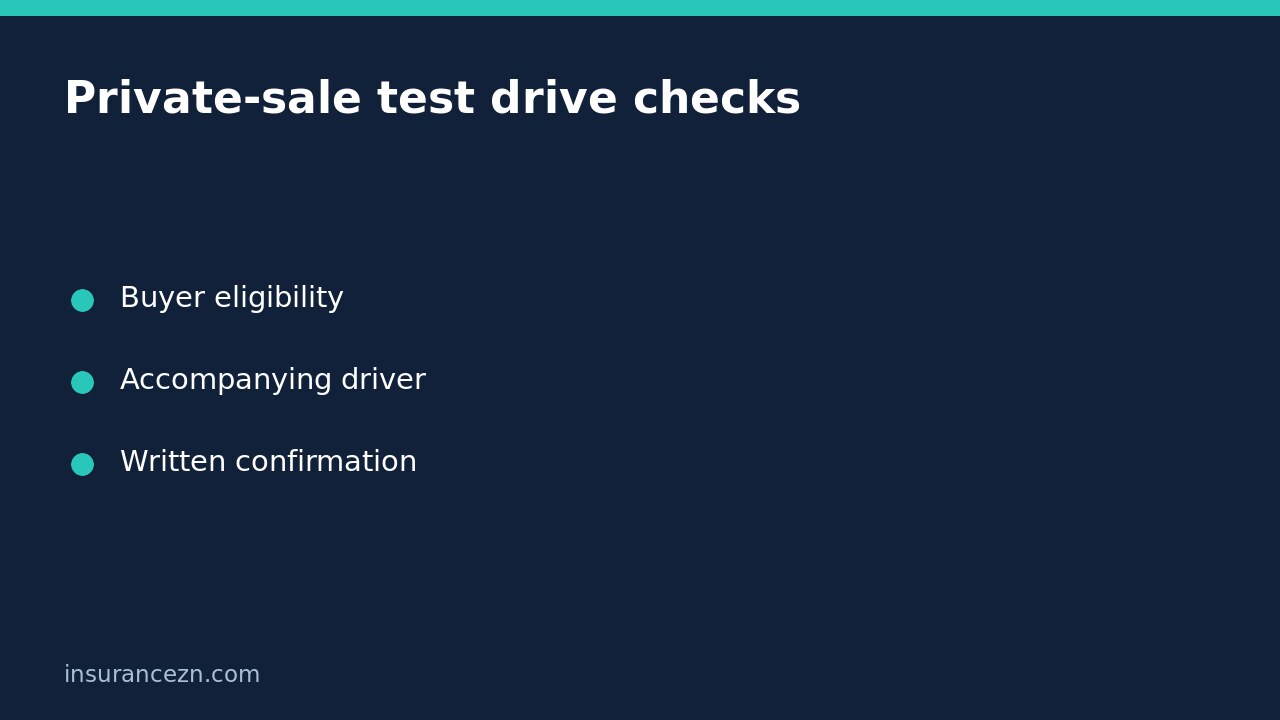
Use this example to build a comparison question rather than to rank products. Ask each insurer to identify the clause for private-sale test drives and explain whether you, a listed driver or another approved person must accompany the buyer. Do not assume that an authorised friend and a listed driver mean the same thing.
Describe the actual driver and journey
A vague enquiry such as ‘Are other drivers covered?’ may not resolve a private-sale condition. Explain that you still own the car, it is advertised for sale, and a prospective buyer will drive it before making a purchase. Tell the insurer who will sit in the passenger seat and whether the buyer is already listed on the policy.
- Ask which licence types and driver eligibility conditions apply.
- Check whether any driver-age or other restrictions affect this test drive.
- Ask what excesses could apply to that driver and incident.
- Check whether the route, vehicle use or any existing modification matters.
- Ask whether a change to the policy is required before the drive begins.
A seller should also check that the person is legally permitted to drive the vehicle. Legal driving permission and insurance eligibility are separate checks: satisfying one does not prove the other.
Compare two scenarios, not just two premiums
Consider a hypothetical seller, Alex. A buyer asks to drive alone while Alex waits at home. Another buyer is happy for Alex to ride along. Alex should put both scenarios to each insurer. A policy with an accompanying-driver condition could produce different coverage questions for those journeys, even though the car and driver are otherwise unchanged.
Record the answers in a simple comparison sheet: accompanying-person requirement, buyer eligibility, damage-to-your-car cover, liability for damage to other property, excess conditions and any required endorsement. Leave an unanswered item marked ‘not confirmed’, rather than treating a broad sales statement as a yes.
Do not infer that passing the passenger requirement guarantees a paid claim. The remaining policy conditions and exclusions still apply. AAMI’s overview itself directs readers to the PDS for the full terms.
Resolve an amendment before the buyer arrives
If an insurer says the arrangement needs an amendment, ask exactly what will change and when it becomes effective. A submitted online request or automated acknowledgement is not the same as a processed endorsement. Obtain updated documents or written confirmation that records the accepted arrangement before relying on it.
Keep the quotation, relevant PDS version and insurer response together. If the answer conflicts with the wording, ask the insurer to reconcile the conflict. Do not change the facts of the enquiry to obtain a more reassuring answer.
Checklist before handing over the keys
- Read the private-sale test-drive clause and driver restrictions.
- Confirm the actual buyer and accompanying-person arrangement.
- Understand which excesses could apply without assuming fault is already settled.
- Check any amendment is accepted and effective.
- Retain the insurer’s written response with your policy records.
If you are reviewing cover at renewal before selling, also read our comparison of renewal quotes and agreed value. The insured value and the test-drive conditions answer different questions; both can matter.
Does agreeing to buy the car change the answer?
A promise to purchase does not resolve who owns the vehicle, when cover ends or when the buyer’s insurance begins. Ask the insurer about the actual handover timing separately. If a test drive cannot meet the confirmed conditions, change the arrangement or postpone it rather than assuming a later purchase will fix a coverage gap.