
Switching from comprehensive car insurance to third party property cover can lower the quoted premium, but it also changes which repair bills you may need to fund yourself. Before comparing prices, test a specific scenario: you cause an accident, another vehicle is damaged, and your own car cannot be driven. A quote that addresses the other vehicle does not necessarily pay to restore yours.
This is general information for Australian readers, not personal financial advice. Cover depends on the policy wording, Product Disclosure Statement (PDS), schedule, exclusions and claim circumstances. This worksheet does not recommend a particular product or insurer.
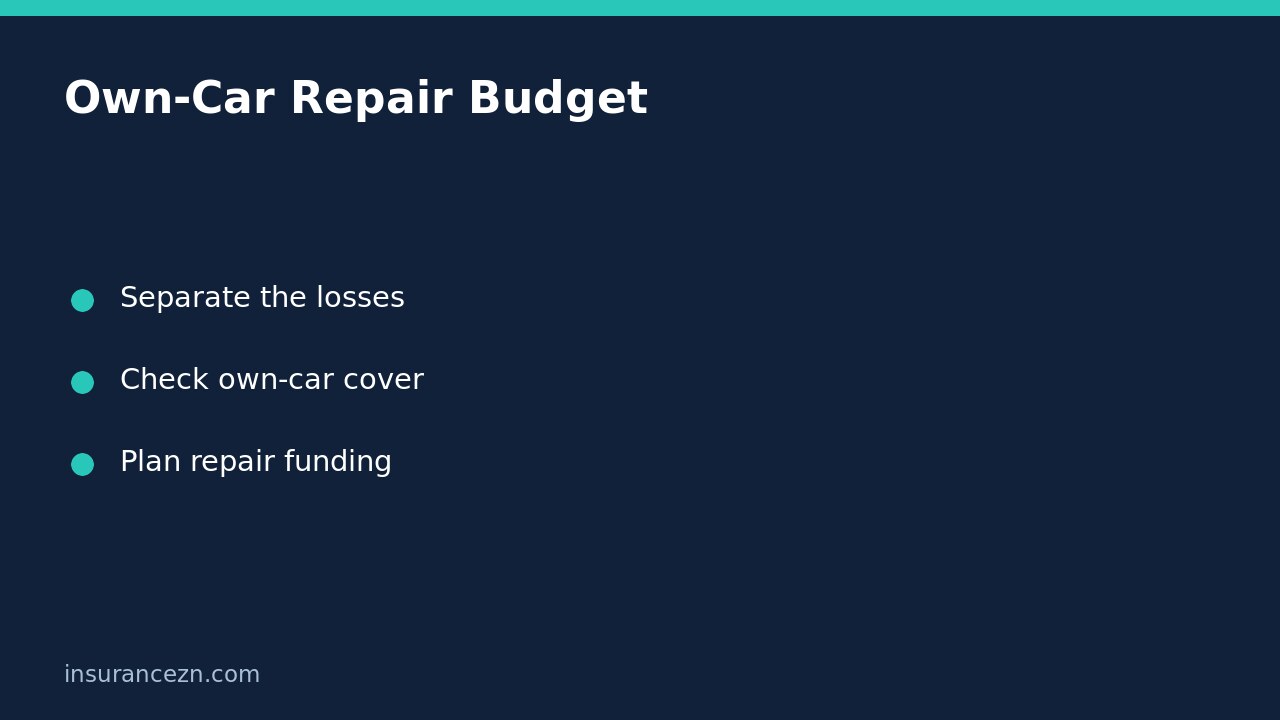
Separate your car from the other party’s property
Legal Aid NSW explains the difference: third party property insurance addresses claims for damage to other cars and property, while comprehensive insurance also addresses damage to the insured car, subject to its terms. Compulsory third party injury insurance is a different protection and does not pay vehicle repair bills.
Draw two columns on your comparison sheet. Label one ‘other people’s property’ and the other ‘my car’. For each quote, record the relevant cover, applicable excess and important limits in each column. Do not place a tick beside both columns simply because the product includes the words ‘car insurance’.
Use an at-fault accident as the budget test
Start with an accident where you cannot assume another driver will reimburse you. Imagine your car needs repairs that you cannot immediately afford, or the damage makes repair uneconomic. This is a planning scenario, not a prediction of an insurer’s assessment or a guaranteed total-loss outcome.
- Ask whether the proposed policy provides any benefit for your own accidental damage in this scenario.
- Identify money actually available for repairs or replacement, rather than a credit limit you may not be able to repay.
- List practical transport alternatives while the car is unavailable, including getting to work or essential appointments.
- If the car is financed, check the finance contract’s insurance requirements before changing cover.
An older vehicle can still be essential to a household. Its modest resale value does not automatically mean losing it would be affordable. Conversely, being able to fund a replacement does not remove the separate need to consider liability for expensive damage to someone else’s property.
Do not treat uninsured-driver benefits as comprehensive cover
Legal Aid NSW notes that some third party property policies provide a limited own-car repair benefit where an identified uninsured driver caused the accident. That is a conditional benefit, not a substitute for broad own-car accidental-damage cover.
Ask each insurer to point to the exact clause and explain the limit, identification requirements and other conditions. Then return to your original scenario: does that clause help when you caused the accident? If it does not, leave that repair cost in your self-funded column. Do not assume another motorist’s lack of insurance will always be established or that every policy offers the benefit.
Compare a premium saving with the protection removed
Request quotes using the same drivers, address, vehicle use and policy period. Record the comprehensive premium and the third party property premium separately, along with their excess arrangements. A lower premium is a certain quoted cost difference; the future repair bill is an uncertain risk. They are not interchangeable amounts.
For the comprehensive option, establish the valuation basis and insured amount rather than assuming it will replace your car with an equivalent advertised vehicle. Our renewal comparison guide on agreed value explains why valuation should remain visible in the worksheet. Also ask which transport or towing benefits, if any, actually apply; do not add advertised benefits to your budget without checking their conditions.
Questions to settle before changing policies
- Could I fund my own repairs or replacement without relying on an unconfirmed claim against another driver?
- Does the new cover meet any finance requirements?
- Which excesses apply to the scenario I am testing?
- Have I checked the actual start and end times so there is no unintended gap?
- Have I saved the accepted quote, PDS and schedule rather than just a comparison-screen summary?
Does deciding not to claim remove notification duties?
Not necessarily. Legal Aid NSW says the policy may require accident notification even when no claim is made. Check that obligation separately. If an accident has already happened, changing cover afterwards does not retrospectively insure it. Keep the existing event, the decision to claim and the choice of future cover as three separate questions.