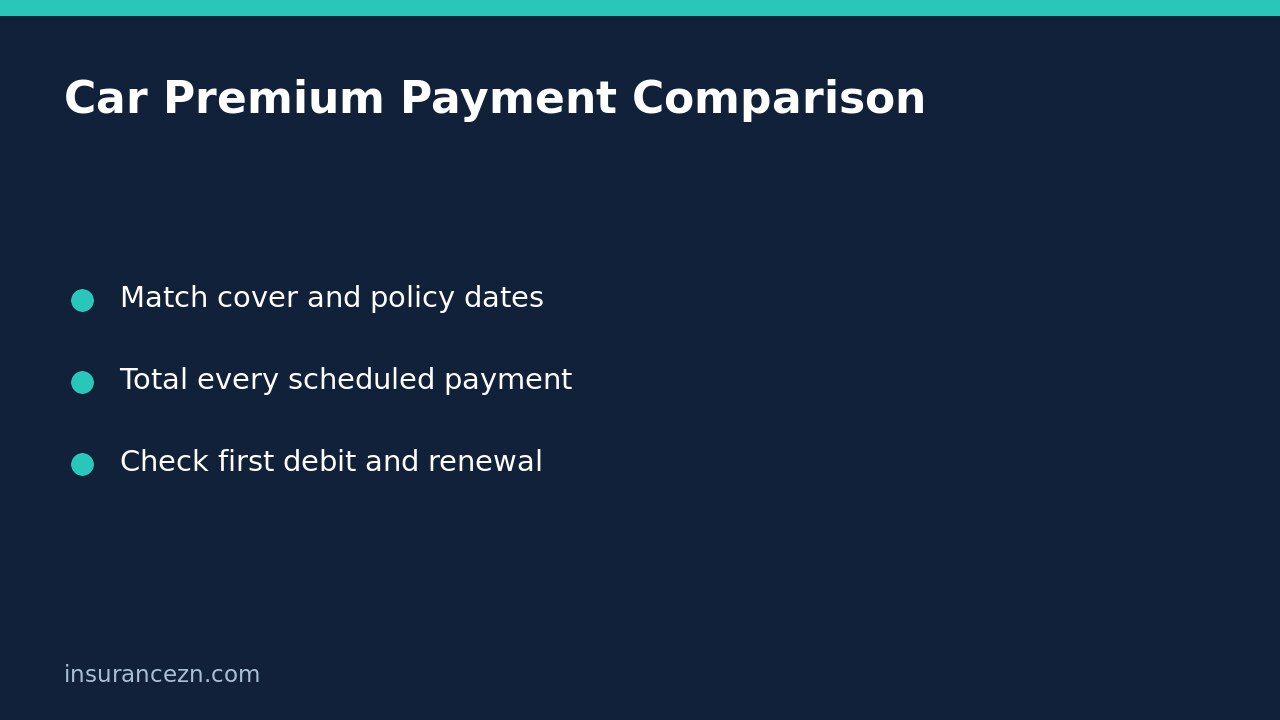

When comparing Australian car insurance quotes, do not compare one insurer’s monthly debit with another insurer’s annual premium. Obtain the complete payment schedule for the same period of cover, total the amounts actually payable, and then compare the payment timing alongside equivalent policy benefits. A manageable monthly amount and a lower overall cost are different questions.
This is general information for Australian readers, not personal financial advice. Cover, payment obligations and claims depend on the applicable policy, Product Disclosure Statement (PDS), schedule and insurer acceptance. There is no recommendation of a particular insurer or payment method.
Start with genuinely equivalent quotes
Save an annual-payment quote and an instalment-payment quote with the same vehicle, drivers, address, use, cover dates, excess and optional benefits. Check the insured value as well. Otherwise an apparent payment-method saving may actually come from reducing protection or increasing the amount payable when claiming.
Record each quote reference and expiry date. If selecting a different payment frequency refreshes the quote, compare the newly displayed terms rather than relying on an earlier screenshot. Ask which discounts apply to each version and whether the stated total already includes applicable charges. Do not assume every insurer prices instalments the same way.
For the separate value comparison, use our guide to comparing renewal quotes without losing agreed value. Payment timing does not compensate for an unintended change in the vehicle’s insured value.
Total the actual schedule, not an attractive headline
Make a worksheet with columns for insurer, cover period, payment frequency, first debit, later debit amounts, number of payments, separately payable charges and total payable. Ask for clarification if the quote displays only an indicative monthly amount without the complete schedule.
The comparison is the sum of all scheduled premiums for the quoted period, plus any applicable charges not already included. Avoid counting an included charge twice. Only multiply a monthly figure by twelve when the actual schedule confirms twelve equal payments for the same policy period. A different first payment or irregular dates require the actual amounts instead.
Keep a promotional discount separate from the ongoing price question. A first-period saving does not establish next year’s renewal premium. Equally, do not describe instalments as universally more expensive: use the difference between the particular matched quotes you obtained.
Compare affordability at the dates money leaves
Next, write the payment dates against your normal household cash flow. Can the annual amount be paid without consuming the money reserved for an excess or essential expenses? Can the first instalment be met before the next pay day? A lower yearly total may still create an immediate cash shortfall.
Ask whether the proposed debit date can be selected or changed, what processing time applies and what confirmation you will receive. Do not move money or cancel a debit instruction on the assumption that an online request has already been processed. Obtain the accepted schedule and verify the first actual debit.
Also ask how cancellation, a vehicle replacement or a total-loss claim affects remaining premiums under the applicable contract. Do not assume monthly collection means a month-to-month contract or that stopping the bank instruction ends every obligation.
Check the missed-payment process before choosing
Suncorp’s payments and renewals page describes overdue-instalment notification and cancellation notice, as well as conditions for requesting a delayed debit. This is a provider-specific process, not a rule to transfer to every Australian car policy. Confirm the current conditions for the exact product you are considering.
Ask each insurer how an unsuccessful debit is communicated, what action is required and how a requested payment change is confirmed. Keep contact details current. An acknowledgement of a request is not proof that the due date changed, and a bank payment record alone does not establish that the insurer has correctly allocated it.
Final questions before accepting a quote
- Are both quotes for identical dates, cover, insured value and excess?
- Do I have every payment amount and due date, not just an estimate?
- Have I included charges once and separated temporary promotions?
- Can I meet the first payment while retaining practical emergency cash?
- Do I understand missed-payment, cancellation and remaining-premium terms?
Does the smallest monthly debit identify the best policy?
No. It identifies only one part of the payment arrangement. Compare the full-period cost, the contract’s protection and exclusions, and the payment dates you can realistically meet. After acceptance, retain the certificate and processed payment schedule; requesting a quote or submitting a payment preference is not itself confirmation that cover has commenced.