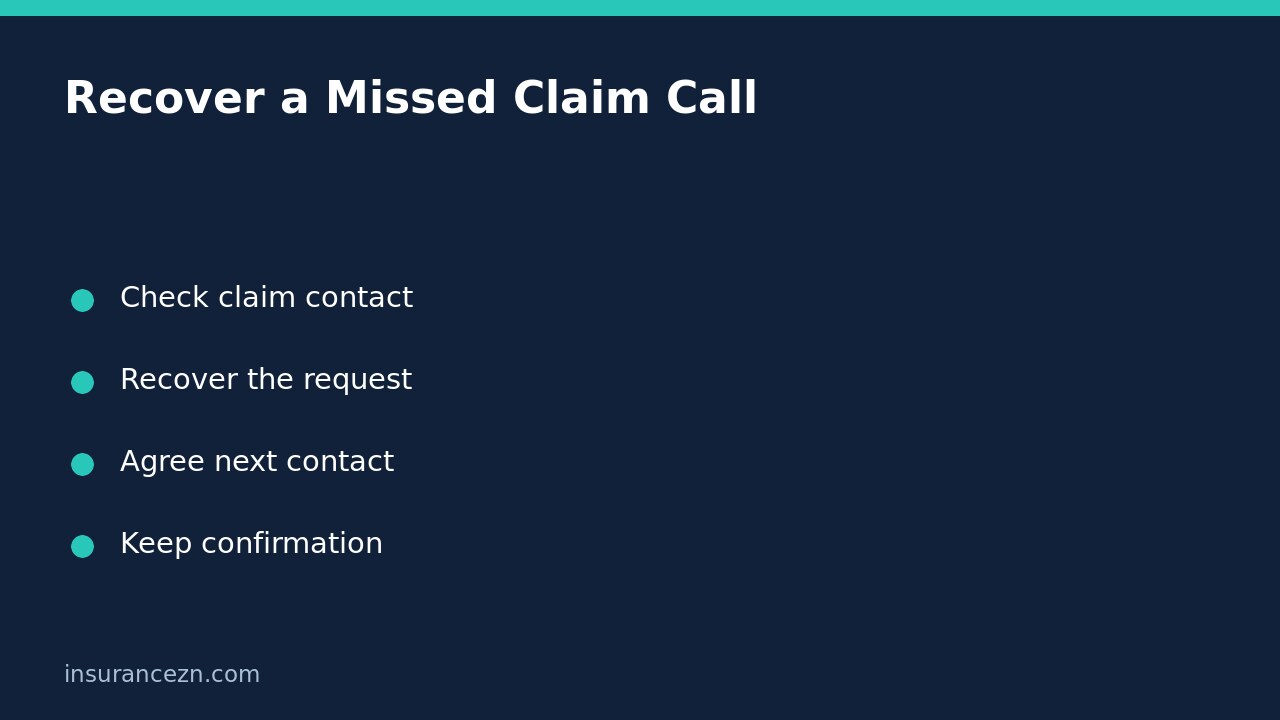

If you miss a call about an Australian car insurance claim, do not assume the insurer has approved repairs, rejected the claim or stopped needing information. Recover the message through a verified contact route, check the telephone number actually recorded on the claim and establish the next action.
The avoidable mistake is changing a number somewhere in your account and assuming every person handling the claim now has it. Ask what contact information is held for this particular claim and whether the requested change has been processed.
Recover the outstanding request, not just the missed number
Start with your claim reference and the time of the missed call. Check voicemail, email and the claim tracker for an explanation. Avoid relying on an unfamiliar caller’s number as proof of identity. Open the insurer’s website or app yourself, or use contact details from your policy documents, to ask whether the insurer attempted contact.
Ask three focused questions: who was trying to reach you, what information or decision they needed, and what action remains outstanding. A missed call could concern incident details, an assessment arrangement or another administrative matter. The missed-call notification alone does not establish which.
Do not start a second claim merely because the first caller did not reach you. Keep the conversation attached to the existing incident reference unless there is genuinely another event requiring separate notification.
Check the number held on the claim record
Suncorp’s comprehensive-car claims page states that if it needs to confirm something, it will call the number provided during the claim. It also describes online claim management and tracking. This supports checking the contact details supplied at lodgement; it does not establish that an account-profile edit automatically changes every downstream record.
- Ask which number is recorded for contact on the current claim, using the insurer’s identity checks.
- Explain whether it is obsolete, temporarily unavailable or simply difficult to answer during work.
- Confirm the correct number and whether voicemail can safely be left.
- Ask whether an assessor, repairer or other relevant service contact needs a separate update.
- Request confirmation that the change is recorded, rather than treating an automated acknowledgement as completion.
A phone-number change is not the same as giving another person authority to discuss your claim. If someone else will handle calls, ask about the insurer’s representative-authorisation process instead of assuming possession of your phone is sufficient.
Arrange a realistic next contact
Give a practical availability window and ask what contact options are supported. If your reception is unreliable or answering calls is difficult, explain the limitation and ask about suitable alternatives. Do not assume a preferred channel has been accepted until the insurer confirms the arrangement.
For example, imagine you lodged the claim while using a temporary mobile, then returned to your usual number. A profile update may have been submitted, but the unresolved task is to confirm the number on the claim and recover the caller’s actual question. Write down both outcomes separately: ‘contact corrected’ and ‘information request answered’. This is an illustrative scenario, not a claim about a particular insurer’s systems.
If a request has a due date, recover the exact date and ask promptly for clarification or additional time where needed. Sending a contact-update request does not itself extend a deadline or prove that earlier correspondence no longer matters.
Keep the contact outcome separate from claim approval
Suncorp lists several post-lodgement activities, including uploading documents, managing assessments and viewing authorised repairer details. A successful callback or access to a tracker is only a communication step. Ask separately about the claim decision, assessment arrangements and any authorised repair scope.
After the conversation, retain a short note of the date, team, contact correction and outstanding tasks. If you send documents in response, preserve the submission record and ask whether anything further is needed. Evidence received is not necessarily evidence assessed, and neither establishes that every requested repair is approved.
For the separate task of organising incident records, use our car accident claim evidence register. Keep the contact log alongside that register rather than replacing photographs, reports or repair documents with call notes.
Before you stop following up
Has the number changed? Obtain confirmation of the processed claim contact record, not just confirmation that you submitted a request.
Has the caller’s question been resolved? Identify the requested information, your response and what remains outstanding.
Does silence mean rejection? Do not infer a decision from a missed call or lack of a new tracker entry. Ask for the current status and any actual decision in writing. If a problem remains unresolved, ask the insurer about its complaints process rather than assuming a routine progress enquiry is already a formal complaint.
Source: Suncorp comprehensive car insurance claims instructions, including its contact-number and online-tracking explanations. These describe Suncorp’s service, not a universal procedure for every Australian insurer.
This is general information for Australian readers, not personal financial advice. Your policy, PDS, schedule and insurer’s current procedures govern applicable cover, conditions and claim requirements; a contact correction does not create a benefit entitlement.