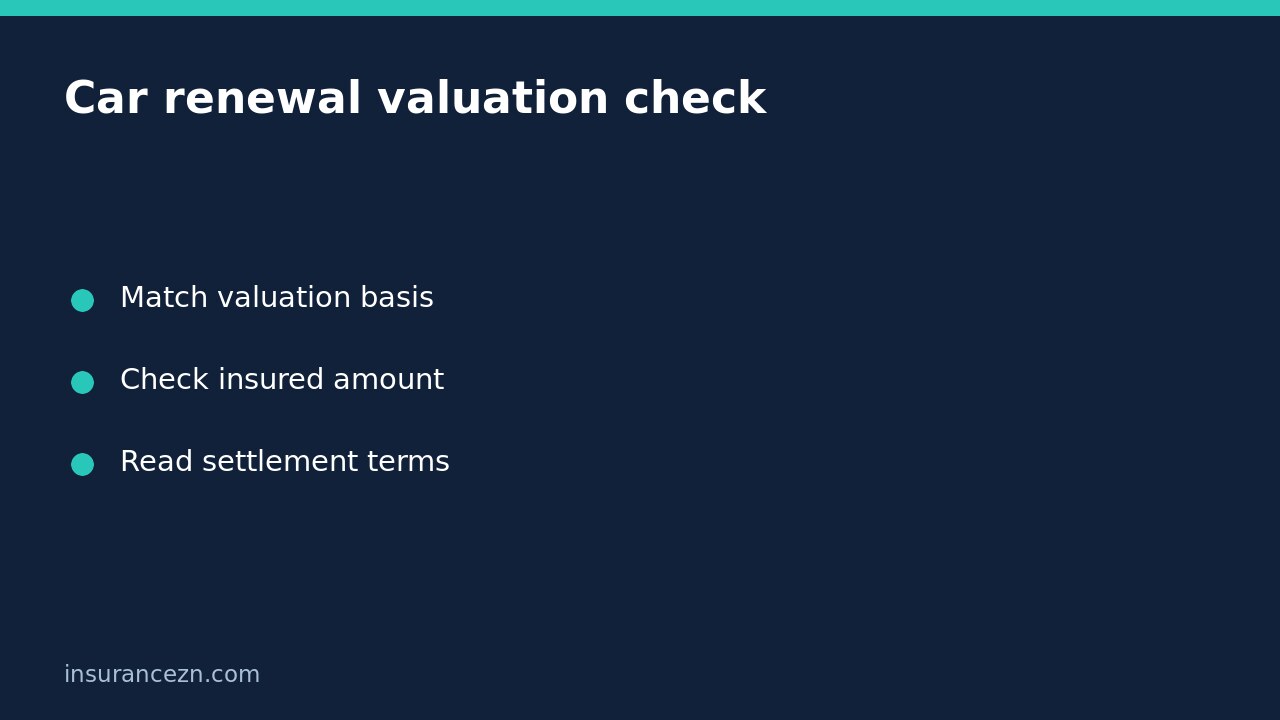

Before accepting a cheaper car insurance renewal quote, check whether it uses the same valuation basis and insured amount as your current policy. A lower premium can accompany a lower agreed value or a change to market value. Those are changes in protection, not simply a discount for identical cover.
This comparison is particularly useful when your car is financed, has approved accessories, or would be difficult to replace from your savings. The aim is to identify what each quote promises before comparing its price.
Separate market value from agreed value
Market value is assessed at the time of loss, using the insurer’s policy definition. Factors can include the vehicle’s model, age, kilometres and condition. An advertised asking price for a similar vehicle can provide context, but it is not a guaranteed claim valuation.
Agreed value is a sum accepted by you and the insurer for the policy term. Do not assume last year’s amount automatically continues into the next term. Read the renewal certificate and the new quote rather than relying on the old schedule or a familiar product name.
Budget Direct’s explanation of market and agreed value describes this distinction and notes that agreed-value availability can depend on eligibility. Its own eligibility rules are an example, not rules that necessarily apply to every Australian insurer.
Build a like-for-like renewal worksheet
Keep the current policy certificate beside each proposed quote. Record the following details in separate columns:
- The valuation basis: market value or agreed value.
- The actual agreed amount, where offered, and the policy dates it applies to.
- Whether declared modifications and accessories are accepted and included.
- The basic excess and any additional driver-related excesses.
- Any new-car replacement benefit and its eligibility conditions.
- The total premium, payment frequency and optional benefits selected.
If one quote uses market value, write that explicitly instead of filling its valuation cell with your own estimate. Otherwise a worksheet can falsely suggest two fixed amounts are comparable when only one is agreed.
Test the replacement task, not just the premium
Consider a hypothetical owner whose current certificate records an agreed value of $24,000. A competing quote offers $21,000 agreed value. Even before checking the excess and other terms, those are different insured amounts. The cheaper quote should not be described as equivalent protection.
Ask what vehicle would realistically meet your needs after a total loss. Check comparable make, variant, age, kilometres and condition rather than selecting the most expensive advertisement. Keep dated examples for your records, but remember they do not bind the insurer.
If a loan remains, request a current payout figure from the lender and check how the insurance policy handles a financier’s interest. The amount borrowed originally is not proof of the current debt, and an agreed value is not automatically a promise to clear every outstanding loan balance.
Read how an accepted total-loss claim is settled
An agreed sum is not permission to ignore the rest of the contract. Locate the total-loss section and ask the insurer which deductions or adjustments can apply, including the relevant excess and any treatment of unpaid premium instalments. Request an explanation for the particular quote rather than assuming another insurer’s method applies.
Also distinguish a cash settlement from a new-car replacement benefit. If replacement is offered, check the age, ownership and other eligibility requirements, and what happens if a qualifying replacement is unavailable. Do not add the advertised benefits together as though every total-loss outcome pays both.
For another important comparison dimension, see our guide to car insurance excess rules when fault is disputed. Valuation and excess answer different questions and both can affect the practical outcome.
Questions to resolve before switching
Can I choose any agreed value? Not necessarily. An insurer may restrict the available range or decline agreed-value cover for a particular vehicle. Ask for an adjusted quote and written confirmation if the amount matters to your decision.
Should I cancel while waiting for clarification? Avoid creating a gap. First confirm the replacement policy is accepted, its start time is correct and the agreed terms appear on its certificate. Then check the old policy’s cancellation arrangements.
What should I save? Keep both quotes, certificates, relevant policy wording and the insurer’s written answers. Recheck the issued documents: a conversation about a preferred value is not a substitute for the actual agreed policy terms.
This is general information for Australian readers, not personal financial advice. Cover depends on the policy, Product Disclosure Statement (PDS), certificate, exclusions, limits and insurer acceptance. Read those documents before buying or switching.