
The headline figure in an insurance cash settlement is not necessarily the amount still to reach your bank account. Before accepting, ask for a written breakdown showing what the offer covers, which amounts have already been paid and what deductions the insurer proposes. Then check whether accepting closes the whole claim or only an identified part.
This is general information for Australian readers, not personal financial advice or legal advice. Your policy, Product Disclosure Statement (PDS), settlement terms and individual circumstances determine available benefits. A payment worksheet does not establish entitlement or replace advice about signing a release.
Start with the scope of the offer
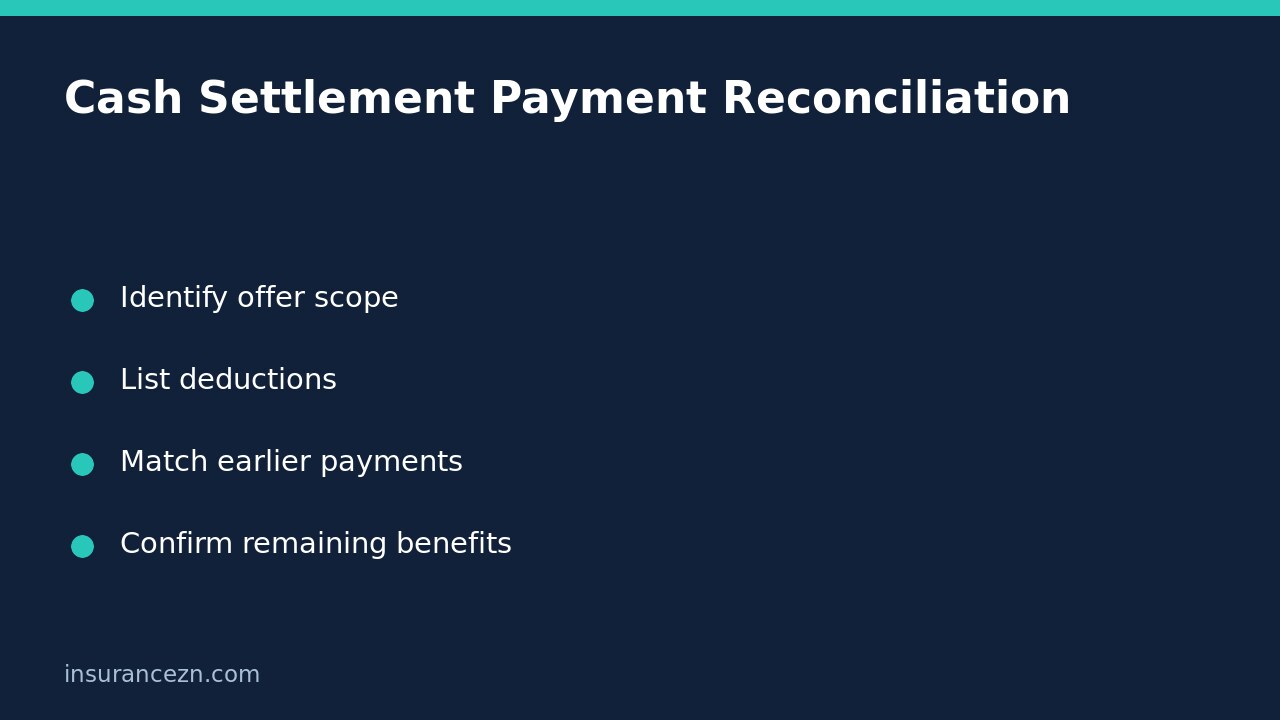
Ask the insurer to label the offer clearly: building repairs, contents, temporary accommodation, another benefit, or a combination. Request the repair scope and calculations behind each component. A single number labelled “settlement” leaves too much room for misunderstanding.
Legal Aid NSW’s Insurance claims after a disaster recommends asking for the reports, documents and calculations used to work out a settlement offer. It also highlights checking whether accommodation is included. This October 2023 publication is used here for practical reconciliation guidance, not current statutory deadlines or historical service contacts.
Record the offer date and version. If a later email changes the scope or amount, retain both and ask which version replaces the earlier offer. Do not silently combine the most favourable parts of different proposals.
Build a gross-to-net payment worksheet
Create a worksheet with four columns: description, amount, supporting document and unresolved question. Use the insurer’s own labels before trying to regroup them. Suggested rows include:
- The proposed allowance for each repair or benefit component.
- Any excess the insurer says remains payable.
- Earlier cash advances it proposes to deduct.
- Any payments to repairers or other parties that affect the balance.
- The remaining payment to you, with the proposed recipient and timing.
Not every row applies to every claim. Ask the insurer to explain the policy or settlement basis for each deduction rather than assuming it is correct merely because it appears on a statement. In particular, do not count an excess twice if you already paid it. Supply the receipt and ask how it has been credited.
The Legal Aid publication notes that emergency money may be deducted from the final claim payment. That makes matching previous payments important, but it does not mean every expense or separately provided benefit should automatically be deducted from the same repair allowance.
Match previous payments to their purpose
In a fictional example, a household has received an emergency transfer, a separate accommodation reimbursement and an insurer email proposing cash for repairs. The family should not assume all three payments belong to the building repair settlement. Instead, match each bank transaction to its approval letter, date and stated purpose.
Ask: “Does the proposed remaining payment already account for the emergency transfer? Is the accommodation reimbursement being treated under a separate benefit? Please identify where each appears in the calculation.” This resolves the accounting question without claiming a particular deduction is necessarily invalid.
If the statement includes money paid directly to a contractor, ask which completed work it represents. Check whether that work is also included in the cash repair scope. A matching description can flag a question, but is not proof of double charging; request the insurer’s explanation.
Separate repair funding from benefits that may continue
Ask whether temporary accommodation, debris removal or other benefits remain available after acceptance, and under what limits and approvals. Do not treat “claim remains open” as a clear promise that every benefit continues. Equally, do not assume a repair settlement necessarily uses up every separate benefit without reading its terms.
Reconcile the proposal with independent repair quotes and the actual scope. A clearly calculated payment can still be inadequate for the agreed work. Check whether quotes include relevant approvals, necessary work and identified uncertainties, without assuming every contingency is insured.
Before accepting responsibility for repairs, also consider whether the damaged home will remain insured after a cash settlement. Ongoing cover is a separate question from whether the payment calculation balances.
Questions to send before accepting
- What exactly does this offer settle, and what remains unresolved?
- What is the proposed remaining payment after each listed deduction?
- Where have my excess and previous payments been credited?
- Which benefits continue, and which end on acceptance?
- Who receives the money and what conditions apply to payment?
- Does the release match the written explanation?
Should you sign first and query the calculation later? Avoid relying on that approach. Acceptance can have significant consequences and reopening a settlement may be difficult. Ask for clarification and, where the scope or release is unclear, obtain independent advice before agreeing. A request for clarification does not itself extend any applicable deadline.