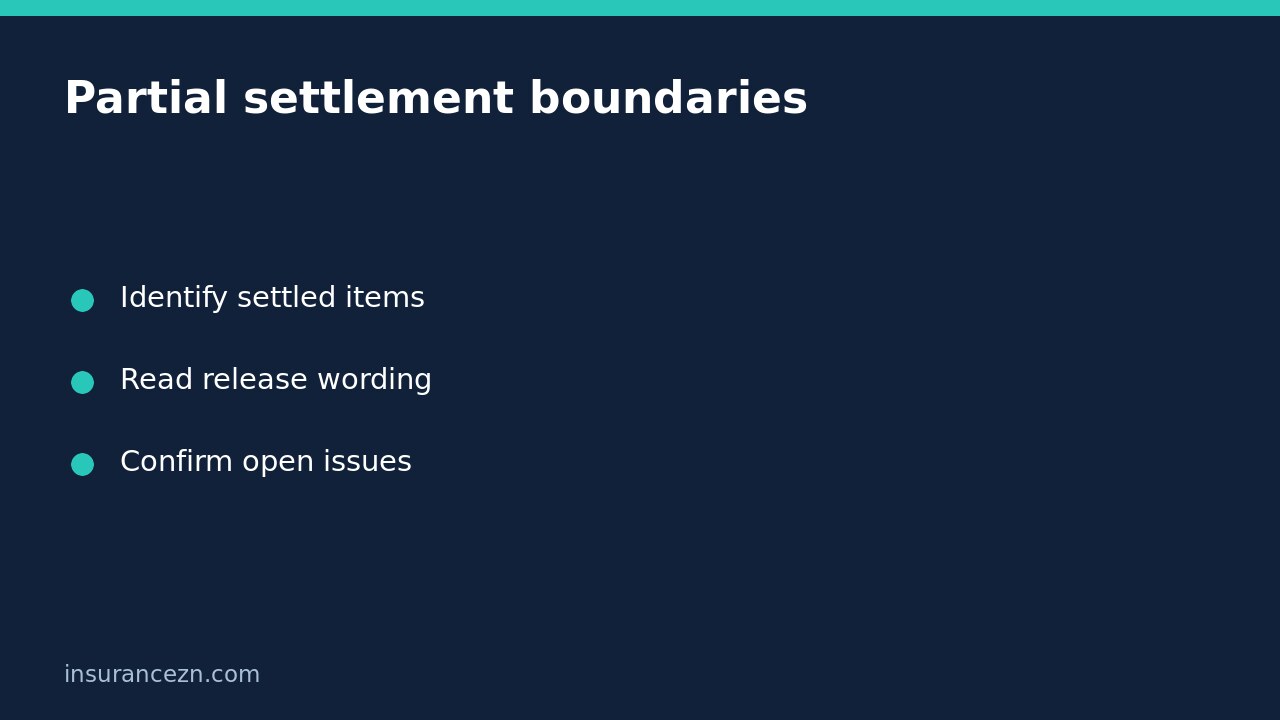

A payment described as a partial insurance settlement needs a clear boundary: which damage does it settle, and which parts of the claim remain open? Before signing an acceptance or release, compare the offer, repair scope and proposed agreement. Do not rely on the word ‘partial’ in an email if the attached document appears to release the entire claim.
This is general information for Australian readers, not personal financial advice or legal advice. Your policy, Product Disclosure Statement (PDS), settlement terms, limits and circumstances determine the position. Obtain independent legal advice about a release or disputed settlement before agreeing.
Distinguish an advance from a settlement
An emergency payment, an undisputed amount and a negotiated settlement can serve different purposes. Ask the insurer how it classifies the proposed payment and whether accepting it requires an agreement ending any part of the claim. A deposit into your account should not be interpreted through assumptions about its label alone.
Legal Aid NSW’s October 2023 disaster-claims publication explains that an insurer may offer money to settle all or part of a claim. It also warns about the consequences of accepting cash and taking responsibility for repairs. That makes the scope of the agreement a practical question to resolve, rather than a detail to address after spending the money.
Create a settled-versus-open worksheet
List the damaged areas or benefit types in separate rows. Beside each, record the insurer’s current position, the proposed payment treatment and the document supporting that position. Use plain descriptions that match the assessment and quotation, not broad labels such as ‘house repairs’.
For example, a fictional storm claim might involve roof repairs, internal ceilings and temporary accommodation. An offer described as payment for the roof should prompt questions about the ceiling assessment and accommodation arrangements. This illustration does not establish that any particular benefit is payable or independent of another limit.
- Settled item: identify its location and the precise scope version.
- Unresolved item: record what decision or evidence remains outstanding.
- Payment: ask whether it is an advance, final payment for that item or part of a broader offer.
- Responsibility: establish who will arrange repairs and handle defects.
- Remaining process: ask who will assess open items and provide the next update.
Keep a dated copy of the worksheet with the actual offer. A phone conversation can help identify the issue, but request written confirmation before treating it as resolved.
Read the release alongside the offer
Check whether the proposed document identifies the same damage as the payment email. Look for wording about full and final settlement, all losses arising from an event, future damage, or the entire claim. These phrases need interpretation in their actual context; do not assume that deleting one phrase yourself creates an effective reservation of rights.
If the documents seem inconsistent, ask the insurer to explain and provide corrected documents where appropriate. A useful question is: ‘The email describes this as settlement of the roof component only. Please confirm which claim items remain open and show where the agreement preserves their assessment.’
Do not assume an email you send unilaterally changes an agreement the insurer asks you to sign. If retaining a disputed part of the claim matters, get independent legal advice on the proposed wording and its effect.
Check practical consequences beyond the release
Clarify who will manage the cash-funded work, whether the accepted scope is adequate and how concealed damage would be handled. Obtain appropriate repair quotations and ask about exclusions from those quotations before making a decision. The cheapest quotation is not evidence that the proposed settlement funds every necessary task.
If repair work uncovers another damaged area, a separate evidence trail matters. Our article on requesting a variation when more damage is found explains a related documentation task. It does not mean a closed settlement can automatically be reopened.
Also ask how any ongoing accommodation arrangements or other benefits are treated. A partial repair payment should not be your basis for guessing whether another benefit continues, has been included in the amount, or remains subject to a policy limit.
Final checklist and common question
- Do the offer and agreement describe the same settled component?
- Are unresolved items identified accurately in writing?
- Have you checked the scope version, payment classification and repair responsibilities?
- Do you understand the treatment of later-discovered damage?
- Have you obtained advice if the release is broad, unclear or disputed?
Does asking for clarification extend the acceptance deadline? Do not assume so. Request any extension in writing and seek prompt advice if time is short. Equally, do not assume that a payment labelled partial preserves every possible claim. The actual documents and circumstances matter.
Source and limits of this guidance
Legal Aid NSW: Insurance claims after a disaster, October 2023 discusses cash settlement, repair responsibilities and checking the offer before acceptance. This article uses that practical guidance without reproducing historical contacts or asserting current legal deadlines or nationally uniform release rules.