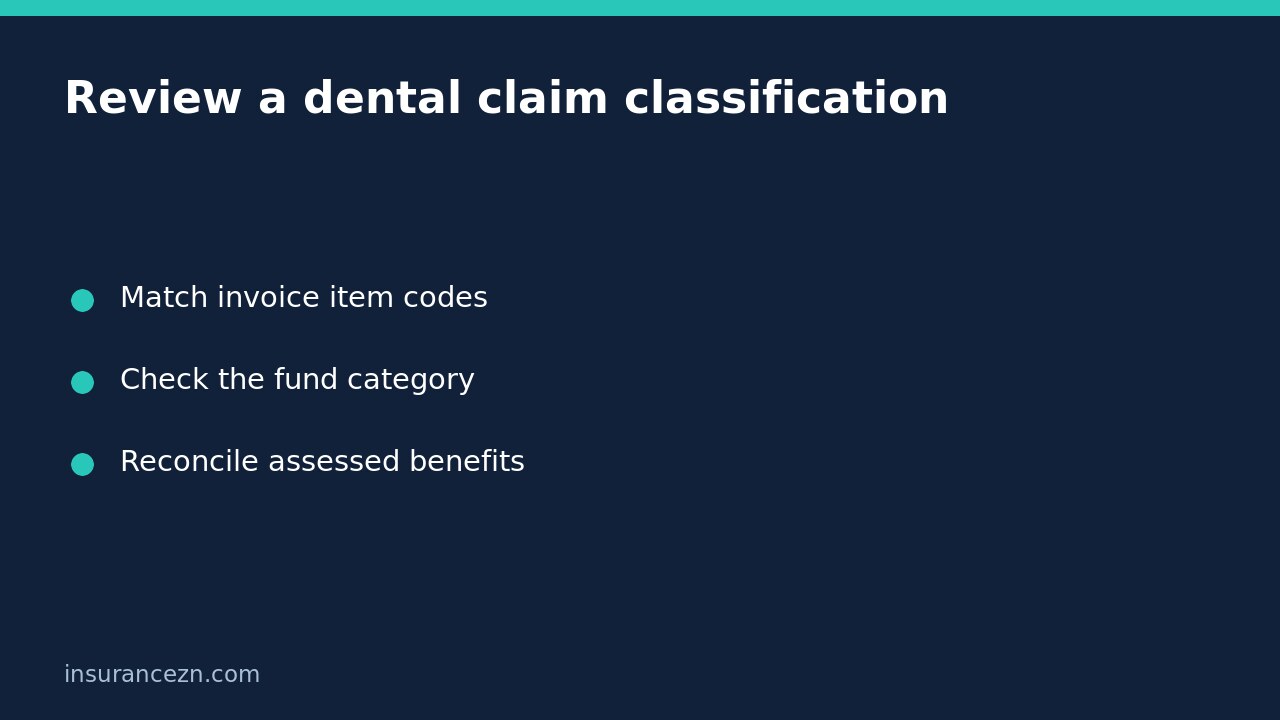

If an Australian health fund has assessed a dental item as major dental when you expected general dental, first compare the exact item on your invoice with the fund’s classification rules. The dentist’s everyday description of a treatment does not, by itself, determine the insurance category. A category difference is a reason to seek an explanation, not proof that the assessment is wrong.
This is general information for Australian readers, not personal financial advice. Benefits depend on your policy, fund rules, applicable PDS and treatment circumstances; this article does not promise a corrected assessment or payment.
Why the same treatment label can cause confusion
The Australian Government’s General Treatments definitions describe typical general and major dental services, but expressly say that classification of specific items depends on each insurer’s rules. Do not rely on a general example to insist that every filling or extraction belongs in a particular benefit category.
Keep four things separate: what treatment was performed, which dental item code was submitted, how your fund categorises that item, and how much your policy pays for it. Even a correctly classified item may attract a smaller benefit than expected because of other policy conditions.
Build a three-document comparison
- Get the itemised account. Ask the dental practice for the actual item codes, service dates, fees, treating provider details and any corrected invoice. Use the final account rather than an earlier treatment plan.
- Save the claim assessment. Record the claim reference, submitted items, assessed categories, benefits paid and any explanation or rejection message.
- Find the applicable policy rules. Ask the fund which dental schedule and benefit rules applied on the treatment date. A current advertising page may not explain an older assessment.
Mark each disputed line separately. A single visit can contain several items, and one questioned category does not establish that the whole account needs changing. Avoid sending unrelated medical records when a line-item explanation is enough.
Ask whether the code or the category needs review
Use a neutral request: ‘For claim [reference], invoice item [code] dated [date] was assessed under major dental. Please explain its classification under my policy and identify the rule used. If the submitted code differs from the account, please tell me what evidence is required to review it.’
If the fund says it received a different code, return to the practice and ask it to verify the clinical and billing record. Do not ask anyone to substitute a more favourable code that does not accurately describe the service. If the submitted code is accurate but you disagree with the classification, request a review against the fund’s rule rather than inventing a replacement code.
Reconcile the money without assuming a larger benefit
Consider an illustrative account with two treatment lines. One is paid from general dental and the other from major dental. Your task is to match each assessment to its invoice line, then ask whether the disputed item was classified correctly. Do not assume moving the second line would increase payment: a different category might have its own benefit schedule, remaining limit or other condition.
Ask the fund to show any proposed revised benefit and its effect on used and remaining limits. The government’s private health insurance basics explain that policies differ and can leave out-of-pocket costs. A corrected category is not a guarantee that your entire dental bill becomes reimbursable.
Close the review with a processed outcome
An uploaded invoice or acknowledgement only shows that information was received. Ask for a written outcome identifying the original claim, reviewed item, category decision, revised benefit if any, and whether further action is required. If additional money is approved, reconcile the actual payment and updated limits rather than stopping at an email saying the review is complete.
If the explanation remains unclear, ask how to make a formal complaint and retain the correspondence. For broader evidence-handling principles, see requesting a factual correction to an insurance assessor report; dental classification still needs its own fund-specific evidence.
Quick questions before you finish
Should I lodge the same claim again? First ask the fund how to correct or review the existing reference; do not create a duplicate just to change a category.
Does a revised dentist invoice settle the issue? No. It supplies evidence. The fund must assess it under the relevant rules, and any resulting payment must be separately confirmed.