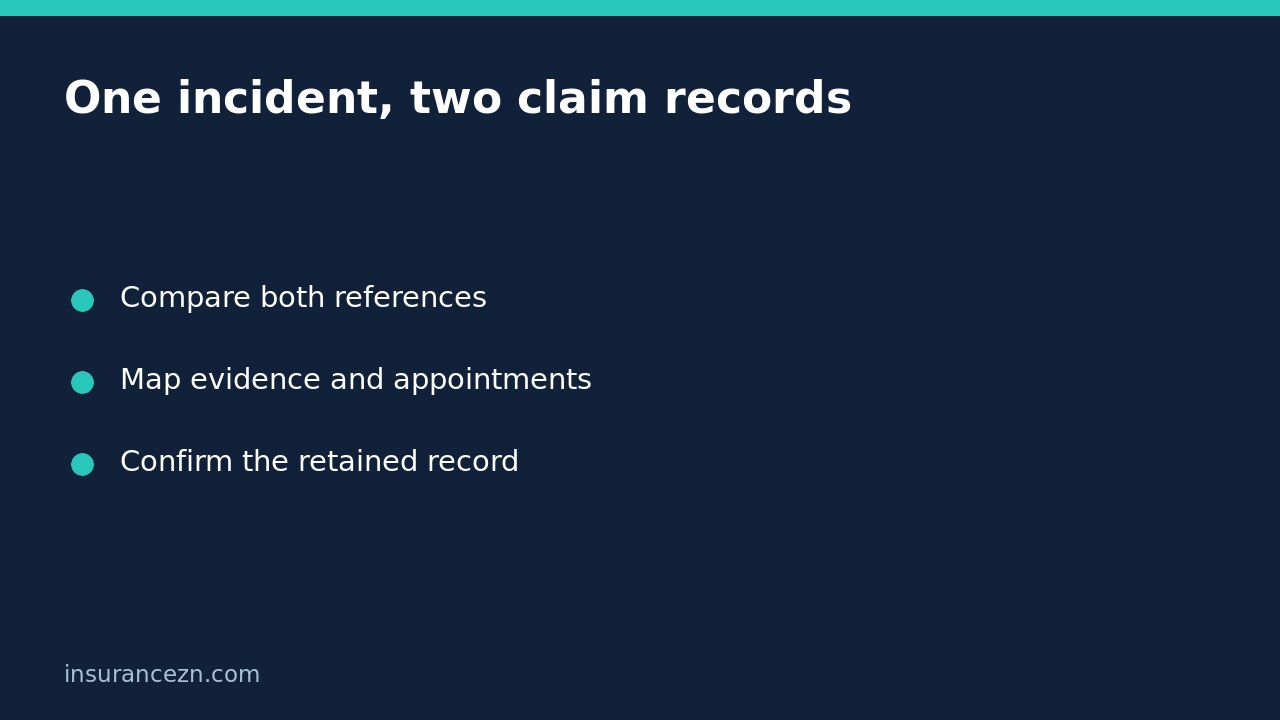

If you receive two home insurance claim numbers after reporting what you believe is one incident, ask the insurer to reconcile the records before requesting that either be closed. Two references are a reason to investigate, not proof that one is an unnecessary duplicate. Preserve both confirmations and establish which incident, policy and work each record represents.
This is general information for Australian readers, not personal financial advice. Cover, excesses and settlement depend on the applicable policy, Product Disclosure Statement (PDS), evidence and insurer assessment. This checklist does not establish a right to merge claims or remove an excess.
First check whether the references describe the same event
Create a short comparison using the original confirmations rather than memory. For each reference, record the policy number, insured address, incident date, reported cause, affected property and lodgement channel. Separate the time you discovered damage from the time you believe the event occurred. Where you do not know, say so.
For example, you might have submitted an online storm report and then received a second reference after a telephone conversation. That sequence does not establish whether the insurer created another claim, a related service request or a separate record for another policy. Ask the claims team to identify the purpose of each number.
Do not change dates or descriptions simply to make records match. If the reports contain conflicting details, identify the original entry, your evidence and the correction requested.
Map the work already attached to each record
Before asking for closure, list anything that may be lost from view or misunderstood if staff use only one reference:
- Photos, ownership records, reports and invoices submitted under each number.
- Assessor appointments, temporary safety work and supplier contact details.
- Excess requests, amounts already paid and any proposed deductions.
- Letters explaining coverage, authorised repairs or outstanding information.
- Complaint references and dates by which a response is required.
Keep the original documents and their submission receipts. A successful upload shows that a document was sent through a channel; it does not prove both claims teams have reviewed it or that it has been allocated to the retained record.
Ask for a coordinated written instruction
Send a factual message through the insurer’s verified contact channel: “I have references A and B for what I understand to be the same incident. Please confirm what each record covers, which reference I should use, and how existing documents, appointments and payments will be handled before any closure.”
Ask whether any record needs to remain open and whether you must do anything further. Do not describe the request as withdrawing your claim unless withdrawal is actually your intention and you understand its implications. A staff member saying they will investigate is not confirmation that the records have been reconciled.
For a provider-specific example, Suncorp’s home claims instructions say it provides a claim number and confirmation after lodgement and uses the claim number for online management. The page does not prescribe a universal duplicate-record process; obtain instructions for your actual records.
Keep safety work and genuinely separate events distinct
Do not cancel an urgent safety visit merely because the booking uses an unfamiliar reference. Verify who arranged it, its purpose and whether the claims team wants the booking changed. Necessary safety decisions should not wait for an administrative tidy-up.
Suncorp’s instructions distinguish additional damage or stolen items discovered after lodgement from damage caused by another insured event, for which it directs customers to make a new claim. That distinction matters: two claim numbers may be appropriate where the facts involve separate incidents. Do not assume that merging paperwork determines causation, coverage or the number of excesses.
If the question concerns extra damage within an existing repair scope, our guide to requesting a repair variation addresses that different task.
Final check: what counts as reconciliation?
Can I ignore one reference after making the request? Not safely on that basis alone. Obtain confirmation of the retained reference, the status of the other record and any action still required. Check that documents and appointments remain accessible.
Does closing a duplicate mean another excess is refunded? Not automatically. Reconcile the actual payment or deduction with the insurer and request a processed adjustment where appropriate. Record reconciliation, coverage acceptance, repair authority and payment approval are separate outcomes.