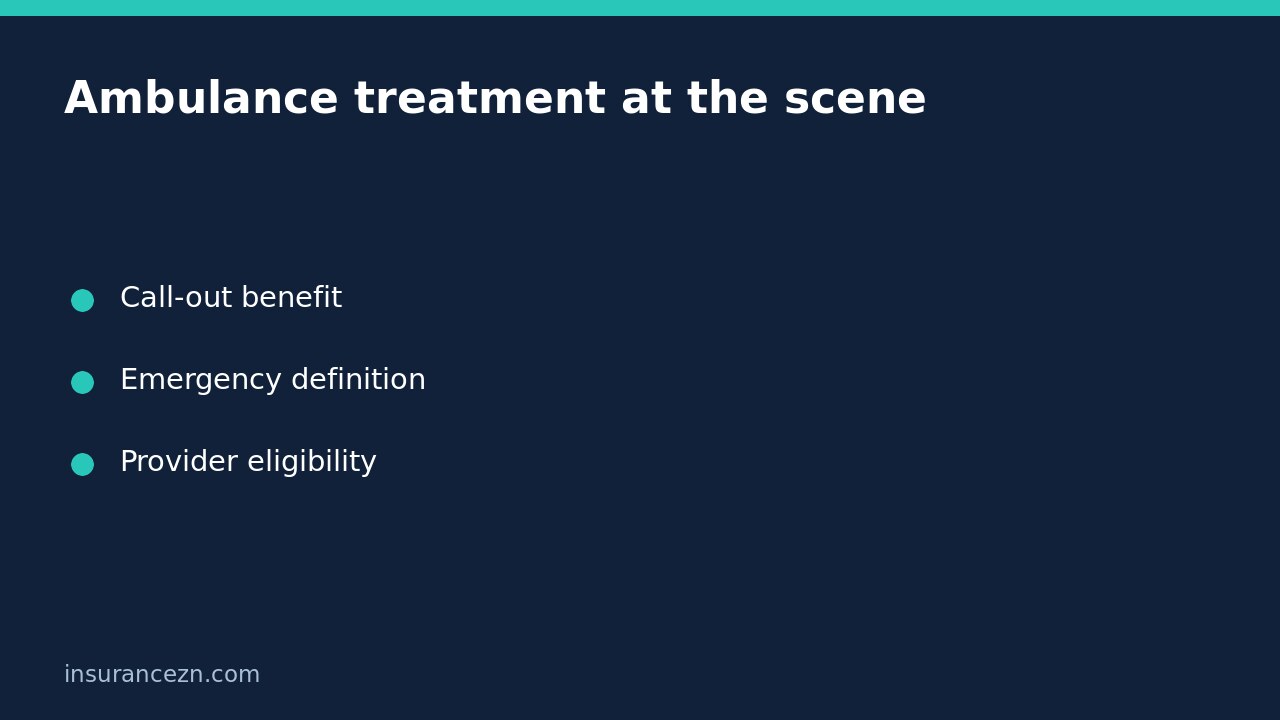

When comparing Australian health insurance, do not stop at the words ‘ambulance included’. Ask whether the benefit includes an ambulance call-out when you receive treatment at the scene but are not transported to hospital. A transport benefit and a treatment-without-transport benefit are not necessarily the same thing.
This is general information for Australian readers, not personal financial advice. Benefits depend on the policy, applicable policy documents and any relevant Product Disclosure Statement (PDS), including definitions, waiting periods, limits and exclusions. This article is not medical advice: in an emergency, seek help promptly rather than delaying care to check insurance.
Why a hospital trip is not the only ambulance question
The Australian Government’s PrivateHealth.gov.au ambulance overview states that Medicare does not cover emergency transport or other ambulance services. It also warns that some insurance policies do not cover call-out fees when an ambulance treats someone at the scene without transporting them to hospital.
That makes the outcome of the attendance important when reading a benefit description. An insurer might describe transport, treatment or both, with conditions attached. A product comparison should identify the actual service covered rather than assume that a generous transport limit automatically includes every attendance.
Separate your existing entitlement from the insurance benefit
State or territory arrangements, residence and concession eligibility can affect whether you need additional cover. PrivateHealth.gov.au explains that ambulance arrangements differ across Australia and that some residents may have discounts or government-funded services. An ambulance-service subscription may also be relevant in some places.
Start by checking the entitlement that applies to you now with the responsible service or authority. Then ask what the proposed health insurance adds. Do not treat a neighbour’s experience, a partner’s concession card or an old membership as proof of your own entitlement. Ask about the precise service: attendance and treatment without transport.
Send the same scenario to each insurer
Use a short hypothetical case so that the answers are comparable: ‘An ambulance attends my home, the crew assesses and treats me, and I am not transported. Does this policy pay a benefit towards the resulting call-out or treatment charge?’
This is a comparison scenario, not a prediction about how an ambulance crew will treat a patient or how much a service will charge. Follow it with these questions:
- Does the benefit require an emergency, and what definition is used?
- Is attendance without transport expressly included?
- Which ambulance providers are eligible?
- Is there a waiting period before this benefit becomes available?
- Are there annual dollar limits, attendance limits or co-payments?
- What evidence would be required if a bill is issued?
The government overview specifically recommends checking emergency definitions, call-out fees, waiting periods, co-payments and provider restrictions. It does not establish that every policy has the same terms or that every clinically necessary attendance meets an insurer’s emergency definition.
Turn the answers into a useful comparison record
For each product, record the call-out clause, eligible provider wording, any limit, waiting-period start date and the insurer’s explanation of the hypothetical case. Add the date and policy version. Mark unclear answers as unresolved instead of filling gaps from a marketing heading.
For example, one response may discuss only transport to hospital while another explicitly addresses treatment at the scene. That is a reason to seek clarification from the first insurer, not proof that it either covers or excludes the charge. Ask for the supporting wording and a written answer tied to the exact product.
A customer-service response also does not remove other policy conditions or guarantee payment of a future claim. Keep the response with the membership documents so you can identify what was represented if an issue arises.
Check changes are recorded before relying on them
If you add or upgrade ambulance cover, confirm that the request has been processed, the correct people are included, the effective date is recorded and any waiting period is understood. An acknowledgement email proves receipt of a request, not necessarily that the new benefit is available immediately.
Travel introduces a separate question about location and entitlement. Our ambulance cover checklist for interstate travel can help with that review. An answer about treatment at home should not be stretched into confirmation of interstate cover.
Does no transport mean there cannot be a bill?
No. The government overview expressly identifies call-out fees as something to check. Whether a particular attendance produces a charge, and who pays it, depends on the applicable service arrangements and cover. If a bill arrives, check the service description and eligibility before assuming either that it must be paid by your insurer or that it cannot be covered.