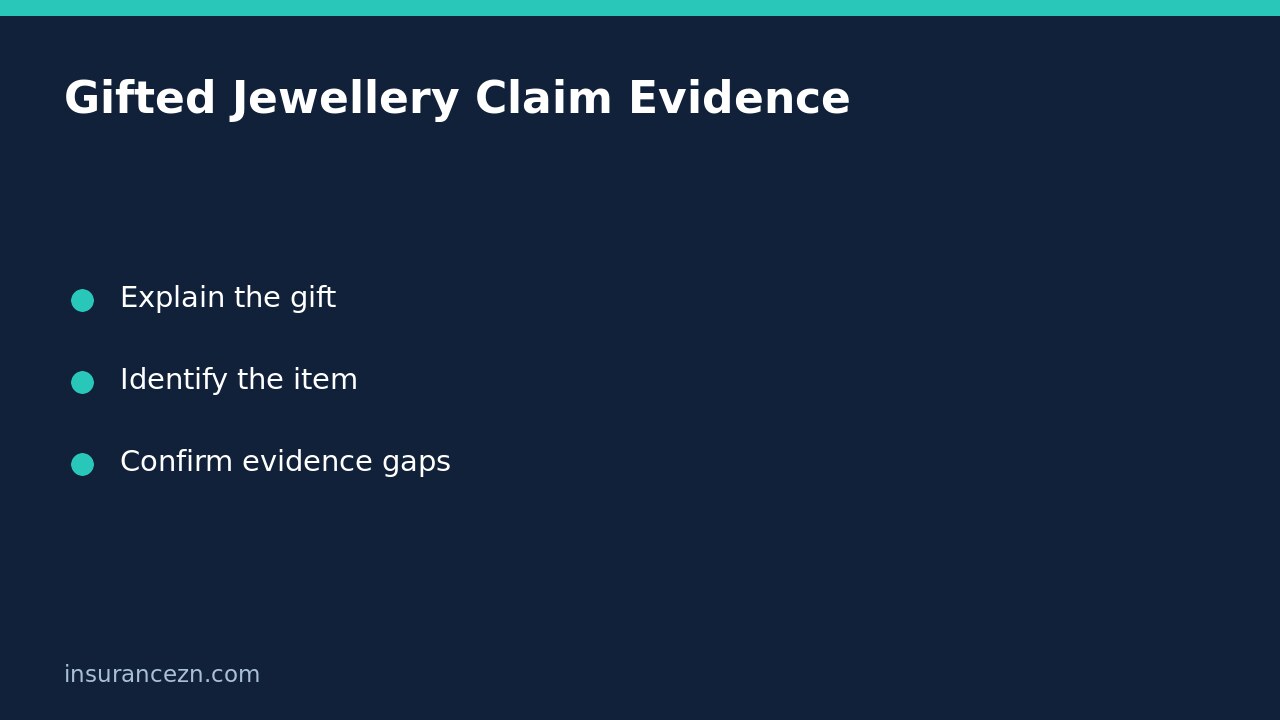

If stolen or damaged jewellery was a gift, you may not have its purchase receipt. Tell the insurer that directly and ask what alternative evidence it will consider. Do not invent a purchase date, turn an estimated value into a claimed fact, or assume the absence of a receipt automatically decides the claim.
This is general information for Australian readers, not personal financial advice. Your policy and Product Disclosure Statement (PDS), limits, exclusions and individual circumstances determine cover. Collecting evidence, lodging a claim or receiving an acknowledgement does not establish entitlement to payment.
Separate ownership, identity and replacement value
A useful evidence bundle answers three different questions: why the jewellery belonged to you, which item was lost or damaged, and what supports its description and value. One document may help with several questions, but it rarely settles every issue.
For example, a photograph of you wearing a bracelet may help show possession and appearance. It does not necessarily establish its metal, gemstone quality or current replacement cost. A valuation may describe those features, but an old valuation in someone else’s name may need an explanation of how the jewellery came to you.
AAMI’s jewellery guide says it may ask claimants for proof of ownership, valuation documents and a police report for theft claims. It also describes the descriptive detail a professional valuation can provide. That is a provider-specific explanation, not a rule that every insurer must accept a particular substitute for a receipt.
Write a short, factual gift history
Record who gave you the item, approximately when, and whether any documents accompanied it. Separate dates you can establish from dates you are estimating. If a relative bought the jewellery and later gave it to you, explain why an invoice or valuation bears their name rather than yours.
A practical account might say: ‘My aunt gave me this bracelet for my graduation. I do not hold the purchase receipt. The attached photograph shows me wearing it at the graduation, and the attached valuation was arranged afterwards.’ Only use that account if those facts are true. An illustrative example is not a script for filling gaps in your own history.
If the donor is available, ask whether they retain an order confirmation or jeweller’s details. Do not pressure them to supply a precise price or date they cannot remember. For inherited jewellery, ask the insurer which documents explaining the transfer are relevant before sending extensive family or estate records.
Ask about alternatives before paying for new documents
Offer an index of the material you actually have: photographs, a gift card identifying the item, a previous valuation, an alteration invoice or existing policy correspondence. Ask which documents the insurer wants and whether anything else is necessary. These are possible leads for discussion, not guaranteed accepted evidence.
Where the item is damaged but still available, ask what inspection or assessment the insurer requires before authorising repairs or commissioning a paid report. If it is missing, explain the limits of the available photographs. Do not describe a later estimate as though a valuer physically examined jewellery that cannot be produced.
Use a question such as: ‘There is no original purchase receipt because this was a gift. Which alternatives will you consider for ownership and item identification, and what evidence do you require separately for valuation? Please identify the remaining gaps.’
Keep evidence requests separate from the claim decision
Request confirmation that the documents reached the correct claim, using its existing reference. A portal upload confirmation establishes a submission step, not that an assessor has reviewed the evidence or accepted cover. Keep copies of what you sent, the submission date and the insurer’s next request.
AAMI’s home-claim preparation guidance says customers can lodge and add details later, and distinguishes starting a claim from submitting it. Ask your own insurer about its process rather than assuming all products offer that workflow. Reconcile an uncertain submission before starting another claim for the same incident.
If the insurer says ownership remains unproven, ask which facts are unresolved and what would address them. If a report misidentifies the jewellery or its owner, see our guide to requesting a factual correction to an assessor report. Correcting a fact is distinct from overturning a coverage decision.
Final checklist for a gifted-item evidence bundle
- Explain why the purchase receipt is unavailable.
- Identify known facts and label estimates honestly.
- Link each photograph or document to the same item.
- Ask what alternatives the insurer will consider before incurring costs.
- Use the insurer’s approved submission channel and confirm the claim reference.
- Keep evidence acceptance, policy cover and payment approval as separate questions.
Does having no receipt mean no claim? Do not decide that yourself; ask for the insurer’s evidence requirements and a reasoned decision. Does a family member’s statement guarantee acceptance? No. Ask whether it helps resolve the particular ownership question and what other evidence is still needed.