
After discovering a stolen car, do not turn an uncertain memory about the keys into a confident statement on an insurance form. Record what you know, identify what you cannot establish, and preserve evidence. Whether the incident is covered depends on the applicable policy and the insurer’s assessment, not simply on the fact that a theft occurred.
This matters because security conditions can affect cover. For example, AAMI’s comprehensive car insurance summary says resultant theft or damage is not covered if the car is left unlocked with the keys inside. That is an insurer-specific summary, not a universal rule for every Australian policy or every missing-key situation. Read the policy documents applying to the incident.
Establish the last confirmed facts
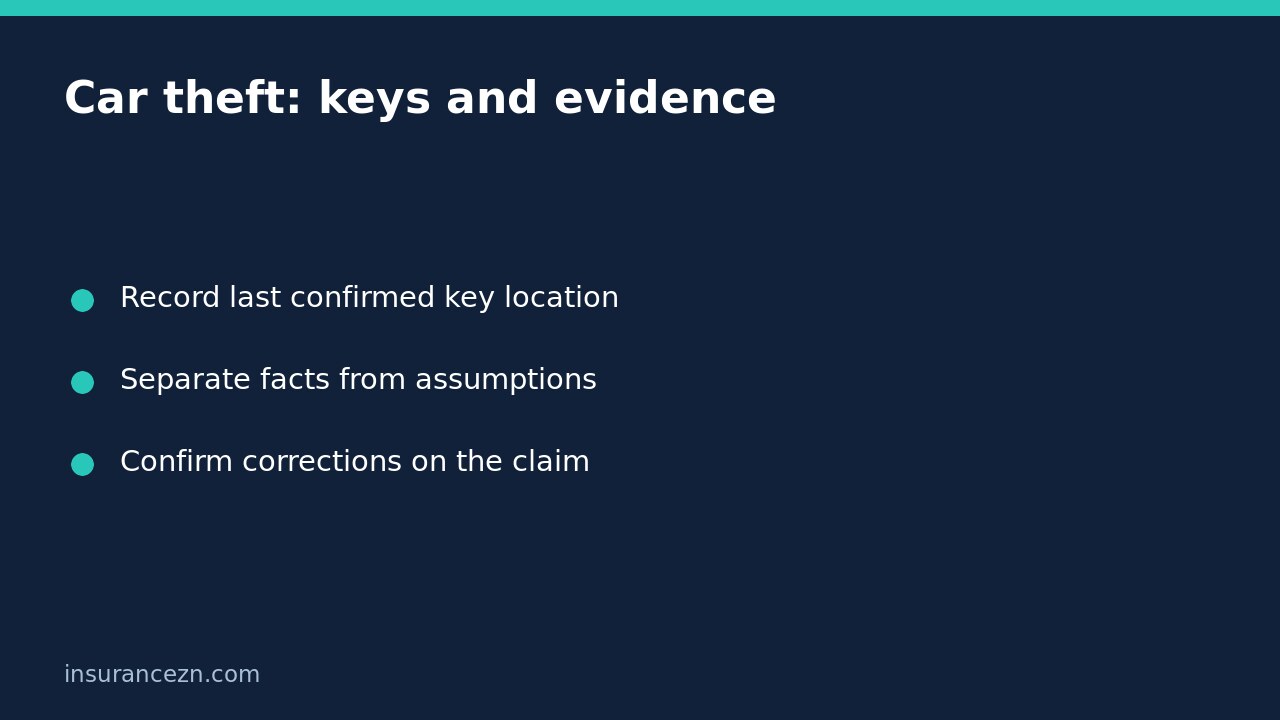
Start with a short chronology, written while the details are fresh. Note when and where the car was last seen, who last used it, when the theft was discovered, and which keys can currently be located. Distinguish a physical key from a remote or spare key; describe what each person actually handled rather than assuming all keys were together.
- Record the last time someone remembers locking the vehicle and how they did it.
- Check safe places for spare keys without disturbing a possible crime scene.
- Preserve relevant messages, parking records and available camera footage.
- Keep the police report reference and the insurer’s claim reference separately.
Do not confront a suspected thief or enter an unsafe location to recover evidence. If there is an immediate threat to safety, obtain emergency help first. Insurance administration should not delay necessary assistance.
Separate uncertainty from a policy conclusion
Suppose one household member remembers leaving the remote on the kitchen bench, but another remembers carrying it outside. Neither memory establishes that the car was unlocked with the keys inside when it was taken. Write down both accounts, with their dates, rather than choosing the version that seems most favourable or most worrying.
A useful statement is: ‘I last remember using the remote at the driveway. I have not located it since. I cannot confirm where it was when the vehicle was taken.’ Only use that wording if it accurately describes the facts. Do not copy an example as a substitute for your own account.
Equally, finding a spare at home does not prove where the other key was. A claim handler may need additional information. Missing evidence is not permission to invent an answer, and an uncertain recollection is not itself a final coverage decision.
Correct a mistaken answer through the existing claim
If you already submitted an answer and later discover it was wrong, contact the insurer using the existing claim reference. Identify the field or statement, the original answer, the replacement information and why it has changed. Attach supporting material where available, preserving the original record.
For example, a dated message from another driver might establish that they retained a spare after borrowing the car. Send the message with an explanation of what it proves and what it does not prove. Do not lodge a second theft claim merely to replace a key-location answer.
Request written confirmation that the correction has been added to the claim record and ask whether the insurer needs another statement. An upload receipt confirms transmission, not that the information has been reviewed, accepted or used in a coverage assessment.
Ask for the actual reason if cover is questioned
Ask the insurer to identify the relevant policy wording and the facts on which it relies. Keep its explanation alongside your evidence chronology. Do not infer from a general website exclusion that your own claim is automatically rejected; equally, having comprehensive insurance does not establish that every theft is payable.
If you disagree, request the insurer’s complaint process and keep the decision and correspondence together. A related administrative distinction is explained in why a claim progress query may not be a formal complaint.
Quick questions before sending your statement
Should I fill gaps with my normal routine? No. Explain that you usually lock the car if relevant, but distinguish that habit from a specific recollection of the incident.
Does a corrected statement guarantee payment? No. Accurate information supports assessment; it does not remove policy conditions or establish an accepted claim.
What should I retain? Keep the chronology, original and corrected statements, evidence files and written acknowledgement under the same claim reference.
This is general information for Australian readers, not personal financial advice. Cover depends on the applicable policy, Product Disclosure Statement (PDS), certificate, conditions, limits and exclusions. Ask your insurer how the exact circumstances will be assessed.