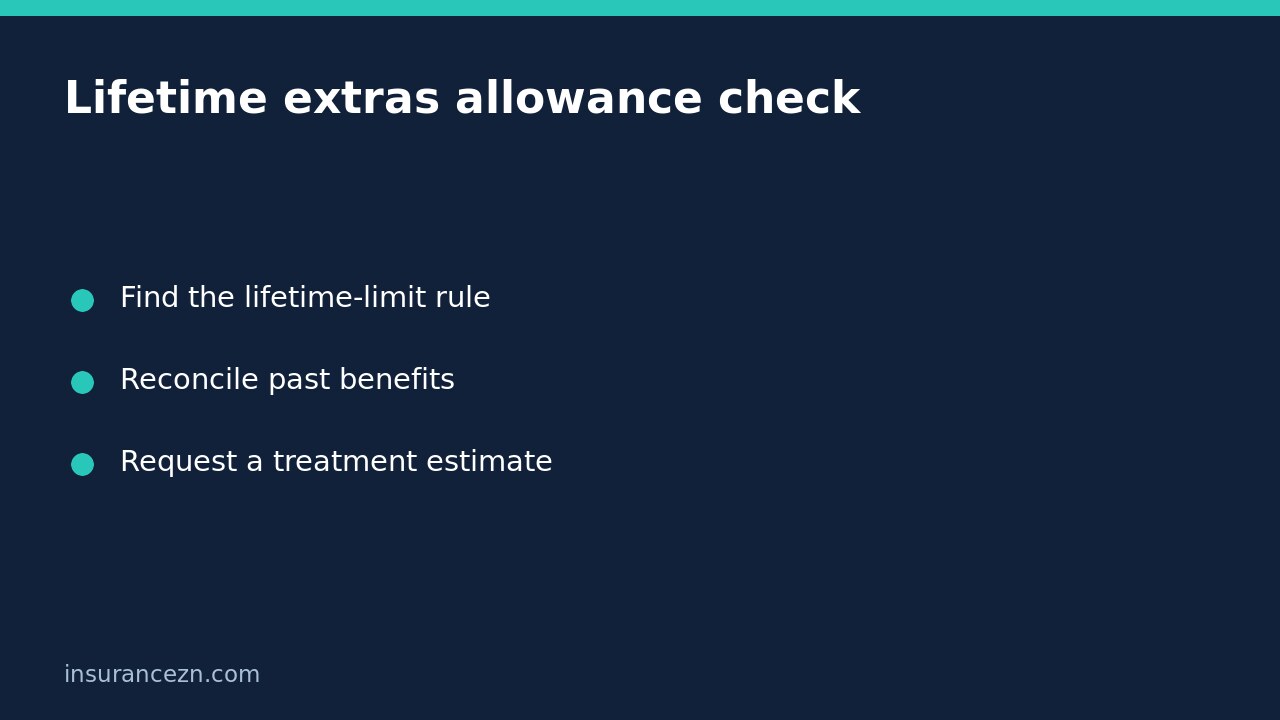

If an extras service has a lifetime limit, do not assume a new benefit year makes that allowance available again. Before booking another course of treatment or an expensive replacement item, ask the fund to explain how the lifetime rule applies to you and how earlier benefits affect the remaining amount. The practical task is reconciling your history, not simply reading this year’s headline annual limit.
This is general information for Australian readers, not personal financial advice. Benefits depend on your policy, applicable PDS or fund rules, exclusions, waiting periods and claim assessment. A fund’s estimate is not a guarantee of payment.
Identify which limit actually controls the service
The Australian Government’s private health insurance coverage overview explains that general treatment, also called extras, is usually covered only to a limited extent. Its examples include per-service, annual and lifetime limits. It recommends checking the Private Health Information Statement and obtaining details from the insurer.
These labels describe different constraints. An annual allowance addresses a benefit-year limit; a lifetime allowance places a longer-term constraint on benefits within the scope defined by the policy. The precise meaning of lifetime, the services grouped together and the claims counted need the fund’s wording. Do not invent a universal rule about whether changing products or funds restores an allowance.
Start with the exact service or item you intend to claim. Ask whether its limit is annual, lifetime, per item, shared with another service or subject to several limits at once. A general extras balance in an app may not answer that service-specific question.
Request a history-linked explanation
Collect earlier benefit statements, relevant invoices and any membership changes. You do not need to reconstruct every unrelated claim. Focus on the service category and dates the fund says matter for the lifetime calculation. Send personal records through the fund’s approved secure channel.
Ask for a written explanation covering:
- The precise lifetime-limit clause and the service or item it applies to.
- Whether the allowance applies to each insured person or another defined unit.
- The relevant past benefits counted against it, with service dates and amounts.
- Any pending claims, reversals or adjustments affecting the displayed balance.
- The remaining allowance and any separate annual or per-service constraint.
- How previous product or fund changes are treated under the applicable rules.
A submitted enquiry is not a corrected record. If you identify a discrepancy, ask for the reviewed calculation and then confirm that any accepted correction appears in the processed record. Keep the original statement and the revised explanation rather than overwriting the evidence.
Use an example without treating the balance as a rebate
Consider someone planning further treatment after an earlier course. Their membership app shows a fresh annual allowance, but their documents also mention a lifetime limit for the relevant service. They should not subtract the new annual figure from the provider’s quote and assume that is their personal cost.
Instead, request an itemised treatment quote and ask the fund to apply both the remaining lifetime allowance and any other applicable limits to those exact items. The result may also depend on provider recognition, service eligibility, waiting periods and the benefit formula. An unused ceiling is not automatically the amount paid on an invoice.
Record separate fields for the quoted charge, fund-estimated benefit, assumptions still unresolved and expected personal payment. Where the fund cannot estimate a benefit yet, mark it unknown. Do not fill the blank with a marketing maximum or decide the treatment is fully funded because a provider accepts health-fund claims.
Check changes before assuming a fresh entitlement
A new year, upgraded product or new membership number can look like a clean start administratively. That appearance is not proof that earlier benefits stop counting. Ask the receiving or current fund what records it requires and how the exact limit applies after the proposed change.
Get the answer before cancelling existing cover or committing to non-refundable treatment costs. Compare the confirmed position, not an assumption about resets. Do not delay clinically necessary care solely to improve an insurance calculation; discuss clinical timing with your practitioner and the funding uncertainty with the fund.
Our guide to PHIS example benefits versus personal rebate estimates explains why comparison figures cannot replace a service-specific enquiry. The additional task here is reconciling historic usage against a lifetime rule.
Questions to settle before booking again
Does a lifetime limit apply to every extras service? Do not assume so. Identify the particular service and the limits in your product documents.
Does a new annual allowance override it? A new annual balance does not establish that. Ask how the separate limits interact for your proposed treatment.
Is written confirmation enough to guarantee the final claim? Treat it as important evidence of the fund’s explanation and estimate, not unconditional approval. Keep the quote and confirmation, and recheck if services, provider, dates or prior claims change.